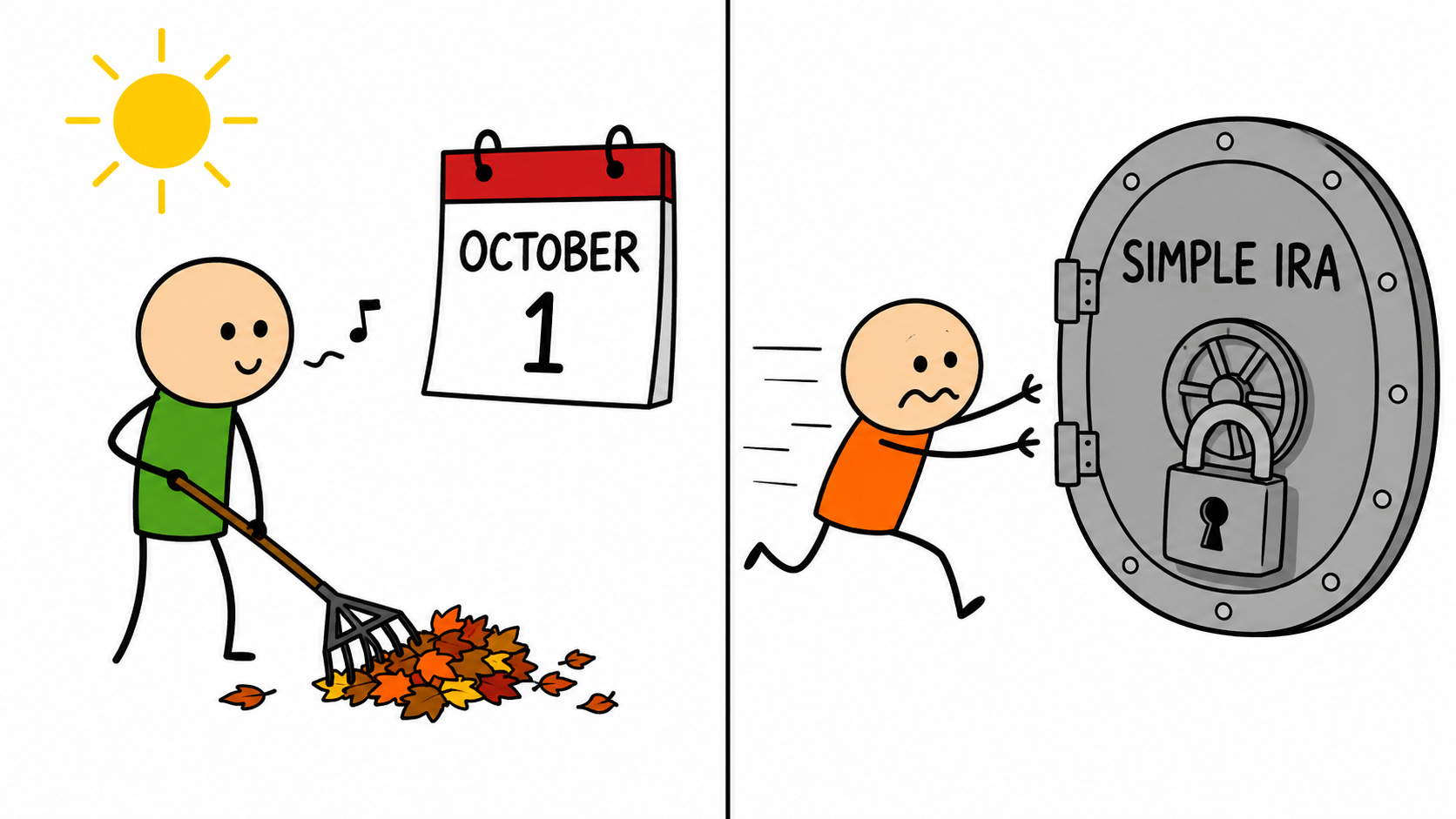
The name does a lot of the marketing. A SIMPLE IRA promises a small business retirement plan without the weight of a 401(k), and the pitch usually rests on two friendly ideas. You set aside part of your pay, and the business adds a contribution on top. For someone with a payroll system and a staff, that is close to how it feels. For a self-employed person funding both sides alone, the friendly version glosses over two quirks that move both the numbers and the calendar.
The first quirk is the base. Your deferral and your employer contribution both ride on net earnings from self-employment, a figure that lands below the profit line on your Schedule C. The second is the clock. A SIMPLE carries a setup deadline that arrives long before tax season, and an owner who goes shopping for one late in the year can find the door already closed. Both are easy to walk into blind, and both are easy to handle once you see them coming.
A SIMPLE holds two contributions. The first is your salary reduction, the deferral, capped at a flat dollar limit that lives on the limits page since it moves most years. The second is the employer contribution, and here a SIMPLE is stricter than a SEP. The business is required to put in either a dollar-for-dollar match of up to three percent of compensation or a flat two percent for everyone eligible. When you are the only worker, that requirement means you are matching yourself, and the match still has to happen.
For an employee, compensation is the W-2 wage. For the owner, compensation is generally net earnings from self-employment, which starts with Schedule C profit and is reduced by the deductible part of self-employment tax. The match is then based on that net-earnings figure, up to the SIMPLE match percentage. That is different from just taking three percent of gross revenue or the unreduced profit line. The deferral sits on top of the match as its own flat dollar amount.
Timing is where a SIMPLE parts ways with a SEP, and it runs on three separate clocks. The plan itself has to be established by October 1 for the current year, assuming your business already existed that year, and that is a fixed calendar deadline with no extension behind it. Miss it and the entire plan is off the table for that year, and you wait until the next one. Your deferral has its own calendar deadline. For a self-employed person with no employees, it has to be deposited within thirty days after the year ends, which lands on January 30, and a late deposit becomes a timing error to clean up rather than a lost contribution. The employer match or nonelective piece is the relaxed one, due by your business return’s due date, extensions included, so April 15 or October 15 with a valid extension, and missing that deadline is what costs you the deduction for the year. If a deferral overshoots the limit, the correction window runs to April 15 of the following year.
Picture a sole proprietor who closes the year with fifty thousand dollars of net profit on the Schedule C. The deductible half of her self-employment tax runs about thirty-five hundred dollars, which pulls her net earnings from self-employment down to roughly forty-six thousand five hundred. That figure is the base for both pieces.
She elects to defer six thousand dollars of her pay, comfortably under the annual cap. Her match comes in at right around three percent of that net-earnings figure, about fourteen hundred dollars. Add the two and she has put about seven thousand four hundred dollars into the SIMPLE for the year.
The dates matter as much as the math. She opened the plan on September 15, ahead of the October 1 deadline, so the year counted. She deposited her six thousand dollar deferral by January 30. She funded the match in March, well inside her filing deadline. Now run the version where she waited. Had she first looked into a SIMPLE in late November, October 1 would already be behind her, and the plan would not exist for that year at all, no deferral, no match, regardless of how much profit she earned.
The smaller total reflects a base built on net earnings and a match taken as a straight percentage of that figure. Knowing that turns the calculation from a guess into a figure you can trust before you fund anything.
What truly matters with a SIMPLE is the calendar more than the arithmetic. The contribution math forgives you. You can run it in the spring, fund the match up to your extended deadline, and fix an overshoot through April 15. The setup deadline is the unforgiving one. October 1 is the gate, and it closes while the year still looks wide open. A SEP rewards you for acting before you file. A SIMPLE rewards you for deciding before the fall. Know which clock you are on, and the plan that markets itself as the easy one earns the label.
I write one of these every day, one retirement rule, explained in plain language and verified against the source. The daily email is free: subscribe here.
Full archive, worksheets, and search live at RetirementNewsRundown.com.
Disclaimer This article is for educational and informational purposes only. It is not tax, legal, or financial advice and does not create an advisor–client relationship. Always consult appropriate professionals regarding your specific situation.