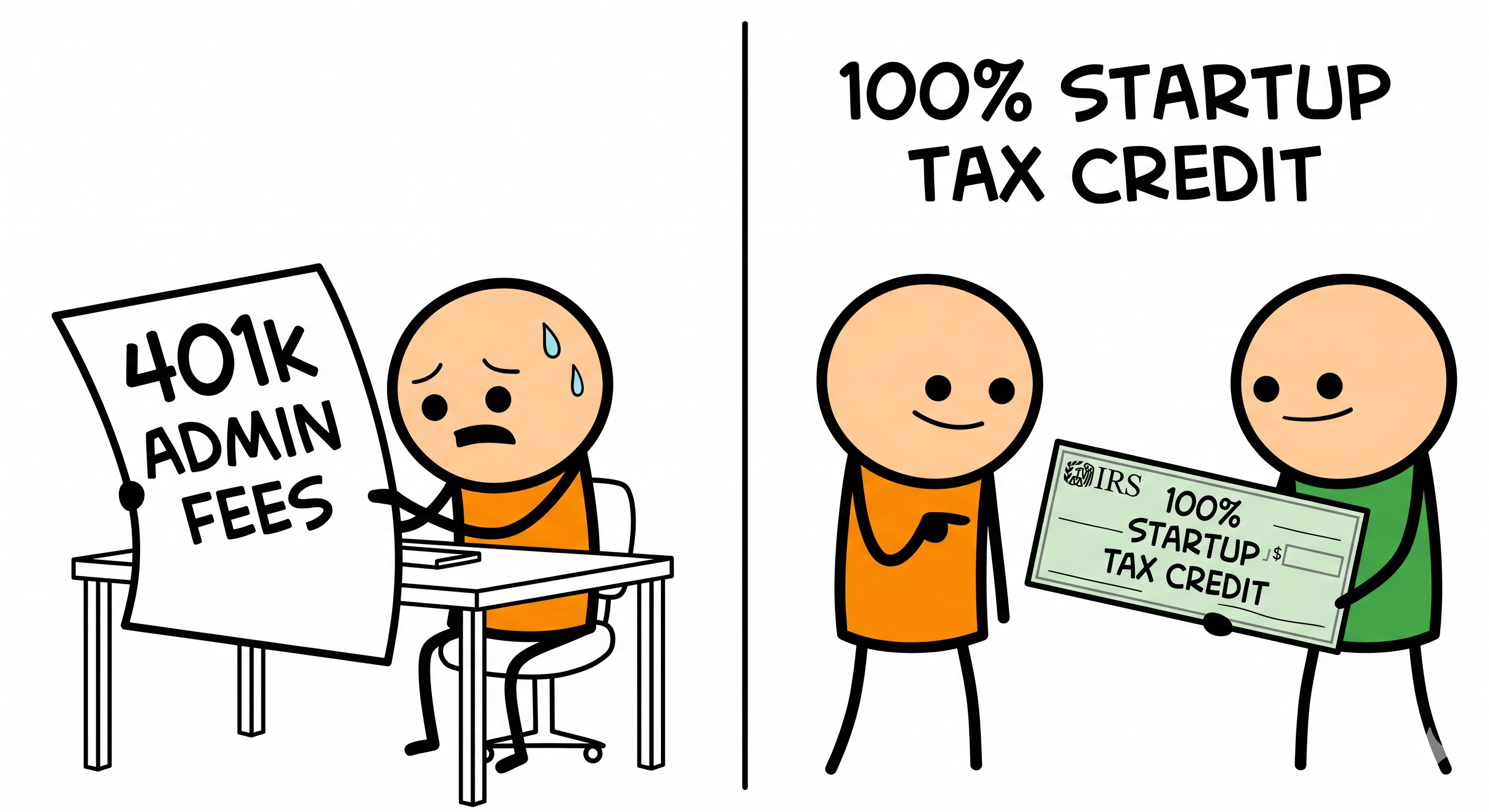
The cost of starting a workplace retirement plan looks like another business expense on the bill. Fees from the plan administrator, the recordkeeper, and any third-party providers all land as an invoice the owner expects to deduct and move on. What does not show up on that invoice is the part of the tax code that may turn a slice of those costs into a direct credit rather than another deduction.
The retirement plan startup tax credit sits behind a form most small employers never look at, and it has been doing more work since SECURE 2.0 expanded the rules. For the smallest employers, the credit can cover one hundred percent of qualified startup costs, up to a cap. For the next size up, it covers half. Both groups can also claim separate credits for adding automatic enrollment or making certain employer contributions. The credit is real, the form is Form 8881, and a small employer who never files it leaves the benefit on the table.
Eligibility for the startup credit is narrower than the marketing suggests. The employer generally must have one hundred or fewer employees who received at least five thousand dollars in compensation in the prior year. The employer generally must not have maintained a plan covering substantially the same employees during the prior three tax years. And the new plan must include at least one non-highly compensated employee who is eligible to participate. This is a credit aimed at employers actually starting a plan, not at someone replaying an old one.
The credit covers qualified startup and administration costs of setting up a SEP, SIMPLE IRA, or qualified plan such as a 401k. SECURE 2.0 increased the credit rate to one hundred percent for employers with up to fifty employees, and left it at fifty percent for employers with more than fifty up to one hundred employees. Either rate is subject to an annual cap.
The cap is the greater of five hundred dollars or a per-employee figure. The per-employee figure is two hundred fifty dollars times the number of non-highly compensated employees eligible to participate, up to a ceiling of five thousand dollars. The credit applies for up to three years, and the employer can choose either the first three plan years or the year before the plan goes into effect plus the following two years.
Two other credits ride on Form 8881 alongside the startup credit. Adding an eligible automatic contribution arrangement opens a separate credit of five hundred dollars per year for up to three years. SECURE 2.0 added an employer contribution credit. It is generally based on employer contributions for eligible employees earning at or below an indexed compensation cap, with a base figure of one hundred thousand dollars, a separate and lower threshold than the one used to define a highly compensated employee. The credit is capped at a per-employee amount and is available for up to five years with phase-down rules starting in year three. Different credit, different bucket, same form.
One coordination rule is worth keeping in view. To the extent the credit is claimed, the employer’s deduction for the same startup costs is generally reduced by the credit amount. That keeps the credit a real benefit without letting the same dollar count twice. A credit reduces tax owed dollar for dollar. A deduction reduces taxable income. The coordination rule makes sure you do not try to use both at full size for the same expense.
What happens if you do it later instead. The credit is claimed on Form 8881 for the tax year it applies to. If the form was not filed when the return went in, a missed credit is generally claimed by amending the prior return. Refund claims have their own statute of limitations, so the window eventually closes, but it does not close on April 15.
A small business owner with a few employees starts a 401k in the fall, paying four thousand dollars in setup and first-year administration fees. The business has fifty or fewer employees, so the credit rate is one hundred percent of qualified startup costs.
That sounds like the full four thousand dollars credited back, but the cap intervenes. The plan covers eight non-highly compensated employees eligible to participate. Two hundred fifty dollars times eight is two thousand dollars, well under the five thousand dollar ceiling. Compared against the five hundred dollar floor, two thousand dollars is greater. The cap for the year is two thousand dollars.
The credit claimed on Form 8881 is two thousand dollars. The deduction for the four thousand dollars in startup costs is reduced by that two thousand dollar credit, so the employer also deducts two thousand dollars rather than the full invoice. The credit hits the tax bill directly, the remainder runs through as a deduction, and the same four thousand dollars is not claimed twice.
The retirement plan startup tax credit gets missed because it does not show up on an invoice. It does not arrive in the mail. The plan administrator does not file Form 8881 for the employer, because the form belongs to the employer’s tax return, not the plan’s. The credit only happens if the small business and its tax preparer know it exists and run the math.
What truly matters is where the lines actually fall. Eligibility runs on three tests, the prior-year employee count and compensation, the absence of a prior plan covering the same employees, and the presence of at least one eligible non-highly compensated employee. The rate runs on size, one hundred percent for the smallest employers, fifty percent for those just above that line. The cap runs on the count of eligible non-highly compensated employees, and it sets the real limit in most cases. The deduction coordination keeps the math honest, so the benefit is real but bounded.
Knowing the form, the eligibility, and the coordination rule is most of what it takes. The structure does not change year to year, which means a small employer who learns this once can use it for the life of the plan.
I write one of these every day, one retirement rule, explained in plain language and verified against the source. The daily email is free: subscribe here.
Full archive, worksheets, and search live at RetirementNewsRundown.com.
Disclaimer This article is for educational and informational purposes only. It is not tax, legal, or financial advice and does not create an advisor–client relationship. Always consult appropriate professionals regarding your specific situation.