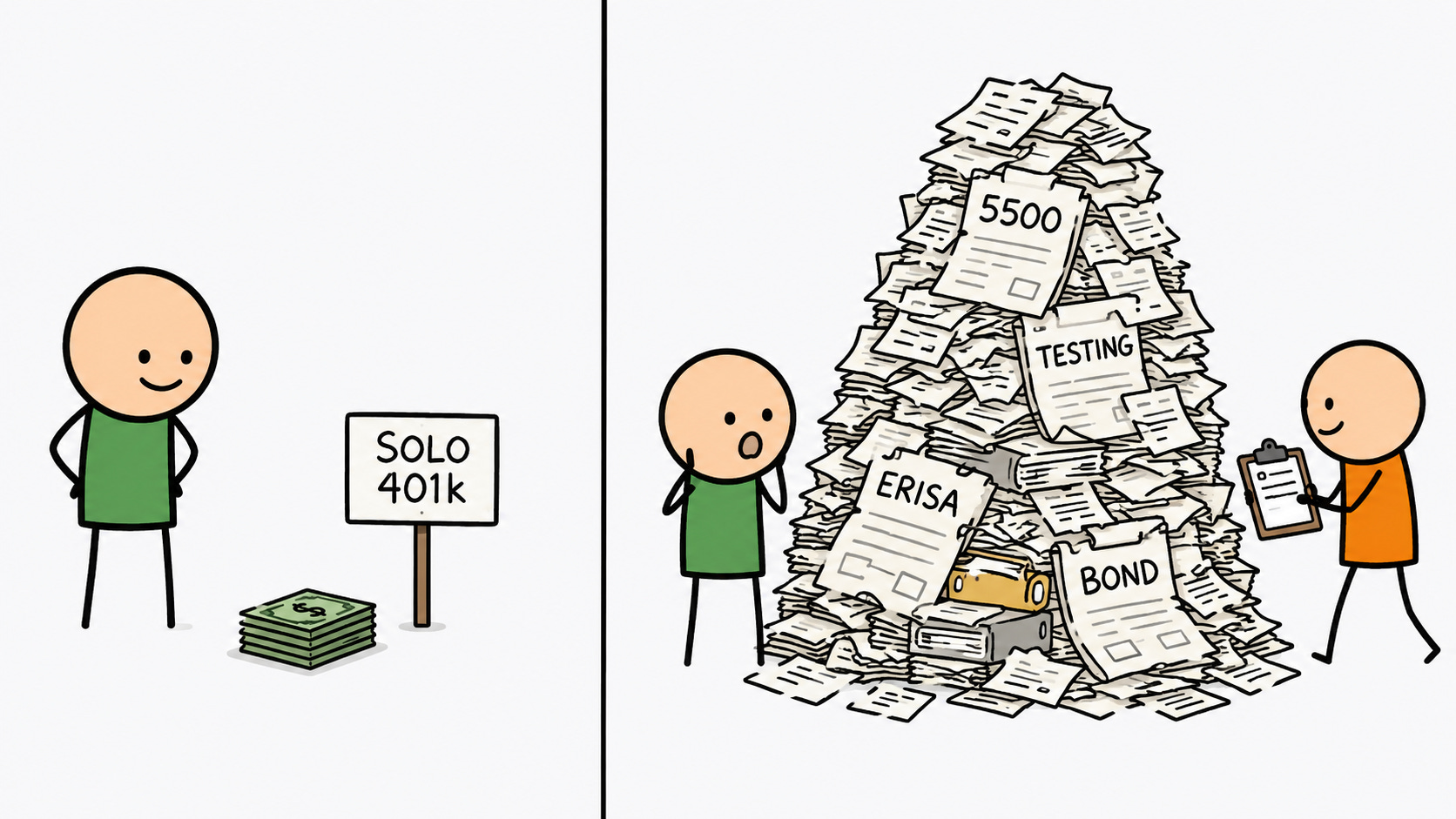
The name “solo 401k” describes the business when the plan was set up. It does not describe the plan forever. When the business stays solo, the plan keeps its simple structure. When the business hires its first employee who is eligible to participate, the plan changes by operation of law, whether the owner notices or not.
That last part is the problem. Nothing about the plan looks different on the day of the change. The investment options are the same. The custodian is the same. The deferral process is the same. What changes is the body of rules sitting behind the plan, and the owner is usually the last person to know.
A solo 401k, more formally a one-participant plan, gets its favorable treatment from one fact. The only people covered are the business owner and, in some cases, the owner’s spouse. The moment a non-owner, non-spouse employee becomes eligible to participate in the plan, that fact stops being true, and the plan becomes a standard 401k by operation of law. The name on the paperwork does not need to change for this to happen.
What defines an eligible employee depends on the plan document, but federal law generally does not let a 401k plan make an employee wait beyond age twenty one and one year of service, usually one thousand hours in a twelve-month period. A plan can be more generous than that, but it cannot pretend employees need to wait longer than the law allows.
There is also the long-term part-time employee rule. For plan years beginning after 2024, an employee who is at least twenty one and works at least five hundred hours in two consecutive twelve-month periods generally must be allowed to make elective deferrals. Employer contributions and testing treatment are not the same as for full-time employees, but an LTPT employee can still be the reason the plan stops being a true one-participant plan.
When the conversion happens, several things start applying that were not in play before. The plan may have to pass annual coverage and nondiscrimination tests, unless it uses a safe harbor design or another testing exception. Safe harbor is a plan design choice, not a magic solo-plan invisibility cloak. Top-heavy rules can require minimum contributions to non-key employees when key employees hold more than sixty percent of plan assets. ERISA fiduciary duties attach. The plan document may need to be amended or restated. And once the plan is covered by Title I of ERISA, the people handling plan funds generally need an ERISA fidelity bond.
The reporting changes too. A true one-participant 401k files Form 5500-EZ only when plan assets exceed two hundred fifty thousand dollars across all one-participant plans the employer maintains, or in the plan’s final year. Once the plan is no longer eligible to file as a one-participant plan, it generally moves to Form 5500 or, if eligible, Form 5500-SF. That filing world is different, more public, and no longer disappears just because the plan is under the owner-only asset threshold.
What happens if you do this later instead. The plan does not stop converting because the owner did not notice. Late Form 5500 penalties are not theoretical. The IRS penalty is currently two hundred fifty dollars per day, capped at one hundred fifty thousand dollars per return, and DOL penalties can also apply. The cleanup for a late annual return is its own filing-relief world, not something to fix inside the plan someday. Operational failures can be corrected through the IRS self-correction process for many issues, though not all. Failure to bond, failure to test, and failure to amend the document are all the kind of things that get caught when an exam or a participant complaint brings a closer look.
A self-employed designer has run a solo 401k for years, contributing for herself and her spouse on the business payroll. She brings on an assistant in March who shifts to full-time later that year. The assistant turns twenty one before year end.
A year later, the assistant has completed twelve months at one thousand hours of service and becomes eligible to participate. The plan, by operation of law, is no longer a solo.
If the designer notices, she can restate the plan, set up the testing, get the fidelity bond, and switch the filing track. If she does not notice, the conversion still happened, and the wrong forms keep going in until the plan is brought into compliance.
The conversion from solo to standard 401k is automatic. The owner’s only real choice is whether to manage the conversion in advance or clean it up afterward.
What truly matters is recognizing the trigger. The conversion happens when a non-owner, non-spouse employee meets the plan’s eligibility rules, not when the employee is hired. Many owner-only plans are drafted around the longest wait the law generally allows, twelve months of service at one thousand hours plus age twenty one. The SECURE 2.0 long-term part-time rules add a second route for hires who work fewer hours over more years. Knowing the eligibility date for each hire is most of what it takes to stay ahead of the conversion.
If the conversion has already happened, the plan is what it is. Testing, bonding, plan document, and the right Form 5500 all need to catch up. The IRS has correction procedures for these situations. A solo plan that grew into a real 401k without the paperwork is a common pattern, and the path back to compliance is well marked. The worst outcome is acting like the conversion did not happen, because the rules keep applying regardless.
I write one of these every day, one retirement rule, explained in plain language and verified against the source. The daily email is free: subscribe here.
Full archive, worksheets, and search live at RetirementNewsRundown.com.
Disclaimer This article is for educational and informational purposes only. It is not tax, legal, or financial advice and does not create an advisor–client relationship. Always consult appropriate professionals regarding your specific situation.