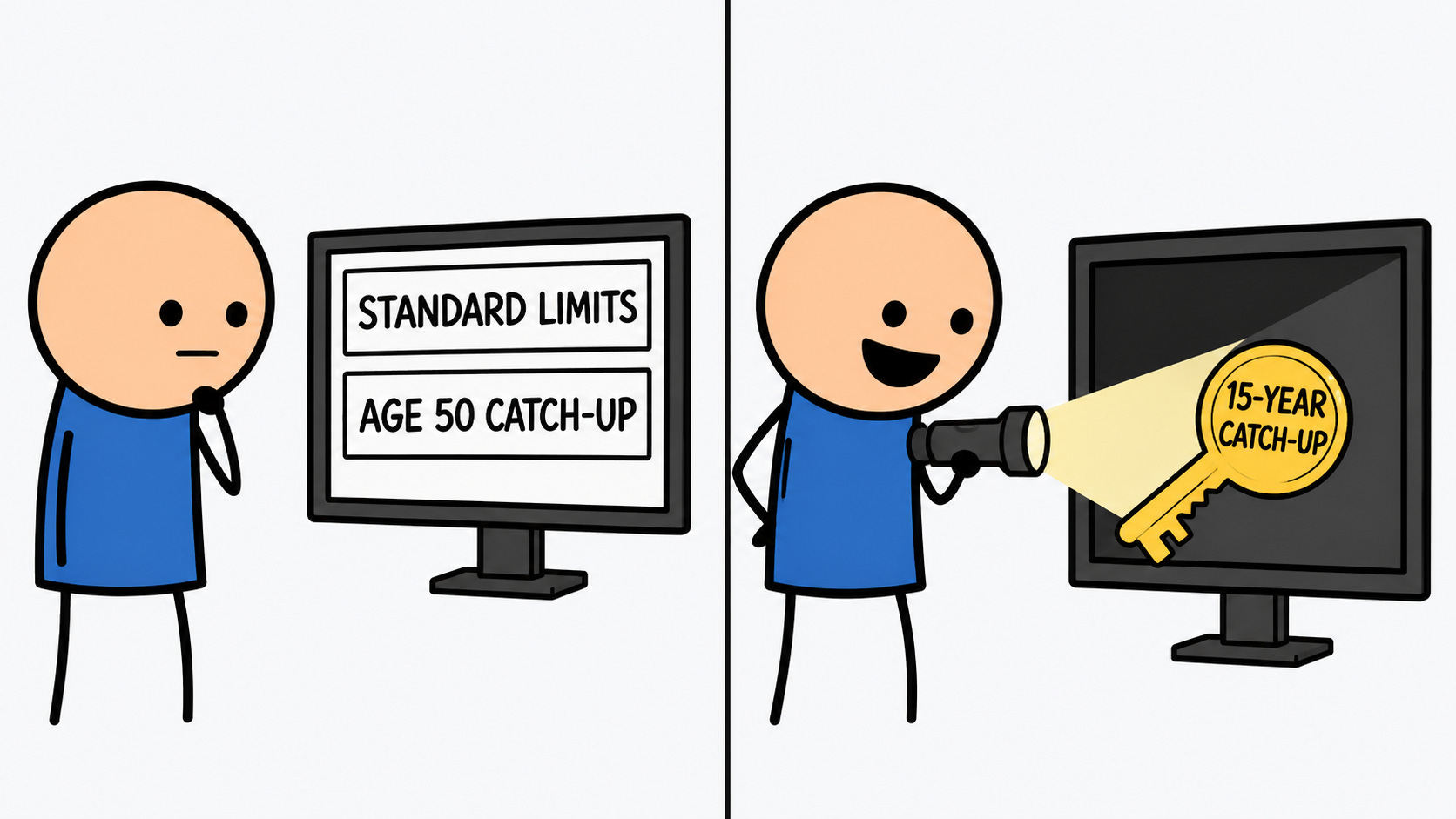
A 403b participant looks at the contribution limit posted on the plan website. The regular elective deferral limit is there. The age fifty catch-up is there for participants old enough to use it. What is generally not posted, because it does not apply to everyone, is a third lever that has been sitting in the tax code for decades, available only to a specific group of long-tenured employees. It is called the fifteen-year catch-up, and the people most likely to qualify are the ones least likely to know it exists.
The mechanism is narrow on purpose. The benefit was written for employees of educational organizations, hospitals, health and welfare service agencies, home health service agencies, and church organizations. Most long-tenured workers in those settings have never heard of it. They keep deferring at the same level they always have, year after year, while a perfectly legal extra deferral slot waits unused.
The fifteen-year catch-up is a special rule for 403b plans only, and only if the plan document permits it. When available, it allows an additional contribution above the standard elective deferral limit, capped at three thousand dollars per year, for participants with at least fifteen years of service with the same qualifying employer. The years of service requirement is per employer, not aggregate across different employers, so the clock generally restarts each time a participant changes jobs.
Eligibility starts with the type of organization. The employer must be a qualified organization under the rule, generally an educational organization, a hospital, a home health service agency, a health and welfare service agency, a church, or a convention or association of churches, including certain associated organizations. A private-sector employer offering a 401k, even one with long-tenured employees, has nothing to do with this rule.
The annual limit on the catch-up is the smallest of three numbers. First, three thousand dollars. Second, fifteen thousand dollars minus the total amount of fifteen-year catch-ups the participant has already used in prior years. Third, five thousand dollars multiplied by the participant’s years of service with the employer, minus the participant’s prior 403b elective deferrals for that employer, including Roth deferrals and prior fifteen-year catch-up amounts.
If the participant also qualifies for the age fifty catch-up, the ordering rule matters. Tax rules require the fifteen-year catch-up to be used first, with the age fifty catch-up stacking on top after the fifteen-year is exhausted. That ordering matters because the lifetime cap on the fifteen-year catch-up means once the participant has used the full fifteen thousand dollars, only the age fifty catch-up remains.
What happens if you do it later instead. The catch-up is an annual opportunity. A year you do not use it is a year that is gone. There is no way to make up an unused fifteen-year catch-up in a future year, and the lifetime cap applies to dollars actually used, not dollars left on the table. The same applies to a year you contribute too much. An over-contribution becomes an excess deferral, subject to the standard correction window. A corrective distribution by April 15 of the following year keeps the tax treatment clean. Miss that window and the excess is taxable in the year deferred and taxable again when finally distributed.
One SECURE 2.0 note worth keeping in view. The rule that requires age fifty catch-up contributions to be made on a Roth basis for high earners does not extend to the fifteen-year catch-up. The fifteen-year catch-up keeps its standard treatment under the plan, pre-tax or Roth at the participant’s election where the plan allows.
A hospital employee with twenty years of service at the same employer turns fifty five. She is eligible for the age fifty catch-up. She is also eligible for the fifteen-year catch-up, since she has well over fifteen years at a qualifying employer, and she has never used it before. Her prior deferrals are within reasonable bounds against the service-based formula, so the third limit does not bind.
She elects to add three thousand dollars to her annual deferral. By the ordering rule, that three thousand dollars is the fifteen-year catch-up, not the age fifty catch-up. Her age fifty catch-up sits on top of that, fully available because the fifteen-year amount was applied first. She has now used three thousand dollars of her fifteen thousand dollar lifetime cap.
She continues at the same pace for four more years, hitting the fifteen thousand dollar lifetime cap. From that point on, the age fifty catch-up is the only catch-up available, and the fifteen-year catch-up door is closed. The total benefit over those five years is an extra fifteen thousand dollars of deferral.
The fifteen-year catch-up is the kind of rule that exists for the right reasons and gets used for the wrong ones. It was written to help long-tenured workers in qualifying organizations close a gap that smaller cumulative deferrals had left behind. It works fine as long as the participant knows it exists and uses it deliberately. The main reason it gets missed is that it is not a default feature on a plan’s benefits page, and the people most eligible for it are the ones who have been at the employer long enough to stop checking the limits each year.
What truly matters is three things. Eligibility runs on the type of employer and fifteen years of service with the same one, so it is narrower than the 401k catch-up world. The lifetime cap of fifteen thousand dollars means the benefit is finite, not annual, and once it is gone it is gone. And the ordering rule, where the fifteen-year catch-up gets used before the age fifty catch-up when both apply, decides which lever runs out first.
If you qualify and have not used it, the slot is available for current and future years. If you have already used some of it, the math runs against what you have left. The rule is not complicated once you see it, and seeing it is most of the work.
I write one of these every day, one retirement rule, explained in plain language and verified against the source. The daily email is free: subscribe here.
Full archive, worksheets, and search live at RetirementNewsRundown.com.
Disclaimer This article is for educational and informational purposes only. It is not tax, legal, or financial advice and does not create an advisor–client relationship. Always consult appropriate professionals regarding your specific situation.