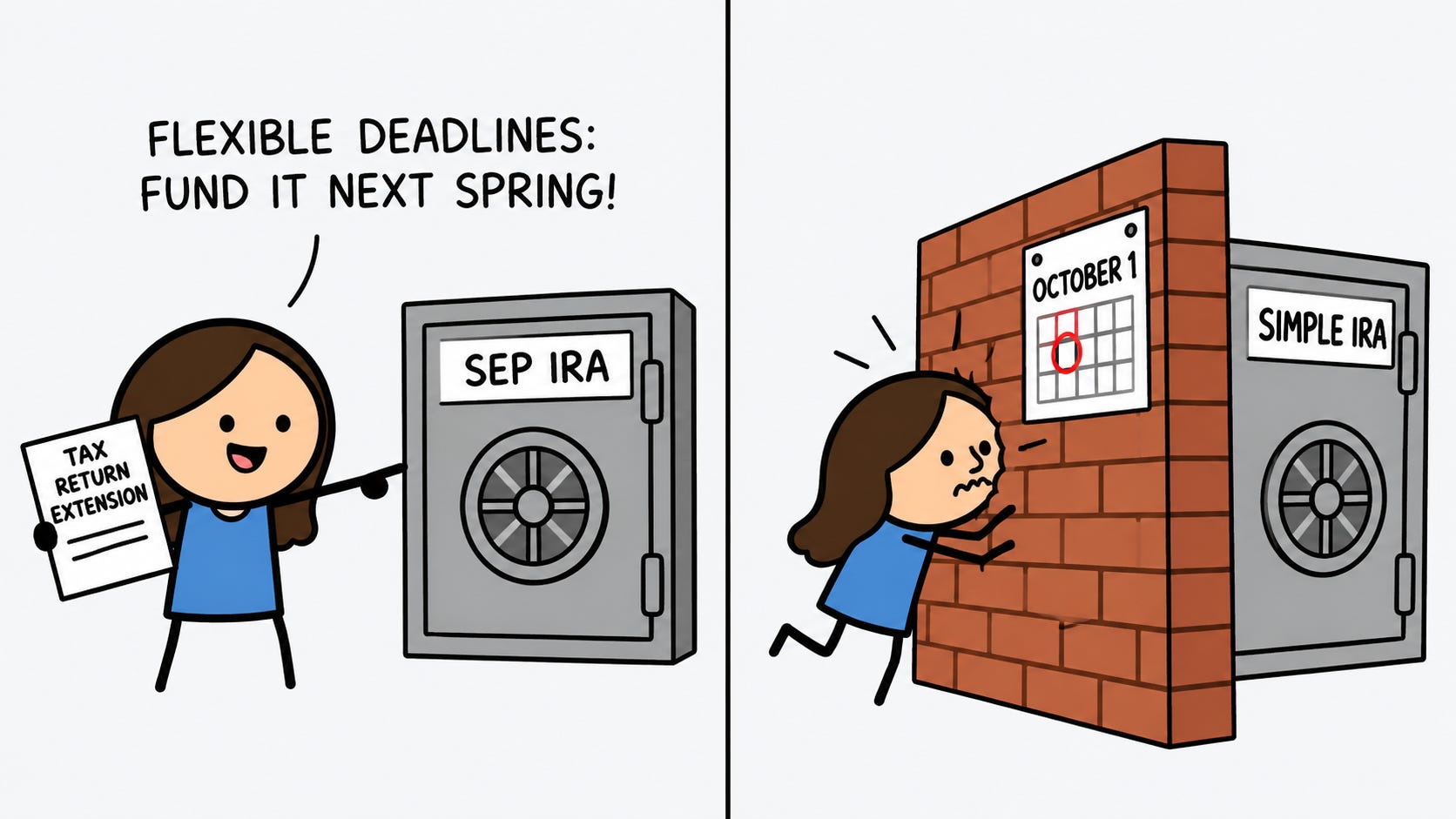
A SEP is unusually forgiving about when an owner decides. It can be adopted for a year right up to the due date of the business return, extensions included, which means someone can sit down in September with a finished profit figure and create a plan for a year already nine months gone. That one plan shapes how people think about the whole category, as though small business retirement saving were a decision you make at tax time.
One plan refuses to work that way. The SIMPLE IRA has a window that opens January 1 and closes October 1, and when it closes there is nothing on the other side. No extension reaches it. No six month relief, no corrective filing, no penalty you can pay to buy your way back in. The publication puts the edge in one sentence: the plan cannot have an effective date earlier than the date you actually adopt it.
The window has three versions. If you have never maintained a SIMPLE IRA plan, you can set one up effective on any date from January 1 through October 1. If you are a brand new employer that came into existence after October 1, you get to adopt one as soon as it is administratively feasible, which is the only path into the back of the year. And if you have maintained one before, your only available effective date is January 1.
That structure stops looking arbitrary once you notice what the plan is made of. A SIMPLE plan runs only on a calendar year. Employees fund it by salary reduction, so the money comes out of paychecks rather than a lump sum the owner writes in April. And before any of that, employees have to be told what the plan offers and given a window to decide how much to defer, normally the 60 days from November 2 through December 31 for the year ahead, which shifts when a plan starts mid-year. Put those together and a plan adopted in November has no payroll left to run through and no honest election period. The October 1 date is where the machinery stops fitting in the year.
Two other gates sit in front of the window. It is available only if you had 100 or fewer employees who received $5,000 or more in compensation for the preceding year, counting everyone you employed at any point in the calendar year whether or not they were eligible to join, including yourself if you have self-employment earnings. And a SIMPLE IRA plan generally has to be the only retirement plan you contribute to for service in any year it is effective, which is why an owner with an existing plan cannot simply bolt one on.
Adopting it commits you to funding it. You either match each participating employee dollar for dollar up to 3% of their compensation, or you make a nonelective contribution of 2% of compensation for every eligible employee whether they defer anything or not. The match can be dropped as low as 1%, but not for more than 2 years out of any 5 year period ending with the year you choose it for. Eligibility runs to anyone who earned at least $5,000 in any 2 preceding years and is reasonably expected to earn $5,000 in the current one, and you can loosen those numbers but cannot tighten them or add conditions of your own.
The funding deadlines, unlike the setup deadline, do bend, though one bends less than it appears. Money withheld from employee pay has to reach the account promptly. The tax rules set an outside limit of 30 days after the end of the month it came out of, and labor rules can require it sooner, with a safe harbor of seven business days after withholding for a plan with fewer than 100 participants. The employer match or nonelective contribution is the genuinely relaxed one, able to wait until the due date of your return including extensions. The money gets the flexible deadline. The plan’s existence gets the fixed one.
One more piece binds employees rather than the employer. Money coming out of a SIMPLE IRA within 2 years of when that person began participating carries a 25% additional tax instead of the usual 10%, and a rollover into a non-SIMPLE IRA is tax free only after those 2 years have run. A plan adopted in September starts that clock for everyone in it.
Nadine runs a four person shop as a sole proprietor and spends most of the year meaning to set up a plan. On August 18 she signs the documents with an effective date of September 1, gives her employees their notice and an election window, and starts withholding from the September payroll. She picks the 3% match.
Ray earns $48,000 for the year and elects a 6% salary reduction beginning with the September payroll. Nadine matches what he actually defers, dollar for dollar, against a ceiling of 3% of his compensation for the whole calendar year, which is $1,440. His deferrals from September through December come to roughly $960, under that ceiling, so she matches $960. The ceiling is built on the full year even though Ray participated in only part of it, which is the piece people get backwards.
Now move her decision seven weeks later. Her accountant raises retirement plans on October 8, while pulling together a return that is on extension to October 15, which is when this conversation usually happens. The SIMPLE window closed on October 1. She cannot adopt one for that year, and she cannot adopt one now and backdate it to September, because the effective date can never precede the adoption date. There is no version of the paperwork that fixes this.
What she has instead are two real options, and one of them has a week left on it. She can adopt a SEP for that same year, up to the extended due date of her return, funded entirely with employer money and no employee deferrals at all. Or she can set up the SIMPLE IRA plan effective January 1, run the notice and election period through November and December, and have it live from the first payroll of the new year. The second option costs her a year of deferrals. The first changes what kind of plan she has. Both doors were open in August. By the second week of October one has shut and the other is closing.
The useful habit here is to stop asking when the deadline is and start asking which kind of deadline it is. Most small business plan deadlines are tied to your tax return, which means they move when your return moves, and an extension buys real time. The SIMPLE IRA establishment date is tied to the calendar instead, and the calendar does not care what you filed or when.
That distinction carries beyond this one plan. Deadlines keyed to a return tend to come with relief provisions, amended filings, and six month windows. Deadlines keyed to a fixed date on the calendar tend to come with nothing at all.
If you are weighing which plan fits the business, the small business retirement plan selector walks through how the funding obligations and coverage rules differ. The full mechanics of this one, including the contribution math and the two year rule, sit in the SIMPLE IRA guide.
I write one of these every day, one retirement rule, explained in plain language and verified against the source. The daily email is free: subscribe here.
Full archive, worksheets, and search live at RetirementNewsRundown.com.
Disclaimer
This article is for educational and informational purposes only. It is not tax, legal, or financial advice and does not create an advisor-client relationship. Always consult appropriate professionals regarding your specific situation.