The exception list is written in shorthand. One entry is a single word, disabled, with no test printed beside it. A definition does exist, but it sits in a different part of the publication from the list, and the form where you claim the exception wants a number rather than evidence. So the common path is to read the word, recognize your own situation in it, claim the exception, and never meet the standard at all.
The standard is worth meeting on purpose, because this is one of the few exceptions with no dollar ceiling and no clock attached. Several of the others cap out at an expense you actually paid, or expire sixty days after something, or require a schedule you have to keep for years. This one has neither limit. That makes it unusually valuable and it makes the definition the entire question.
Two things have to be true. You cannot engage in any substantial gainful activity because of a physical or mental condition. And a physician has to determine that the condition can be expected to result in death, or to be of long, continued, and indefinite duration. The publication also puts the burden where people do not expect it: you qualify if you can furnish proof, which means the evidence is yours to assemble rather than something the account produces for you.
The word carrying weight is “any,” and it reaches past the specific job you held. Being unable to do the exact work you were doing when the condition started does not settle the question by itself. A carpenter who can no longer carry a sheet of plywood up a ladder has lost a trade, which is a serious thing, and has not yet established the tax definition by losing it. What gets weighed is the work you customarily did and activity comparable to it, measured against the impairment together with your education, training, and work experience.
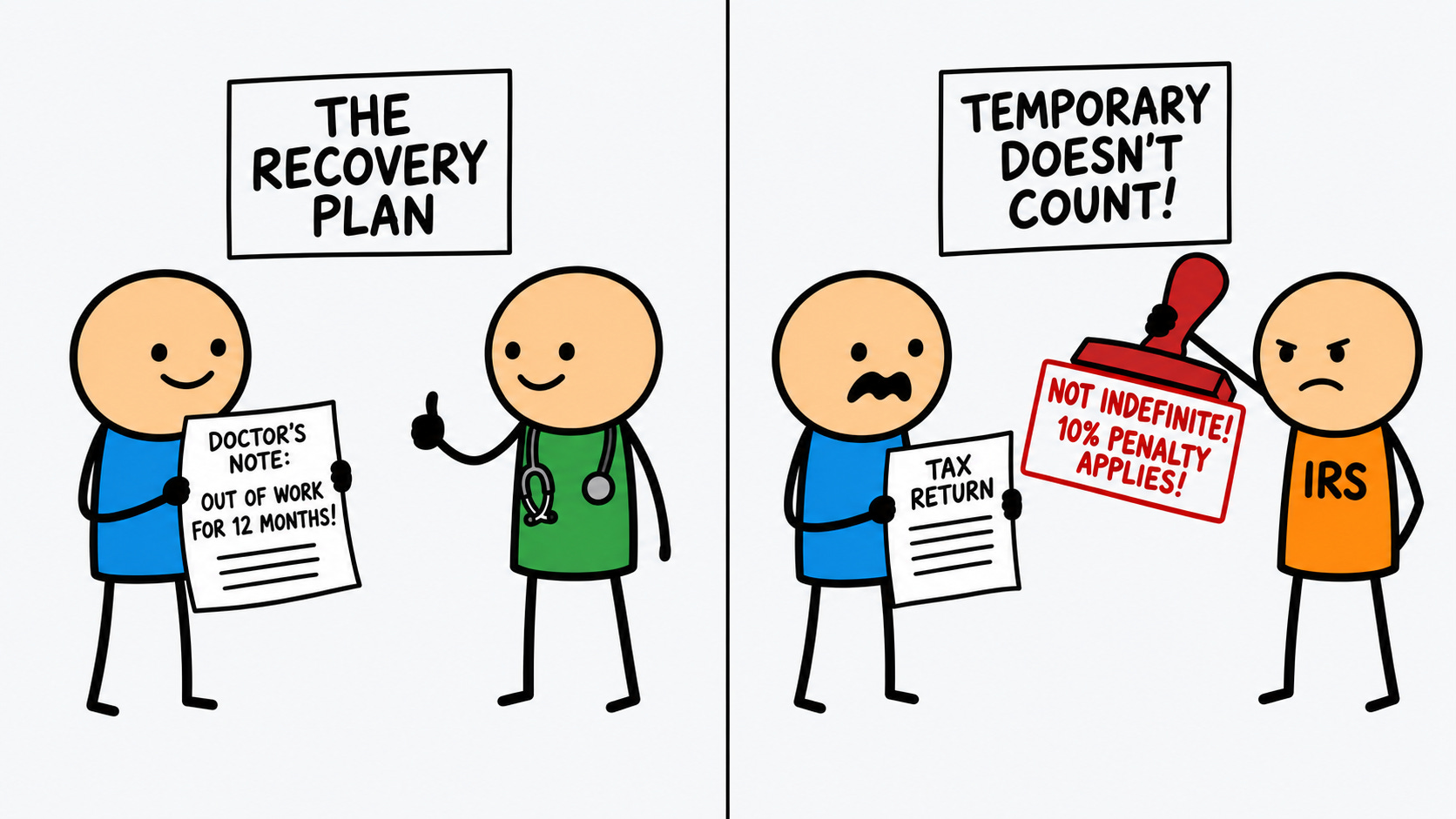
The second word doing heavy work is “indefinite.” A condition that is severe now and expected to improve runs into that requirement. Someone facing eighteen months of recovery is genuinely unable to work during those eighteen months, and eighteen months has an end on it. Long, continued, and indefinite describes a different shape of condition entirely, one where the physician cannot tell you when it resolves because the honest answer is that it may not.
Those two requirements explain much of the gap between who believes they qualify and who does. The tax rule asks for a physician’s determination and for proof you can produce. A determination made elsewhere, by a different program applying its own rules for its own purposes, is a separate thing arrived at separately. Documentation assembled for it may well support this standard, and it is worth having, while the standard being applied here stays the one written above.
What the exception does, it does cleanly. A distribution taken because of the disability, before 59.5, escapes the 10% with no cap on the amount and no deadline to beat. On a Roth IRA the same exception appears in the list covering distributions that are not qualified, applied against the taxable part. And the waiver reaches the 10% and stops there. The taxable portion of a traditional IRA distribution still goes into income for the year, which for someone who has lost their earnings is usually a gentler bill than it would otherwise be, though it still lands in adjusted gross income where other things are keyed.
There is a specific code on the distribution form for a disability distribution. If the payer has enough information to treat the payment that way, that code can appear on the form. If the form instead reports an ordinary early distribution, the exception can still be claimed on the penalty form where the facts support it. Either way the proof stays yours.
One nearby exception shows what an explicit standard looks like. A separate rule covers a distribution taken after a physician certifies that you are terminally ill, defined as an illness or physical condition reasonably expected to result in death within 84 months of the certification. The certification has a spelled-out contents list: the statement itself, a narrative description of the evidence behind it, the physician’s name and contact information, the dates of examination or review and of signature, and the physician’s signature with an attestation that they wrote the narrative from their own examination or review. The publication even closes the obvious loophole, noting that a physician who owns the IRA cannot certify their own terminal illness. That exception tells you precisely what paper to produce. The disability exception tells you the conclusion that has to be supportable and leaves the paper to you.
Russell is 51. He injures his back on March 9, has surgery on May 14, and is out of work for the rest of the year. On September 22 he takes $26,000 from his traditional IRA to cover the months without a paycheck, and when he files he claims the disability exception, because he has spent the year unable to work.
His surgeon’s notes expect him back within twelve to eighteen months with lifting restrictions. That expectation is the problem. An anticipated recovery on a stated timeline runs against the requirement that the condition be expected to result in death or to be of long, continued, and indefinite duration. The restrictions point toward work that may remain open to him. The 10% applies to the $26,000, which is $2,600 on top of the income tax he already owed on it.
Change one fact and the outcome changes with it. If the condition were progressive instead of healing, and his physician determined that he could not engage in any substantial gainful activity and could not say when or whether that would change, the same $26,000 would carry no 10% at all. He could have taken $60,000 with the same result, because nothing here caps the amount. The taxable portion would still be ordinary income either way.
The two readings of Russell’s year differ on medical facts alone. Nothing he filed and no date he hit moved the outcome either way, which is unusual among these exceptions and is the thing to take away. There is no window to miss here and no ceiling to stay under, so the question is only whether the condition meets the standard and whether you can show it.
Which makes the practical move an unglamorous one. If you are taking money out of a retirement account because a condition has stopped you from working, the conversation to have is with the physician who is treating you, about what they can state regarding capacity for work in general and about duration. That is the determination the rule turns on, and it is far easier to document while you are in front of them than to reconstruct two years later when a notice arrives.
What shows up on the distribution form shapes how all of this gets reported, and the guide to Form 1099-R covers which code means what and what it does and does not prove about your situation. If the code arrives as an ordinary early distribution, claiming the exception yourself runs through the process in the Form 5329 guide.
I write one of these every day, one retirement rule, explained in plain language and verified against the source. The daily email is free: subscribe here.
Full archive, worksheets, and search live at RetirementNewsRundown.com.
Disclaimer
This article is for educational and informational purposes only. It is not tax, legal, or financial advice and does not create an advisor-client relationship. Always consult appropriate professionals regarding your specific situation.