Solo 401(k) Deferrals That Never Got Deposited
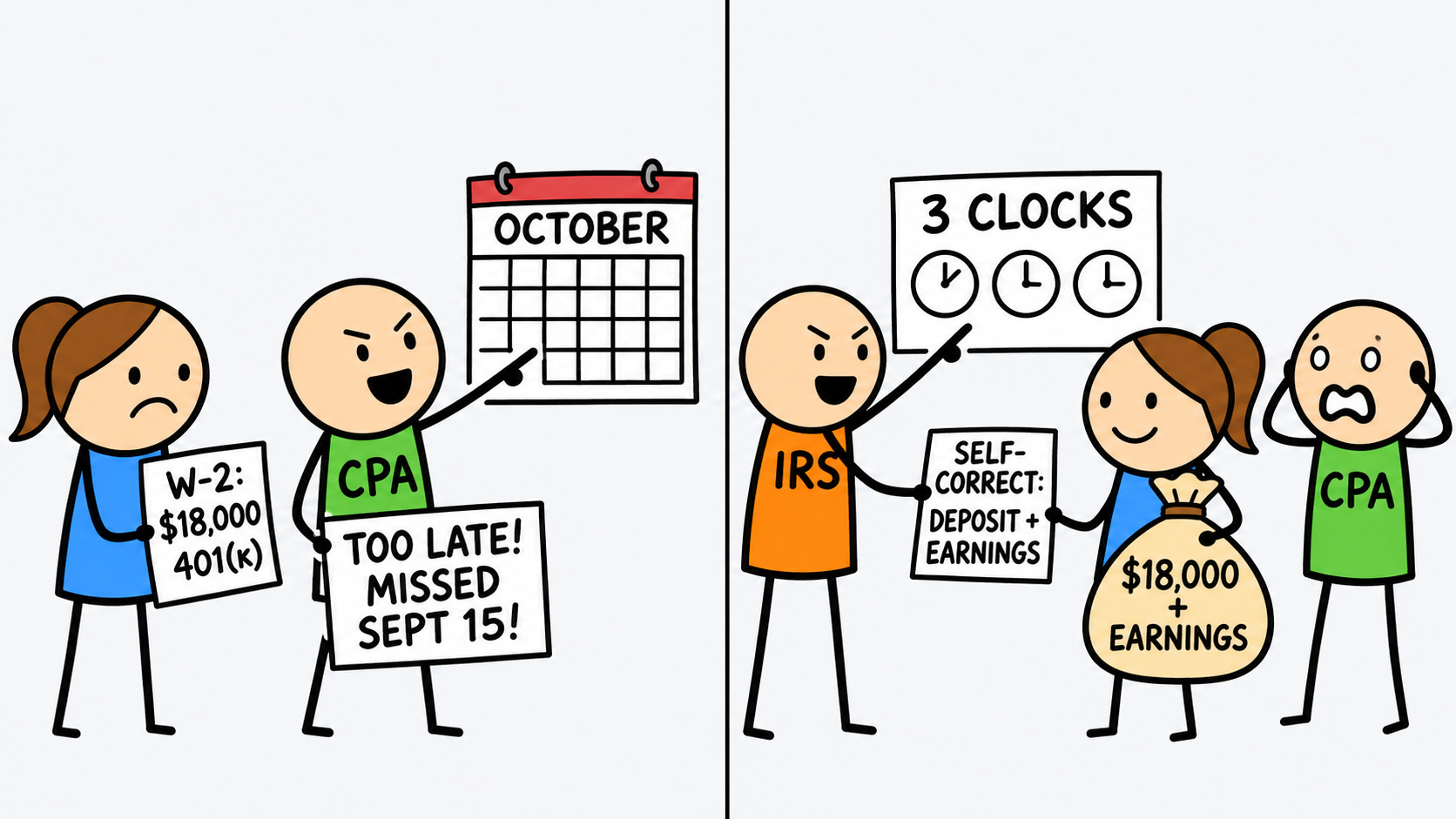
A solo 401(k) runs on three separate clocks, and the money in it gets judged by whichever clock governs that kind of contribution. Salary deferrals have one deadline for the decision, another for the deposit, and the employer’s profit-sharing contribution has a third. When something goes wrong, the first question is which clock the money was on, and that is usually the question nobody asks.
The classic version involves an S corporation owner whose payroll service withheld 401(k) deferrals from every paycheck all year, reported them on the W-2, and then never sent a dollar to the plan. Someone notices the following fall. The CPA, the plan provider and two AI chatbots all give different answers about whether it is too late, and every one of them is checking the wrong clock.
The first clock is the election. A salary deferral has to be chosen before the pay it comes from is available. For an S corporation owner paid through W-2 payroll, that means the deferral comes out of each paycheck as it is paid, and the last paycheck of the year is the last chance for that year. For a sole proprietor or partner, whose earnings are treated as paid on the last day of the business’s tax year, the election has to be in place by December 31 for a calendar-year business, even though the actual dollar amount gets figured later. There is one narrow exception: a sole proprietor with no employees who sets up a brand new solo 401(k) after the year ends can elect deferrals for that first prior year, and has to get them into the plan, by the due date of the personal return, without extensions.
What happens if the election comes later? Then there is no deferral for that year to deposit. An S corporation owner who reaches January without ever having elected a deferral cannot create one for the year just ended. The year’s employee side is closed.
The second clock is the deposit. Once a deferral has been elected and withheld, it belongs in the plan. Plans covering employees answer to the Labor Department’s rule that deferrals go in as soon as they can reasonably be separated from the company’s money. A solo 401(k) covering only the owner, or the owner and spouse, sits outside the Labor Department’s rules, but it is still a qualified plan to the IRS, and the plan document’s own terms say the deferrals get deposited. For a sole proprietor with an existing plan, the year’s deferrals generally can go in up to the due date of the personal return, including extensions, which is also what keeps them deductible for that year.
What happens if the deposit is late? This is a correctable operational mistake, and the IRS has a published fix for it: deposit the missing deferrals and add the earnings the money would have made in the plan, from the date it was due in the plan to the date it actually arrives. The business pays the earnings. Under the IRS self-correction program, a correction finished by the later of the end of the third plan year after the year of the mistake or 18 months after the mistake is found counts as timely. There is no IRS fee, provided the plan meets the program’s requirements, including having compliance procedures in place when the mistake happened. A plan document by itself does not count as procedures. Documenting what happened, how the earnings were figured and when the deposit went in is part of the fix, and it is the part that gets skipped.
The third clock is the employer contribution. The business’s profit-sharing contribution can be made up to the due date of the business’s tax return, including extensions. For a calendar-year S corporation, that is March 15, or September 15 with an extension. For a sole proprietor, it is the personal return deadline. This is the deadline most people have in mind when they ask whether a solo 401(k) contribution is too late, and it governs only the employer side.
What happens if the employer contribution comes after that date? The business generally loses the deduction for the prior tax year. A contribution made within 30 days after the extended filing deadline can still be allocated to the prior plan year, if the plan’s terms allow and within that year’s limits, with the deduction taken in the year it is paid. After that, it counts under the later year’s rules.
Nina is 44 and the only employee of her consulting firm, an S corporation. She pays herself a $90,000 salary and elects to defer $1,500 a month into her solo 401(k). Her payroll service withholds $18,000 over the year and her W-2 shows it as a 401(k) deferral, with her taxable wages reduced to match. Because of a setup error at the payroll service, none of it ever reaches the plan. The corporation’s extended return is filed September 15, with no profit-sharing contribution.
In October, her plan statement comes up $18,000 short of what payroll withheld. Her CPA says September 15 has passed, so it is too late. Her provider says deposit it.
The provider is right, for a reason the CPA has not considered. September 15 was the employer contribution clock, and this money was never employer money. The deferrals were elected and withheld on time, so the election clock was met. The deposit clock is the one she missed, and the fix for a missed deposit is to make the deposit. The corporation deposits the $18,000 plus about $1,100 in lost earnings, based on what her plan’s investments returned over the months each deferral was missing. Her CPA writes up the correction and keeps it with the plan records. Her W-2 was already right, so nothing gets refiled.
Correcting the W-2 to erase the deferrals would leave the actual problem in place. The election happened, the money was withheld, and the plan still needs the deposit it was owed.
Suppose instead that Nina never elected to defer anything, payroll never withheld anything, and her W-2 shows no 401(k) deferral. Then nothing went wrong in the plan. She did not defer that year, the election clock closed on her last paycheck, and no deposit now can create one. If she did make a valid election and payroll ignored it, that is a different mistake, a failure to carry out a deferral election, and the IRS correction for it generally has the business make a corrective contribution of its own, adjusted for earnings.
The panic in these situations usually comes from treating one deadline as the deadline for everything. The election clock decides whether a deferral exists at all. The deposit clock decides whether a correction is needed, and a late deposit has a standard fix with plenty of room to make it. The tax return deadline governs the employer contribution, and for self-employed owners it also sets when deferrals have to be in the plan.
What matters is what the W-2 or the business records show was elected and withheld, how long the money has been out of the plan, and whether the correction is written down. For anyone sorting out what a solo 401(k) or other small business plan allows in the first place, our small business retirement plan selector compares the options side by side.
I write one of these every day, one retirement rule, explained in plain language and verified against the source. The daily email is free: subscribe here.
Full archive, worksheets, and search live at RetirementNewsRundown.com.
Disclaimer
This article is for educational and informational purposes only. It is not tax, legal, or financial advice and does not create an advisor-client relationship. Always consult appropriate professionals regarding your specific situation.