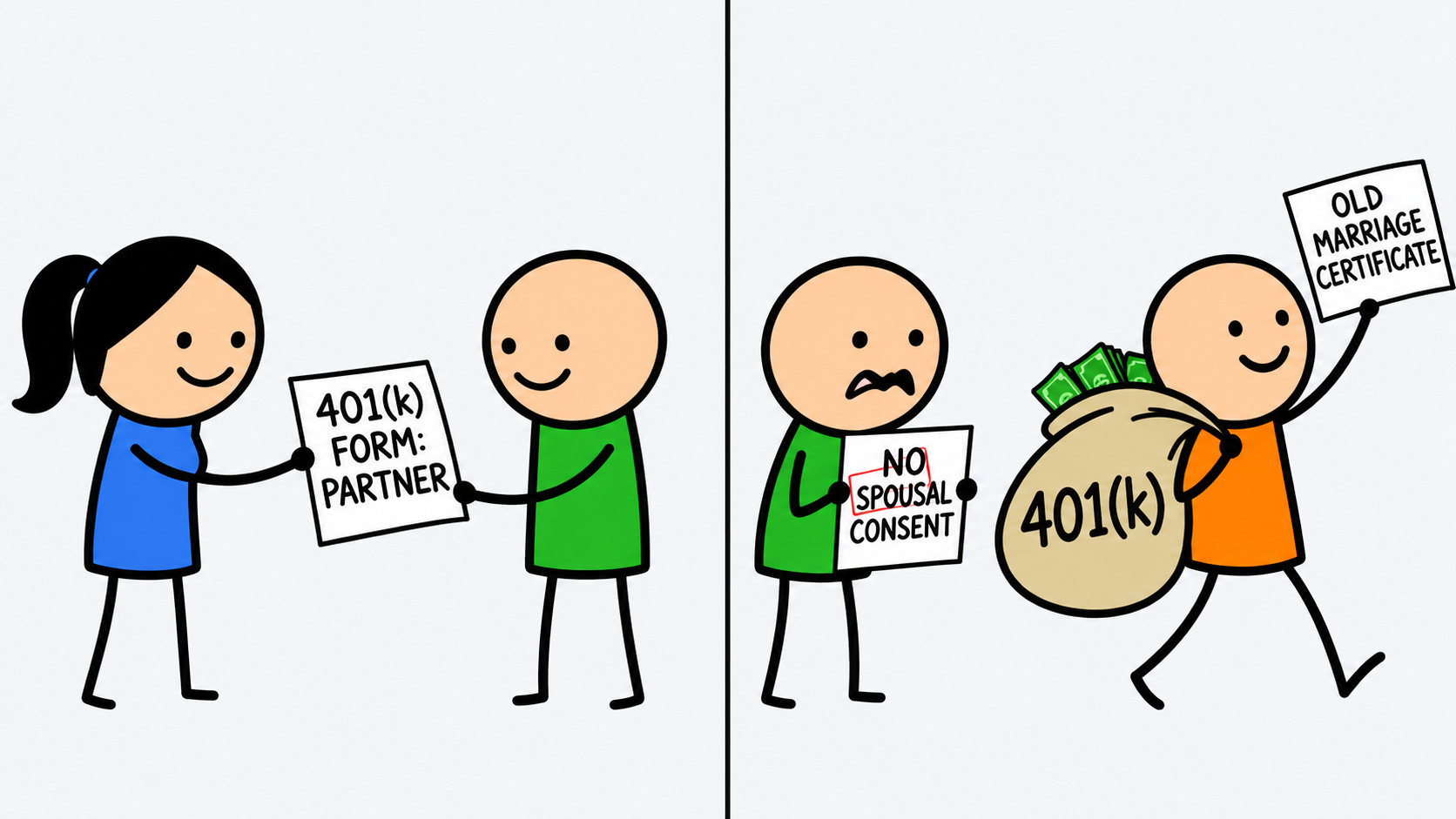
Retirement accounts skip the will. When an account owner dies, a 401(k) or IRA goes to whoever is named on the beneficiary form the plan or custodian holds, and federal law layers automatic protections on top of that form for one person only: a legal spouse. A partner of twenty years, however much a part of the household, gets none of those protections and nothing by default.
That gap runs both ways. A partner who is left off the form can end up with nothing. And a legal spouse who has been out of the picture for years can still end up with the 401(k), because the law protects the marriage certificate, whatever the household looks like.
A 401(k) starts from the spouse. In most 401(k) plans, a married participant’s surviving spouse is entitled to the entire vested balance at death unless that spouse has signed a written consent to someone else being the beneficiary. The consent generally has to name who gets the money instead, and it has to be witnessed by a notary or a plan representative. A beneficiary form that names a partner, signed only by the participant, is ineffective against a spouse who never consented. For this purpose a marriage lasts until a divorce is final, however long the couple has lived apart.
Two related rules matter for couples who marry later. A consent signed before the wedding, including one written into a prenuptial agreement, does not count, so a new spouse who agrees to leave the 401(k) to the participant’s children has to sign a consent after the marriage. And a plan may decline to treat someone as a spouse until the marriage has lasted a year, which is written into some plan documents and absent from others.
An IRA works differently. The owner can name anyone, and no spouse has to sign off. The exception is community property states, where a spouse can have a claim to IRA money earned during the marriage, and custodians there commonly ask for spousal consent before someone else is named.
When there is no valid form at all, the plan document or IRA agreement supplies a default. Plans often run to a spouse, then children, then the estate. IRA agreements often default to the estate. An unmarried partner appears in none of these lists, and intestacy laws in most states leave a partner out too, apart from states that give registered domestic partners or civil union partners a spouse’s inheritance rights. Those state statuses do not change the federal 401(k) spouse rules. A partner can still receive retirement money through the estate if the will leaves it to them, but only after probate.
Then comes the tax treatment, and here a partner is any other beneficiary. Only a surviving spouse can treat an inherited IRA as their own or roll an inherited 401(k) into their own IRA. A partner inheriting from a 401(k) can move the money only by direct transfer to an inherited IRA, with no 60-day rollover available. From there, the timeline depends on age. A beneficiary who is not more than 10 years younger than the owner counts as an eligible designated beneficiary and can take distributions over their own life expectancy. A partner more than 10 years younger generally has to empty the account by the end of the 10th year after the year of death, with annual distributions required along the way if the owner died on or after the required beginning date, the date the owner’s own required distributions had to start.
What happens when the form names the estate, or the account falls to the estate by default? The estate is not an individual, so it gets the least room. If the owner died before the required beginning date, the account has to be emptied by the end of the fifth year after the year of death. If the owner died on or after that date, the payout runs over the owner’s own remaining life expectancy. A partner named in the will receives their share as an heir of the estate, and the estate holds the IRA under its shorter payout rules. The life-expectancy schedule a named individual close in age could have used is gone.
What happens if the form is fixed later? A new beneficiary form and any spouse’s consent have to be completed while the owner is alive. After death, the form the plan or custodian holds generally controls, and nobody else can change it.
Elaine is 63 and has lived with her partner, Tom, 60, for 15 years. She separated from her husband, Doug, 12 years ago and never finalized the divorce. She has a 401(k) at her current job worth $400,000 and an IRA worth $250,000, rolled over from an earlier employer. Both beneficiary forms name Tom. Doug has never signed anything.
Elaine dies at 63, well before her required beginning date.
The IRA goes to Tom. He is three years younger than Elaine, so he is an eligible designated beneficiary. He moves the money into an inherited IRA and takes required distributions each year over his own life expectancy, starting the year after her death. He cannot treat it as his own IRA, so his age and his choices about timing follow the inherited rules.
The 401(k) goes to Doug. He is still her legal spouse, and he never consented to Tom being the beneficiary, so the plan pays the surviving spouse. Doug, as a spouse, can roll it into his own IRA.
Had Doug signed a notarized consent naming Tom, the 401(k) would have gone to Tom on the same inherited terms as the IRA. Had the divorce been finalized, Tom’s name on the form would have been enough by itself.
Had Tom been 52 instead of 60, more than 10 years younger, he would have fallen under the 10-year rule. With Elaine dying before her required beginning date, he would have owed nothing in particular in any year before the 10th, but the account would have had to be empty by the end of that 10th year.
And had the IRA form been blank, with the IRA agreement defaulting to Elaine’s estate, Tom would have received his share only if her will left it to him, through the estate after probate, with the estate emptying the IRA within five years.
Once a partner is named on the form, the tax rules treat them like any other named individual, a sibling or a friend. A partner close in age to the owner can stretch the payments over their own life expectancy.
What matters is the name on each form, whether a legal spouse still exists who would have to sign for the 401(k), and whether those signatures are in place while the owner can still make them. For a sense of how the payout schedule works for a named beneficiary, our inherited IRA calculator shows the required distributions under each rule.
I write one of these every day, one retirement rule, explained in plain language and verified against the source. The daily email is free: subscribe here.
Full archive, worksheets, and search live at RetirementNewsRundown.com.
Disclaimer
This article is for educational and informational purposes only. It is not tax, legal, or financial advice and does not create an advisor-client relationship. Always consult appropriate professionals regarding your specific situation.