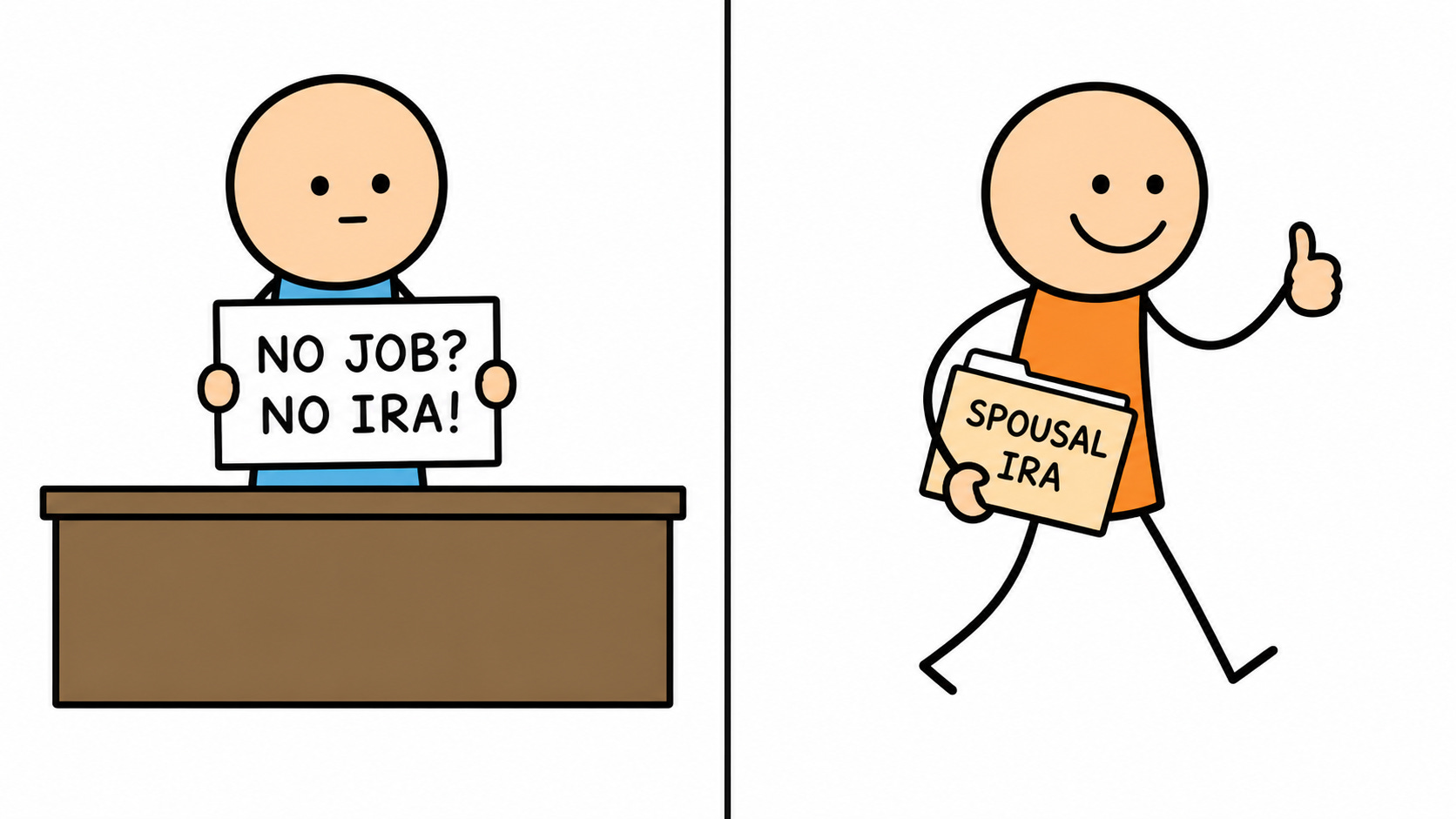
A stay-at-home parent walks into a credit union to open an IRA. The teller asks for proof of earned income. The parent explains that the family files jointly and the working spouse earns plenty. The teller looks confused, says she’ll need to check with a manager, comes back ten minutes later, and tells the customer she can’t open the account because she didn’t have any wages last year. The customer leaves. The IRS rule actually allows this contribution. The credit union just doesn’t know its own product.
Spousal IRA contributions exist because the IRS recognized decades ago that earned income inside a marriage is a household resource, not a personal one. Under IRC Section 219(c), a spouse who has little or no compensation can contribute to an IRA based on the working spouse’s earned income, as long as the couple files a joint return for the year.
The mechanics are simple. The contributing spouse opens an IRA in their own name. The IRA is individually owned by that spouse, and it is not tied to the working spouse’s IRA in any way. The only thing being shared is the earned income that allows the contribution.
The total combined contributions for both spouses can’t exceed the working spouse’s earned income for the year, capped at the standard IRA contribution limit per person. Each spouse can contribute up to the annual limit, plus the catch-up contribution if age 50 or older, as long as the household earned income supports it. If the working spouse earned $80,000, both spouses can fully fund their own IRAs. If the working spouse earned $9,000, the combined contributions across both IRAs can’t exceed $9,000.
Filing status matters. The spousal IRA rule is only available to couples filing jointly. Married filing separately doesn’t qualify, and there’s no filing-separately workaround that produces the same result. A couple that files separately is treated as two individuals for IRA purposes, and the non-working spouse has no earned income to contribute against.
Whether the contribution is to a Traditional or Roth IRA changes the income limit analysis. Traditional IRA deductibility for the non-working spouse phases out at higher joint MAGI levels when the working spouse is covered by a workplace plan. Roth IRA contributions phase out and disappear at MAGI levels that the IRS adjusts annually. Above the Roth phase-out, the spouse may still be able to contribute to a non-deductible Traditional IRA, assuming the household compensation supports the contribution. The basis would need to be tracked on Form 8606.
The contribution deadline is the tax filing deadline, generally April 15 of the following year, with no extension available beyond that date even if the tax return itself is extended. Missing the deadline means the contribution can’t be made for that year. There’s no late filing fix for a missed contribution year. The window closes on April 15 and stays closed.
Excess contributions trigger their own rules. Contributing more than the household earned income supports, or contributing while filing separately, creates an excess contribution subject to a 6% per-year excise tax under IRC Section 4973 until corrected. The correction window generally allows withdrawal of the excess contribution plus net income attributable by the tax filing deadline, including extensions, to avoid the 6% excise tax for that year. Past the extended deadline, the 6% tax applies for each year the excess sits in the account.
A couple files jointly. The husband earns $145,000 in W-2 wages and is covered by a 401(k) at work. The wife took early retirement two years ago and earned no wages this year. They want to contribute to IRAs for both spouses.
In March of the following year, before the April 15 contribution deadline, they each open a Roth IRA. The husband contributes the full annual limit. The wife contributes the full annual limit to her own Roth, plus the age-50 catch-up since she turned 53 last year. Joint MAGI sits at $148,000, comfortably under the Roth phase-out threshold for joint filers. Both contributions go in clean. Total combined contributions are well under his $145,000 of earned income.
Run the same scenario with one change. They file separately because she has a large medical deduction she wants to claim against a smaller income base. Her spousal IRA contribution becomes an excess contribution. She has no earned income on her separate return, and the spousal IRA rule requires a joint filing. If she catches the mistake before the extended filing deadline, she can withdraw the contribution plus net income attributable to avoid the 6% excise tax. If the extended deadline passes with the contribution still sitting in the account, the 6% tax applies for that year and continues to apply each subsequent year until the excess is removed.
Run it again. They file jointly, but the husband earned $4,800 in part-time wages. Total household earned income is $4,800. They each contribute $4,000 to their respective IRAs. The combined contribution of $8,000 exceeds the husband’s earned income by $3,200. They need to correct $3,200 of excess contributions across the IRAs. If not corrected in time, the 6% excise tax applies until the excess is removed or absorbed by future-year contribution room.
Same couple, same intent, three different outcomes driven by filing status and earned income.
The spousal IRA isn’t a special account or a different product. The contributing spouse opens a regular IRA in their own name. The rule that lets the contribution happen lives in IRC Section 219(c), not in a special account type.
What matters for the household is that filing jointly opens the door, that combined contributions stay within the working spouse’s earned income, and that the contribution lands by April 15. Beyond that, the standard IRA rules apply. Roth phase-outs, Traditional deductibility, the 6% excess contribution tax, and the Form 8606 basis tracking all work the same way they do for any other IRA.
Most credit union tellers don’t know the rule exists. The IRS does.
I write one of these every day, one retirement rule, explained in plain language and verified against the source. The daily email is free: subscribe here.
Full archive, worksheets, and search live at RetirementNewsRundown.com.
Disclaimer This article is for educational and informational purposes only. It is not tax, legal, or financial advice and does not create an advisor–client relationship. Always consult appropriate professionals regarding your specific situation.