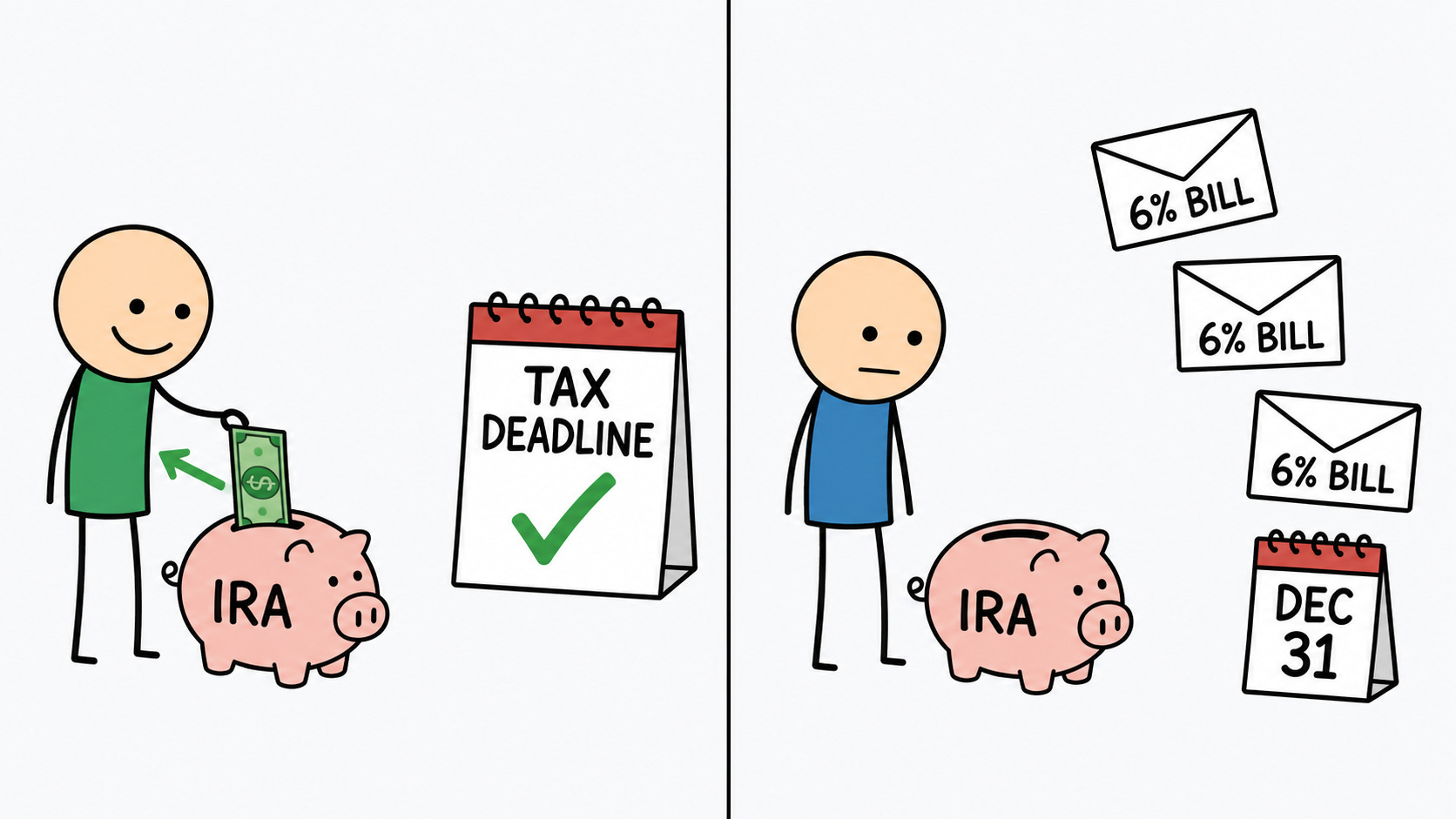
The IRS puts a ceiling on what you can contribute to an IRA each year. It also decides who is even allowed to contribute, based on income and earned income rules. What it does not do is stop you at the door. Your custodian will accept money you were never eligible to put in, and the account will not flash a warning. The excess just lands, sits there, and starts collecting a tax.
That tax is the six percent excess contribution penalty, and the thing people misunderstand most about it is that it is not a one-time fine. It is an annual event. Every year the excess stays in the account, the six percent comes around again. Most people picture a single slap on the wrist. What they actually have is a subscription they never signed up for.
The penalty applies when you contribute more than the rules allow. That can mean exceeding the annual limit, contributing to a Roth when your income was too high, or contributing at all when you had no earned income to support it. The amount over the line is the excess.
The six percent is an excise tax, charged on the excess for the year, and it is measured at the end of the calendar year. The year-end value matters, but December 31 is not the last chance for a current-year excess. A current-year excess can still be removed by the tax return due date, including extensions, and avoid the six percent tax. Once that correction window closes, the calendar-year snapshot matters every year the excess remains in the IRA. There is a cap worth knowing. The penalty is six percent of the smaller of two numbers, the excess contribution itself or the total value of all your IRAs at year end. For most people the excess is the smaller number, so the cap rarely changes anything, but it exists.
Now the part that actually saves money. You can avoid the six percent entirely with a return of excess. Withdraw the excess plus any earnings it generated by your tax filing deadline, including extensions, and the contribution is treated as if it never happened. No excise tax for that year. The earnings come out as taxable income for the year of the contribution, but under current law the ten percent early distribution penalty does not apply to a timely corrective IRA distribution. This is the tax-filing deadline, and it can stretch to October if the taxpayer has a valid extension or qualifies for the limited six-month amended-return procedure after timely filing.
What happens if you do it later instead. Miss that window and the six percent applies for that year. It is not retroactively erased. But the excess is still correctable, and here the math gets simpler. After the deadline you remove only the excess principal, with no earnings calculation, and that withdrawal stops the penalty going forward. You can also absorb the excess by counting it as a future year’s contribution, assuming you have room under that year’s limit. Either route ends the annual six percent. What you cannot do is undo the years that already closed with the excess still inside.
That is the trap. The penalty is not severe in any single year. Six percent of a few thousand dollars is a couple hundred dollars. The damage comes from repetition. Leave an excess in place for five years and you have paid the six percent five times, on the same mistake, for doing nothing.
Someone contributes the full amount to a traditional IRA in March, planning to deduct it. They had no earned income that year, only investment income, which means they were never eligible to contribute at all. The entire contribution is excess.
They do not notice. The tax filing deadline passes, the October extension passes, and the excess sits in the account at year end. The six percent applies. On a contribution of a few thousand dollars, that is a couple hundred dollars of excise tax, reported on Form 5329.
The next year they still do not notice. Year end arrives, the excess is still there, and the six percent applies again. Same mistake, second charge.
In the spring of the third year their tax preparer catches it. They withdraw the excess principal before that year ends. No earnings calculation is required, because the timely correction window is long gone. That withdrawal stops the clock. The six percent applied twice, for the two completed years the excess sat uncorrected. It does not apply for the third year, because the account was clean by the time that year closed.
The six percent excess contribution penalty sounds frightening because of how it is usually described, as a penalty that compounds. It does repeat, but it does not snowball. Each year stands alone at six percent of the excess. It does not grow, it does not stack interest on itself, and it does not threaten the rest of your account.
What truly matters is the difference between the two deadlines. The tax-filing deadline, including extensions, is your one chance to make the excess disappear with no excise tax at all. After that, the calendar-year deadline takes over, and every December the excess is still in the account costs you another six percent. The penalty is not the emergency. Leaving the excess in place year after year is the emergency, and it is the one part of this entirely within your control.
Knowing which excess you have, how it happened, and which deadline you are past tells you exactly where you stand. The six percent is annoying. It is also finite, predictable, and stoppable the moment you remove the excess.
I write one of these every day, one retirement rule, explained in plain language and verified against the source. The daily email is free: subscribe here.
Full archive, worksheets, and search live at RetirementNewsRundown.com.
Disclaimer This article is for educational and informational purposes only. It is not tax, legal, or financial advice and does not create an advisor–client relationship. Always consult appropriate professionals regarding your specific situation.