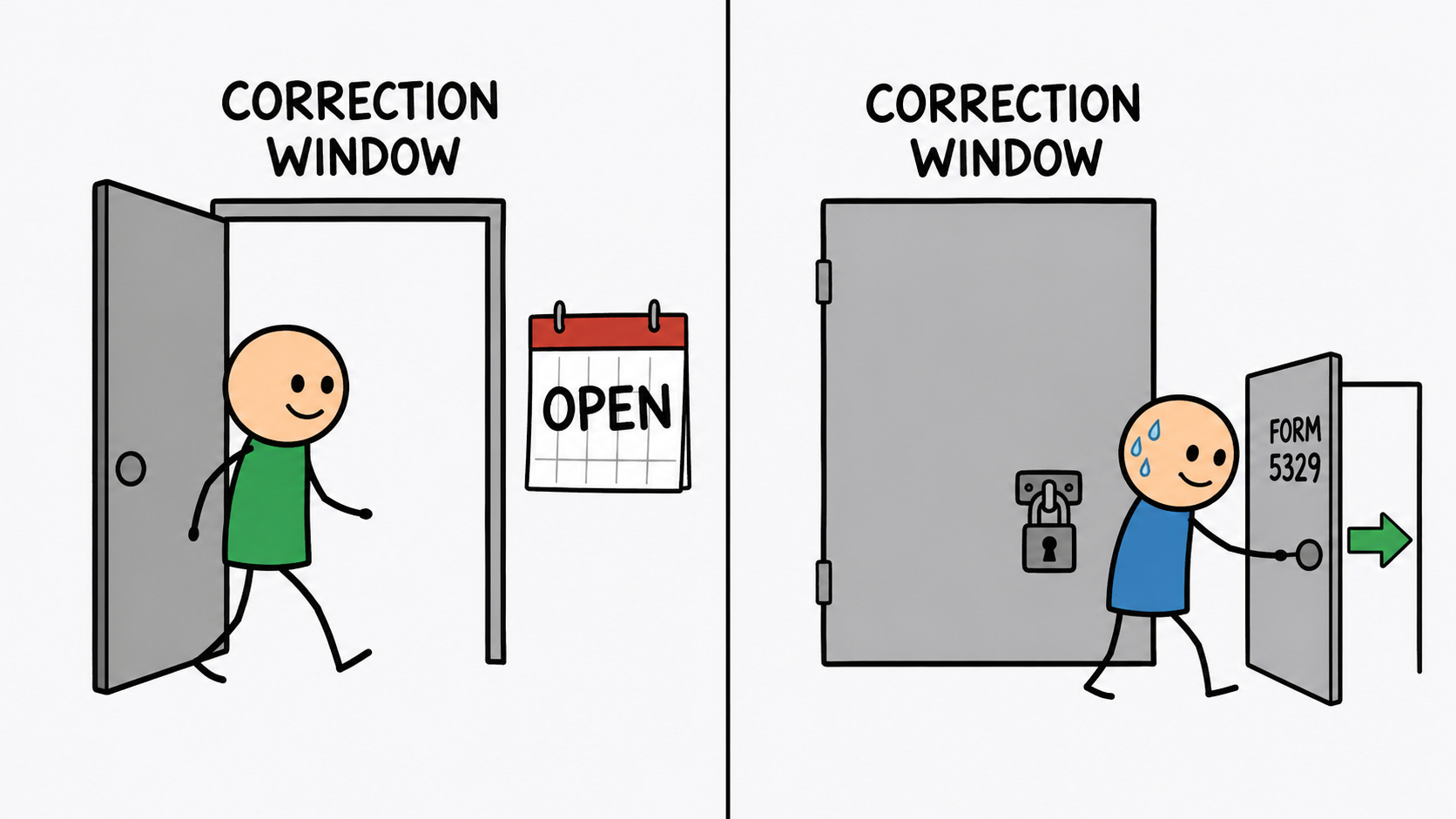
The tax code does something people rarely expect from it. It builds in second chances. Almost every IRA mistake comes with a correction window, a stretch of time when you can undo the worst part of the error before it becomes more expensive. The catch is that those windows do not all close on the same day, and the rules treat a missed deadline very differently depending on which mistake you made.
Most people discover this the hard way. You put money in a Roth, then realize your income was too high to allow it. You meant to roll a distribution into an IRA and the check sat on the kitchen counter too long. You turned the age that triggers required withdrawals and the withdrawal slipped your mind. The first instinct is to assume the mistake is now permanent, or that the IRS is about to treat you like a criminal. Neither is usually true. What happens next depends entirely on the calendar.
Start with the excess contribution, since it is the most common. If you contribute more than you are allowed, whether you exceeded the annual limit or were not eligible in the first place, you have a return of excess option. Withdraw the excess plus any earnings it generated by your tax filing deadline, including extensions, and the contribution is treated as if it never happened. The six percent excise tax never applies. The earnings come out as taxable income for the year of the contribution, but under current law the ten percent early distribution penalty does not apply to a timely corrective IRA distribution.
Miss that deadline and the math changes. The excess now triggers a six percent excise tax for that year, and that tax is not a one-time event. It applies again every year the excess sits in the account uncorrected. The fix after the deadline is actually simpler in one way, since you no longer calculate earnings and just remove the excess principal, but you have already paid six percent for at least one year. You can also absorb the excess by counting it as a future year’s contribution if you have room. Either way, waiting has a real and compounding cost.
Recharacterization runs on the same clock. If you contributed to a Roth and should have used a traditional IRA, or the reverse, you can recharacterize the contribution and the IRS treats it as if you made it to the correct account all along. The deadline is the tax return due date, including extensions. If a return was timely filed, a limited six-month amended-return procedure may also preserve the ability to fix the contribution. Miss it and the contribution stays where you put it. One limit worth knowing. You can recharacterize a contribution, but you cannot recharacterize a Roth conversion. That door closed years ago and does not reopen.
The sixty-day rollover window is the strictest of the group. When you take a distribution intending to roll it into another retirement account, you have sixty days from the day you receive the funds to finish the job. Miss it and the distribution becomes taxable to the extent it was not already taxed, plus a ten percent early distribution penalty if you are under fifty nine and a half and no exception applies. There is one escape hatch. The IRS allows a self-certification process for a waiver of the sixty-day rule if you missed it for a qualifying reason, such as a financial institution error, a death in the family, or a check that never got deposited. Self-certification is not automatic forgiveness, but it is a path that did not always exist.
Then there is the missed required minimum distribution. If you fail to take an RMD on time, the shortfall is subject to an excise tax. The penalty used to be brutal. It is now twenty five percent of the amount you should have withdrawn, and it drops to ten percent if you correct the shortfall within the correction window, which generally runs through the end of the second year after the miss. The IRS can waive the penalty for reasonable cause when the missed distribution is corrected and the explanation is properly reported on Form 5329. A missed RMD is annoying. It is rarely expensive if you act.
Picture someone who contributes the full amount to a Roth IRA in February, early and responsible. Over the summer their income climbs higher than expected, and by autumn it is clear they earned too much to contribute to a Roth at all. The October extension deadline passes before they notice. Their excess was a few thousand dollars, and the six percent excise tax for that year comes to a couple hundred dollars on Form 5329.
In December they withdraw the excess principal. Because the correction deadline already passed, they do not calculate or remove earnings. That single withdrawal stops the clock. The six percent applied once and does not apply again. The mistake cost them a couple hundred dollars and an extra form, not their account.
Missing a correction deadline rarely means what people assume it means. In most cases it does not erase your ability to fix the mistake. It changes the price, the paperwork, or the procedure. The return of excess becomes a plain withdrawal plus an excise tax. The recharacterization becomes a contribution you live with. The blown rollover becomes a taxable event unless a waiver applies. The missed RMD becomes a form and a request rather than a disaster.
What truly matters is knowing which window you are in. Calendar-year deadlines, like the year an RMD is due, are fixed. Tax-filing deadlines, like the return of excess and recharacterization windows, stretch to October if you filed on time or extended. Correction windows, like the reduced penalty period for a missed RMD, give you a longer runway at a higher but still survivable cost. The worst outcome is almost never the mistake itself. It is assuming nothing can be done and leaving the problem in place while the cost keeps adding up. The deadline you missed closed one door. There is almost always another one, and it tends to still be open.
I write one of these every day, one retirement rule, explained in plain language and verified against the source. The daily email is free: subscribe here.
Full archive, worksheets, and search live at RetirementNewsRundown.com.
Disclaimer This article is for educational and informational purposes only. It is not tax, legal, or financial advice and does not create an advisor–client relationship. Always consult appropriate professionals regarding your specific situation.