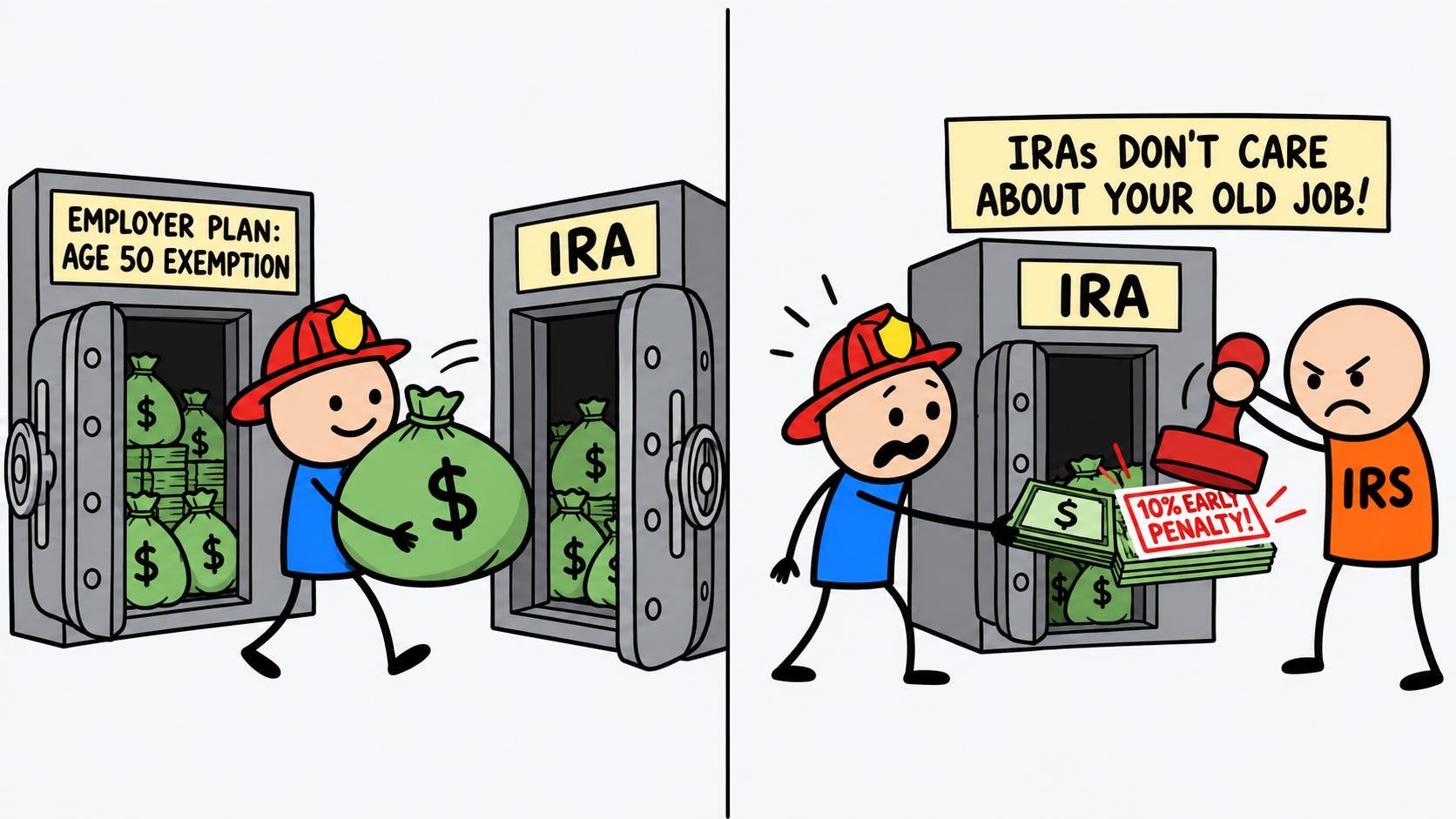
A fire captain retires at 51 with 28 years on the job and $340,000 sitting in his employer’s retirement plan. Everybody tells him the same thing, which is to roll it into an IRA. Better investment options, one account instead of three, simpler paperwork for his wife if anything happens to him. He does it in March.
In August the roof goes and his daughter gets engaged in the same fortnight, and he takes $30,000 out of the IRA. The following winter his tax bill includes a $3,000 early distribution penalty, because he is 52.
Had he taken that same $30,000 out of the plan he left, in March, before the rollover, the penalty would have been zero. The exception he qualified for belonged to the plan, and it did not travel with the money.
Most people know some version of the rule that says retirement money is locked until 59 and a half. Fewer know there is a separate door that opens at 55, and almost nobody outside the affected professions knows that for some workers it opens at 50.
Here is the general shape first. If you leave a job during or after the calendar year you turn 55, distributions from that employer’s plan escape the ten percent early distribution tax. The income tax still applies. Only the penalty goes away.
For public safety workers the age is 50 instead of 55. The core group is police, firefighters and emergency medical services employees of a state or one of its political subdivisions, covered by a governmental retirement plan. The covered list has been widened more than once, and now reaches specified federal law enforcement officers, corrections officers, customs and border protection officers, federal firefighters, private sector firefighters and air traffic controllers. Several of those additions are recent enough that plenty of people holding those jobs have never been told the rule applies to them. If your work sits anywhere near that description, the question of whether your particular position and plan qualify is worth putting to your plan administrator in writing rather than assuming either way.
There is also a service based alternative. Separating after 25 years of service under the plan can qualify even before you reach 50, with whichever milestone arrives first doing the work. The wrinkle is that 25 years of service under the plan is a plan defined measure, so what counts toward it belongs to your plan document rather than to a universal rule.
Now the part that decides everything, and the part the captain missed. What matters is the year you separated, and the account you separated from.
The separation date is fixed permanently on the day you walk out, and what it has to clear is whichever threshold arrives first for you. Walk out having met neither, and turning 50 later does nothing for that separation. Walk out at 49 with 26 years under the plan and the service test may have carried you already. Clear either one and there is no deadline at all on the distribution side. The money can sit in that plan for five years and the exception still holds when you finally take it.
The account is the other half. This exception applies to distributions from an employer plan. IRAs have no version of it. So the balance sitting in the plan you retired from carries a right that the identical dollars carry nowhere else. Once the money is in an IRA this exception no longer reaches it, and a withdrawal before 59 and a half would have to qualify under some other exception instead. Rolling it over is a decision about a tax rule, whether or not anyone frames it that way while they are helping you fill out the form.
Two mechanics worth expecting. A distribution from the plan is the kind that can be rolled over, so twenty percent gets withheld automatically and you cannot decline it. If the captain had taken $30,000 from the plan, about $24,000 would have reached him and the rest would have gone to withholding he could reconcile at filing. The penalty would still have been zero.
And the tax form can land either way. A payer who knows the exception applies may code the distribution as an early one with an exception attached. A payer who does not may code it as an early distribution with no known exception, which reports your age rather than ruling on your situation. Either way, this is an exception you can claim on your own return.
Put dates on the captain.
He separates on February 28, during the year he turns 51, which is comfortably after the year he turned 50. From that moment, distributions from his employer’s plan carry no ten percent for him, and that is true whether he takes money in March or nine years later.
Version one is what happened. He rolls the full $340,000 to an IRA on March 15. In August he takes $30,000. He owes ordinary income tax and $3,000 of penalty, and the $3,000 buys him nothing.
Version two, he leaves the balance where it is through the year. In August he takes $30,000 from the plan. Twenty percent is withheld, so about $24,000 lands and $6,000 goes to the government against a tax bill he settles in April. No penalty. The other $310,000 stays in the plan, still carrying the exception, available on the same terms whenever he needs it.
Version three is the one most people actually want. He splits it. He leaves enough in the plan to cover what he realistically expects to need before 59 and a half, and rolls the rest to the IRA for the investment options he was promised. The part he rolled would need some other exception to come out before 59 and a half. The part he left keeps this one. The only cost of getting this right is deciding the split before the paperwork goes in rather than after.
The thing worth carrying out of this is that a rollover looks like an administrative step and is sometimes a tax decision.
For somebody retiring in their fifties with a pension and a plan balance, the order of operations matters more than almost anything else in the first year. Leave first, then decide what moves, and decide it with the penalty rule in view.
Two facts settle your position. The calendar year you separated from that employer, which is fixed and unchangeable. And whether the money is still in that employer’s plan, which is the only part you still control. Everything else is detail.
If neither one lands in your favor, the other exceptions still exist, and our rollover IRA guide covers why some people deliberately leave money in an employer plan rather than moving all of it.
The unfairness people feel when they learn this late is fair enough. Nobody told them, the rollover paperwork had no warning on it, and the person helping with the transfer may not have known either. The rule is old, the list of who qualifies has grown, and the number of retirees who find out about it after the money has already moved is the reason it is worth reading about while the money is still where you left it.
I write one of these every day, one retirement rule, explained in plain language and verified against the source. The daily email is free: subscribe here.
Full archive, worksheets, and search live at RetirementNewsRundown.com.
Disclaimer
This article is for educational and informational purposes only. It is not tax, legal, or financial advice and does not create an advisor-client relationship. Always consult appropriate professionals regarding your specific situation.