A daughter arrives in February. Between the deductible, two weeks of leave that turned out to be unpaid, and a car that picked that month to need a transmission, her parents are $12,000 short by April.
He is 34. He calls his 401(k) provider and is told the plan does not offer withdrawals for having a baby, though he qualifies for a distribution on other grounds. He takes $12,000. The following January a Form 1099-R arrives coded as an early distribution with no known exception, so he pays the ten percent on all of it, $1,200, and files.
About $500 of that was never owed, and the reason is that the plan was answering a different question than the one he was asking.
There is an exception to the ten percent early distribution tax for money taken because a child was born or an adoption was finalized. It comes in three pieces, and each one is where somebody loses it.
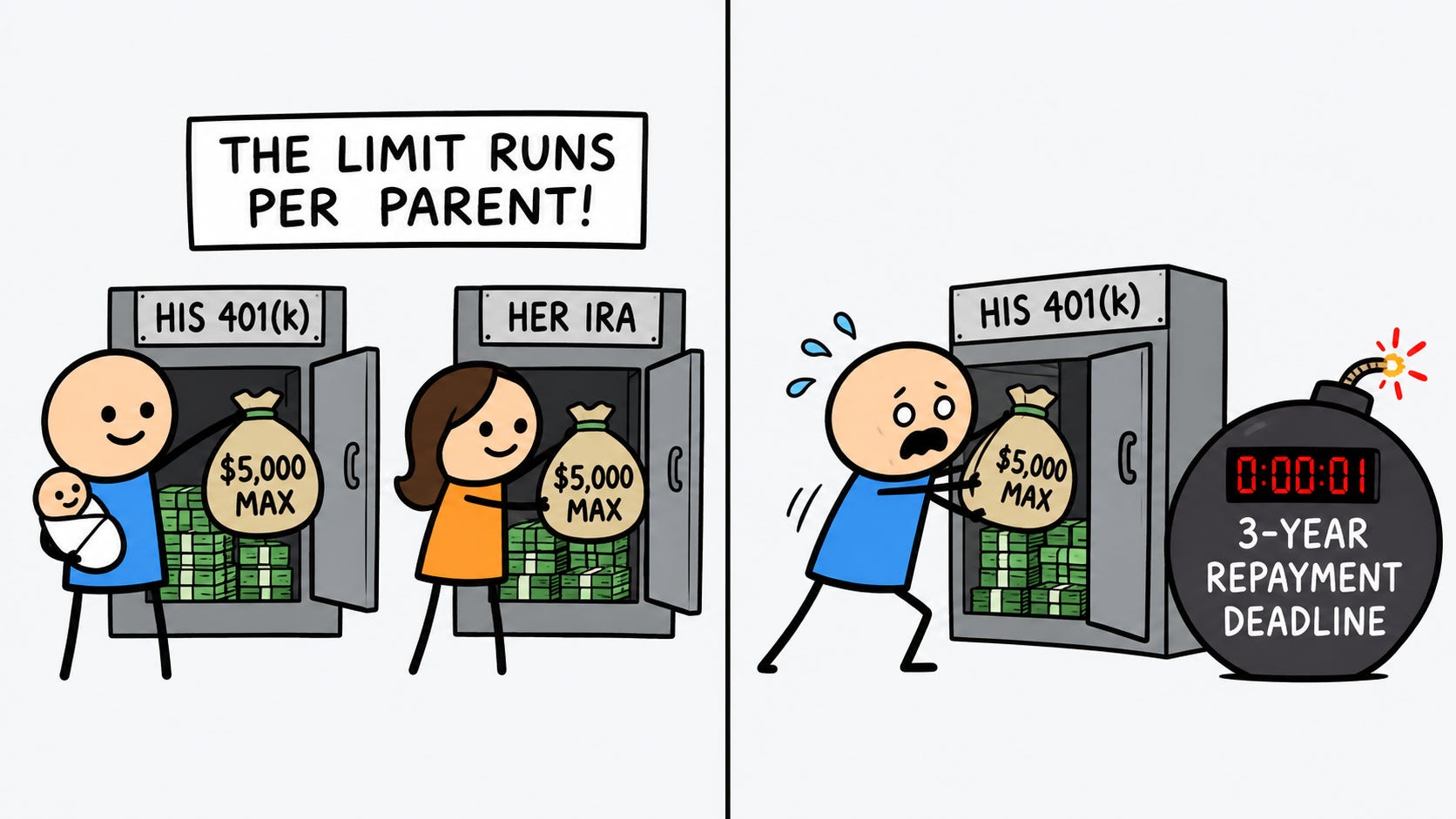
The first piece is the size and the shape. The cap is $5,000 per taxpayer, and it runs per child rather than per birth, so both parents get their own $5,000 for the same baby and twins support $5,000 apiece for each parent. The catch inside that structure is that the limit belongs to the person taking the money. One parent cannot pull $10,000 out of one 401(k) and claim both shares. Her $5,000 has to come from an account that is hers.
The second piece is the clock, and it is a rolling one rather than a tax year. The distribution has to happen within the one year period beginning the day the child is born or the day the adoption is finalized. A baby born in November gives you until the following November, which straddles two filing seasons and confuses people accordingly. Take the money after that year closes and it is an ordinary early distribution with nothing to claim. There is no late election and no form that reopens it.
The third piece is the one that cost the man above his $500. Whether your plan offers this as a reason to hand you money is a separate question from whether you can claim the exception. Plans may add birth and adoption as a distributable event and many have skipped it. But if you get money out by some other permissible route, or take it from an IRA where the question of permission never arises, you can treat it as a qualified birth or adoption distribution on your own return.
The form will still say otherwise, and this trips people badly. IRS reporting rules direct the payer to use the early distribution code even when the payer knows the money went out for a birth or an adoption. A 1099-R showing an early distribution with no known exception is doing what it was told to do. You claim the exception yourself, on Form 5329. And if you already filed and paid the ten percent because you believed the form, an amended return can generally recover it while the refund window is open.
You also put the child’s name, age and taxpayer identification number on your return for the year of the distribution. For a newborn that number usually arrives within a few weeks of the hospital paperwork. For an adoption, getting the child a usable number is its own timeline and worth knowing about early.
Income tax still applies in full. The exception removes the ten percent and leaves everything else alone, so pre-tax money taken this way is ordinary income in the year you take it. Where the plan itself processes the withdrawal as a birth or adoption distribution, it escapes the automatic twenty percent and defaults to ten, with the right to elect a different rate. Where the plan pays you under some other provision and you claim the exception later, the withholding follows whatever the plan thought it was paying.
Then there is the part almost nobody knows about. You can put it back. The repayment window runs three years beginning the day after you receive the distribution, and a repayment is treated as a rollover, which means the income comes back out. Repay inside that window and you have effectively borrowed from your own retirement account with no interest and no loan paperwork. Let the three years pass and the money simply stays taxed, permanently, with no way to undo it.
The repayment can go to any eligible retirement plan that accepts rollover contributions and that you have a right to, so an IRA is usually available even when the original plan would rather not deal with it. Timing drives the paperwork. Repay in the same year you took the money and it all lands on one return. Repay in a later year and you amend the return for the year of the distribution, lowering that year’s income by what you put back.
Take the same family and change only which accounts the money comes from.
He needs $12,000 in April, two months after the birth and comfortably inside the one year window. He takes $5,000 from his 401(k), his wife takes $5,000 from her IRA where no plan permission arises, and a credit union loan covers the last $2,000.
Their return lists their daughter’s name, age and Social Security number, and claims the exception on both withdrawals. Ten thousand dollars is ordinary income at their bracket with no ten percent attached. His original approach would have protected $5,000 of the $12,000 and exposed the other $7,000 to $700 of penalty.
Two years later a bonus lets them repay the $10,000 inside the three year window. Because it lands in a later year, they amend the return for the year of the birth and lower that year’s income by what they put back. Past three years, the $10,000 stays taxable from the year of the birth and the accounts stay permanently smaller.
What matters is knowing the exception exists before the money moves, because almost everything about it is decided at that moment.
The size is fixed and modest. Five thousand dollars apiece will not cover a hard year, and treating it as the whole answer leads people to take more than qualifies and assume all of it is protected. Knowing where the line sits lets you pull the protected part from the right accounts and solve the rest elsewhere.
The clock is the thing to write down. One year from the birth or from the day the adoption is final, then three years from the day after the money lands if you want the option of putting it back. Neither of those is your tax filing deadline.
And the form is not the last word on any of it. Our 401(k) guide covers which withdrawal types a plan has to opt into and how in-service distributions work, which is the part that decides whether the money can come out of a plan at all.
New parents get a lot of advice about retirement accounts, most of it some version of do not touch them. That advice is mostly right, and it is also why this exception goes unused by the people it was written for. The money is still yours, the tax still applies, and for one year there is a door that closes on schedule whether or not anyone told you it was there.
I write one of these every day, one retirement rule, explained in plain language and verified against the source. The daily email is free: subscribe here.
Full archive, worksheets, and search live at RetirementNewsRundown.com.
Disclaimer
This article is for educational and informational purposes only. It is not tax, legal, or financial advice and does not create an advisor-client relationship. Always consult appropriate professionals regarding your specific situation.