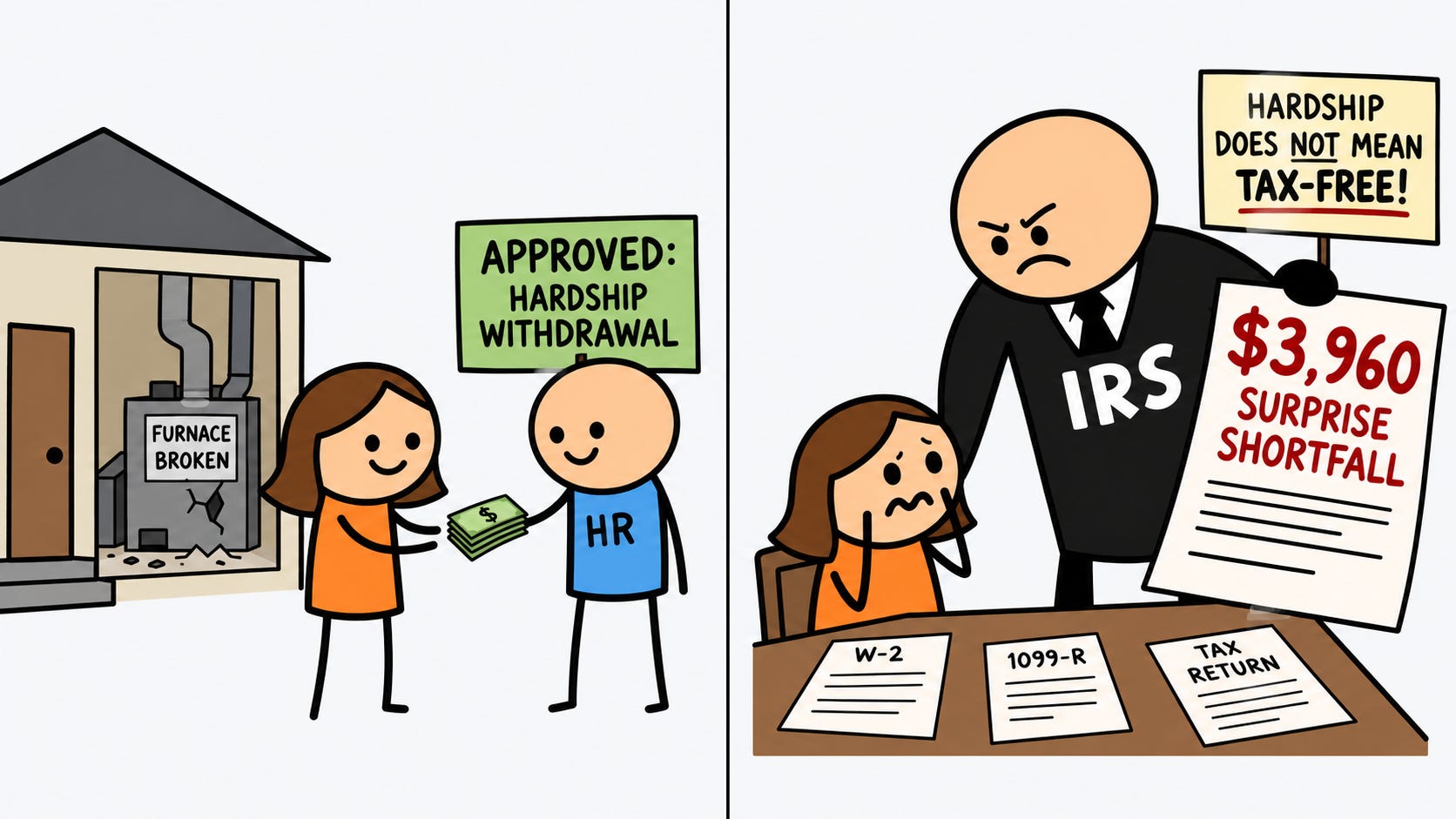
A woman who is 47 falls three payments behind on her mortgage after a slow year. The lender sends a notice with the word foreclosure in it. She needs $18,000 to bring the loan current, she has $61,000 in her 401(k), and her plan allows hardship withdrawals.
The paperwork takes a day. She certifies the need herself, the plan approves it, and the money moves. Federal withholding comes out at ten percent, so $1,800 is held back and $16,200 arrives in her account. She sends the lender $18,000, covering the last $1,800 with a credit card.
The following April she owes roughly $3,960 more on money she spent in October.
The gap between what she took and what it cost comes from three separate rules, and each one is easy to miss on its own.
Start with what a hardship withdrawal is for. A plan may allow one when you have an immediate and heavy financial need, and the rules list situations that automatically count: certain medical expenses, the cost of buying a principal residence, tuition and related educational fees, payments that prevent eviction from your principal residence or foreclosure on the mortgage on it, funeral expenses, repairs to your home from a casualty, and losses from a federally declared disaster where you live or work. That list is what most plans use, and it is narrower than it sounds. A property tax foreclosure is a different thing from a mortgage foreclosure, and a furnace that dies of old age is a different thing from casualty damage. A plan is permitted to write a broader standard, and it is also permitted to offer no hardship withdrawals at all, so the plan document decides what your particular emergency counts as.
The amount is capped at your actual need. That sounds restrictive and is actually the door to the thing most people walk past, because the need is allowed to include the federal, state and local taxes and penalties the withdrawal itself will reasonably generate. She needed $18,000 to hand the lender. She could have requested enough to cover the $18,000 plus the tax bill the $18,000 would create, and the rules would have permitted it. Nobody at the plan is obligated to suggest this. You have to ask.
The second rule is the one that does the real damage. A hardship withdrawal carries ordinary income tax, and if you are under 59 and a half it also carries the ten percent additional tax on early distributions. Hardship itself is not on the list of things that waive that ten percent. Having a genuine emergency, certifying it honestly, and getting plan approval changes nothing about the penalty. The list of waivers is a separate list.
That separate list is worth reading anyway, because a couple of items on it overlap with hardship reasons. One waiver covers distributions up to the amount of your qualifying unreimbursed medical expenses that exceed seven and a half percent of your adjusted gross income, and it applies whether or not you itemize. Medical expenses are also a hardship category, so somebody taking a hardship withdrawal for a large medical bill can land on both lists at once. Leaving a job during or after the calendar year you turn 55 is another waiver, and it has nothing to do with hardship. The waiver travels with the reason, never with the hardship label.
Then there is the withholding, which is the reason April surprises people. Money you take from a plan and could have rolled over gets twenty percent withheld automatically and you cannot decline it. A hardship withdrawal cannot be rolled over at all, which puts it in a different category with a ten percent default and the right to elect any rate you want on Form W-4R, from nothing up to everything. Lighter withholding on a distribution that is taxed the same way means the bill simply arrives later, at filing, with the penalty attached.
Run her numbers. In a 22 percent bracket, $18,000 produces about $3,960 of federal income tax and $1,800 of early distribution tax, which is $5,760 before her state takes anything. She had $1,800 withheld. The remaining $3,960 comes due when she files.
And the money is gone permanently. A hardship withdrawal cannot be repaid to the plan and cannot be rolled into an IRA later, even if her situation turns around in a month. There is no correction window, no deadline to hit, no later filing that undoes it. The only timing lever that exists is which tax year it falls in, because the distribution is taxed in the year you receive it. Taking it in late December rather than early January accelerates the entire bill by a full year.
Keep her at $18,000 of need and change only what she asked for.
Version one is what happened. She requests $18,000, receives $16,200, and puts $1,800 on a credit card in October. In April she owes $3,960. Her total cost is $18,000 of retirement money, $5,760 of tax and penalty, and five months of card interest.
Version two, she asks for enough to cover the need and the federal tax the withdrawal will create. Between the 22 percent bracket and the ten percent additional tax, roughly 32 cents of every dollar is going to the government, so she needs the $18,000 to survive a 32 percent haircut. That means asking for about $26,500 rather than $24,000, which is the number most people guess at.
At $26,500, the default ten percent withholding takes $2,650 and about $23,850 reaches her. She sends the lender $18,000 and sets aside the remaining $5,850. At filing, $26,500 produces roughly $5,830 of income tax and $2,650 of early distribution tax, which is $8,480 against the $2,650 already withheld, leaving about $5,830 due. The money she set aside covers it almost exactly.
She could also skip the setting-aside entirely by electing about 32 percent withholding on the form instead of accepting the ten percent default, which sends the tax straight to the government and hands her close to the $18,000 she actually needs. Same arithmetic, less temptation in between.
Version two pulls $8,500 more out of her retirement account, permanently, and that is a real cost. What it buys is an April with no surprise in it. Neither version avoids the ten percent, because neither version has a reason on the waiver list.
The thing to settle before taking a hardship withdrawal is what it costs you after tax. Self certification made qualifying the easy part, and the cost is the part that stays hard, though the number is knowable in advance.
Three questions get you there. What bracket does this land in on top of your other income for the year. Does your reason appear anywhere on the list of things that waive the ten percent, which is a different list from the one that qualifies you. And what does the request have to be, grossed up, for the money you actually need to survive the tax.
The answers can also point away from a withdrawal. A plan loan is taxed at nothing so long as it is repaid, and the cost of carrying one is interest paid back into your own account. It comes with its own trap, since leaving the job can turn the balance into a taxable distribution, but for somebody staying put it is a different shape of decision. Some plans also allow a small emergency distribution once a year that can be repaid, which is worth asking about before reaching for a hardship. The hardship section of our 401(k) guide lays out how plans handle each of these and what paperwork each one takes.
What makes hardship withdrawals expensive is rarely the decision itself. Sometimes there is no better option and the lender has to be paid. It is that people request the number they need, spend all of it, and meet the rest of the bill six months later with no plan for it.
I write one of these every day, one retirement rule, explained in plain language and verified against the source. The daily email is free: subscribe here.
Full archive, worksheets, and search live at RetirementNewsRundown.com.
Disclaimer
This article is for educational and informational purposes only. It is not tax, legal, or financial advice and does not create an advisor-client relationship. Always consult appropriate professionals regarding your specific situation.