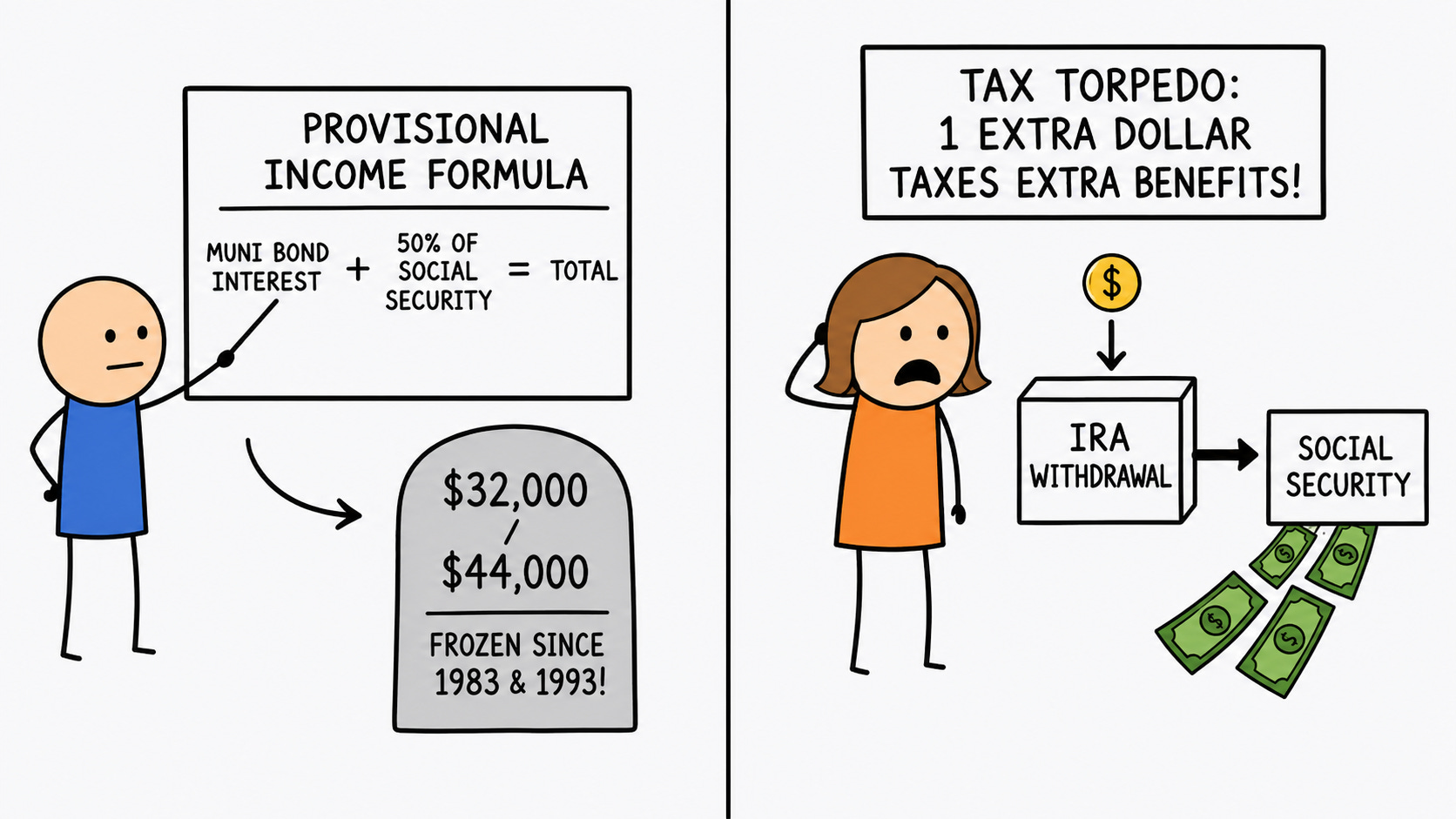
Social Security benefits were not taxable at all until the mid 1980s. Then a formula was added to tax a portion of them for people above certain income levels, and a second tier was added a decade later. The thresholds written into that formula were never indexed to inflation. Many major tax brackets, deductions, and retirement limits move upward over time with inflation. These four numbers do not. They sit exactly where Congress set them decades ago.
That single design choice explains most of what confuses people about this subject. A rule built to reach a small minority of retirees now reaches a large share of them, and it got there without Congress ever voting to expand it. Meanwhile a widespread belief has taken hold that Social Security is no longer taxed at all, which is not what happened.
The calculation starts with a figure that does not appear on any tax form. Call it provisional income, which is what most people call it, though the instructions use combined income. For most taxpayers, the calculation is adjusted gross income before Social Security, plus tax exempt interest, plus one half of Social Security benefits. The IRS worksheets contain a few additional adjustments for less common exclusions, but that three part formula covers the ordinary retirement income case.
That middle term catches people. Municipal bond interest is exempt from income tax and is added back here anyway. Someone who bought municipal bonds specifically to keep income low is still counting every dollar of that interest for this purpose.
Compare the result to the base amounts for your filing status. For single filers, head of household, and qualifying surviving spouse, the first threshold is $25,000 and the second is $34,000. For married filing jointly, the first is $32,000 and the second is $44,000. Someone married filing separately who lived apart from their spouse for the entire year uses the single amounts. Someone married filing separately who lived with their spouse at any point during the year has a base amount of zero. There is effectively no tax free combined income threshold before the taxable benefit calculation begins, and up to 85% of benefits can ultimately be included.
Below the first threshold, none of the benefit is included in income. Between the first and second, up to 50% of the benefit can be included. Above the second, up to 85% can be included, computed as a percentage of the excess above that threshold plus a carried amount from the lower tier, capped at 85% of the total benefit.
Here is the part that gets misread more than anything else in this area. The 50% and the 85% are not tax rates. They are caps on how much of the benefit gets counted as income. At worst, 85 cents of every benefit dollar becomes taxable income, and then your ordinary tax rate applies to that. Nobody pays 85% tax on their Social Security, and a great many people believe they do.
Because the thresholds do not move, the population above them grows every year through two separate mechanisms. Cost of living increases raise the benefit, which raises half the benefit, which raises provisional income. And ordinary inflation raises everything else in the formula at the same time. Someone whose real circumstances have not changed in a decade can cross a line simply by standing still.
Several income sources stay outside the calculation entirely. Qualified distributions from a Roth IRA are not included in gross income, so they never enter adjusted gross income and never touch provisional income. A qualified charitable distribution is excluded from income rather than deducted, so it does not enter the formula either, which is a large part of why the mechanic exists. A return of basis is not income. Distributions from a health savings account used for qualified expenses are not income.
That creates an effect worth understanding. In the range where benefits are phasing into taxation, an additional dollar of ordinary income does not add one dollar to taxable income. It adds that dollar plus whatever additional portion of the benefit it drags in behind it. The effective rate on that marginal dollar is higher than the bracket the person believes they are in, sometimes considerably.
One current point of confusion needs addressing directly. A separate deduction for eligible taxpayers age 65 and older was enacted beginning in 2025. As originally enacted, it applies through 2028, and it has been widely described as ending the tax on Social Security. It did not. The deduction reduces taxable income separately. It did not change the provisional income formula, move the Social Security thresholds, or change how much of a benefit is included in income.
Consider a married couple filing jointly. They receive $36,000 in Social Security benefits, withdraw $20,000 from a traditional IRA, and collect $6,000 of municipal bond interest they had assumed was invisible for tax purposes.
Provisional income is $20,000 of IRA withdrawals, plus $6,000 of tax exempt interest, plus $18,000 representing half of their benefits. That totals $44,000, exactly the second threshold.
Had the municipal interest genuinely been invisible, their provisional income would have been $38,000. At that level, about $3,000 of their Social Security would be taxable under the lower phase in. Adding the $6,000 of municipal interest pushes provisional income to $44,000 and raises the taxable benefit to about $6,000. The bond interest itself is still tax free. It caused more of something else to become taxable.
Now suppose they need another $2,000 late in the year and take it from the IRA. Provisional income rises to $46,000, crossing into the 85% phase in range. That $2,000 withdrawal brings roughly another $1,700 of Social Security into taxable income, so taxable income rises by about $3,700 rather than merely $2,000. Their tax bracket did not change. What changed is how much income the bracket applies to.
The useful frame is that provisional income is a separate measurement from taxable income, computed on its own terms, and it decides a question before your tax rate is ever consulted. Two people with identical benefits and identical bracket can owe very different amounts, because one of them has income that enters the formula and the other does not.
That also explains why the composition of retirement income matters here and not just the total. Taxable traditional account withdrawals, taxable pension income, ordinary interest, and even tax exempt municipal bond interest can enter the calculation. Qualified Roth distributions, qualified charitable distributions, qualified HSA distributions, and returns of basis generally do not increase it. A person deciding which account to draw from is deciding, at the same time, whether the withdrawal will affect how much of their benefit is counted.
Anyone weighing how before tax and Roth balances behave differently in retirement can work through the comparison with the Roth versus traditional tool, and anyone projecting how withdrawals interact with brackets and Medicare surcharges across future years can map it with the RMD and Roth conversion planner.
Where you stand comes down to four numbers that have not changed in decades, and a formula that counts income the rest of the tax code agrees to ignore.
I write one of these every day, one retirement rule, explained in plain language and verified against the source. The daily email is free: subscribe here.
Full archive, worksheets, and search live at RetirementNewsRundown.com.
Disclaimer
This article is for educational and informational purposes only. It is not tax, legal, or financial advice and does not create an advisor–client relationship. Always consult appropriate professionals regarding your specific situation.