For most of the history of these accounts the division was clean. Employee money could go in either flavor, before tax or Roth. Employer money went in one way only, before tax, and came out taxable decades later. Anyone explaining a workplace plan could rely on that split.
SECURE 2.0 removed it. Employer contributions can now be Roth, in the plans and accounts that choose to allow it. For someone employed by a company, that is a preference to consider once. For a self-employed person, it is a stranger question, because the employer making the contribution and the person paying tax on it are the same human being.
There is a practical caveat worth knowing before any of the rules matter. A provision existing in law is not the same as a provision you can actually use. Adoption of Roth SEP contributions among custodians has been limited, and many large providers still do not offer it. For a lot of people reading this, the first answer will be that their institution does not support it yet, which makes the rest of the decision academic until it does.
There are two separate provisions here and they get blurred together constantly. One allows a SEP or a SIMPLE IRA to accept designated Roth contributions. The other allows a 401(k), a 403(b), or a governmental 457(b) to let a participant elect that employer matching and nonelective contributions be treated as designated Roth. They arrived in the same law, and they are reported and taxed differently.
Both are optional in the same way. The plan or arrangement has to offer the feature, and no sponsor is required to amend anything to provide it. In practice the binding constraint is the custodian rather than the statute. Supporting Roth employer contributions requires new elections, new tracking, and new reporting, and many providers have not built it. Someone who wants this has to ask the institution directly and get a straight answer, because the account application will not always make the absence obvious.
Where an election is available, it comes with conditions. Only amounts the participant is fully vested in can be designated Roth. If the participant is only partially vested in that category of contribution, none of it can be designated Roth. In a one participant plan this rarely bites, because the owner is generally fully vested in everything, but the rule is there. The election must be available at least once per plan year, and the designation applies to the contribution once it is made.
The tax consequence is unusual, because Roth treatment does not simply turn an employer contribution into an ordinary nondeductible personal Roth IRA contribution. The employer contribution remains subject to the normal employer contribution and deduction rules, while the Roth designation causes the amount to be included in the participant’s gross income. For a self-employed owner, the employer and the participant are the same person, so both sides of that treatment can appear on the same tax return.
The timing of that income inclusion follows the contribution rather than the plan year it is credited to, and it differs between the two doors. For a 401(k), the amount is income in the year it is actually allocated to the participant’s account, even where it is treated as an employer contribution for the prior year. For a SEP or SIMPLE, it is income in the year the contribution is actually made to the Roth IRA, even where it is treated as made for the employer’s prior tax year. So an employer contribution funded in September for the previous year produces income in the current year.
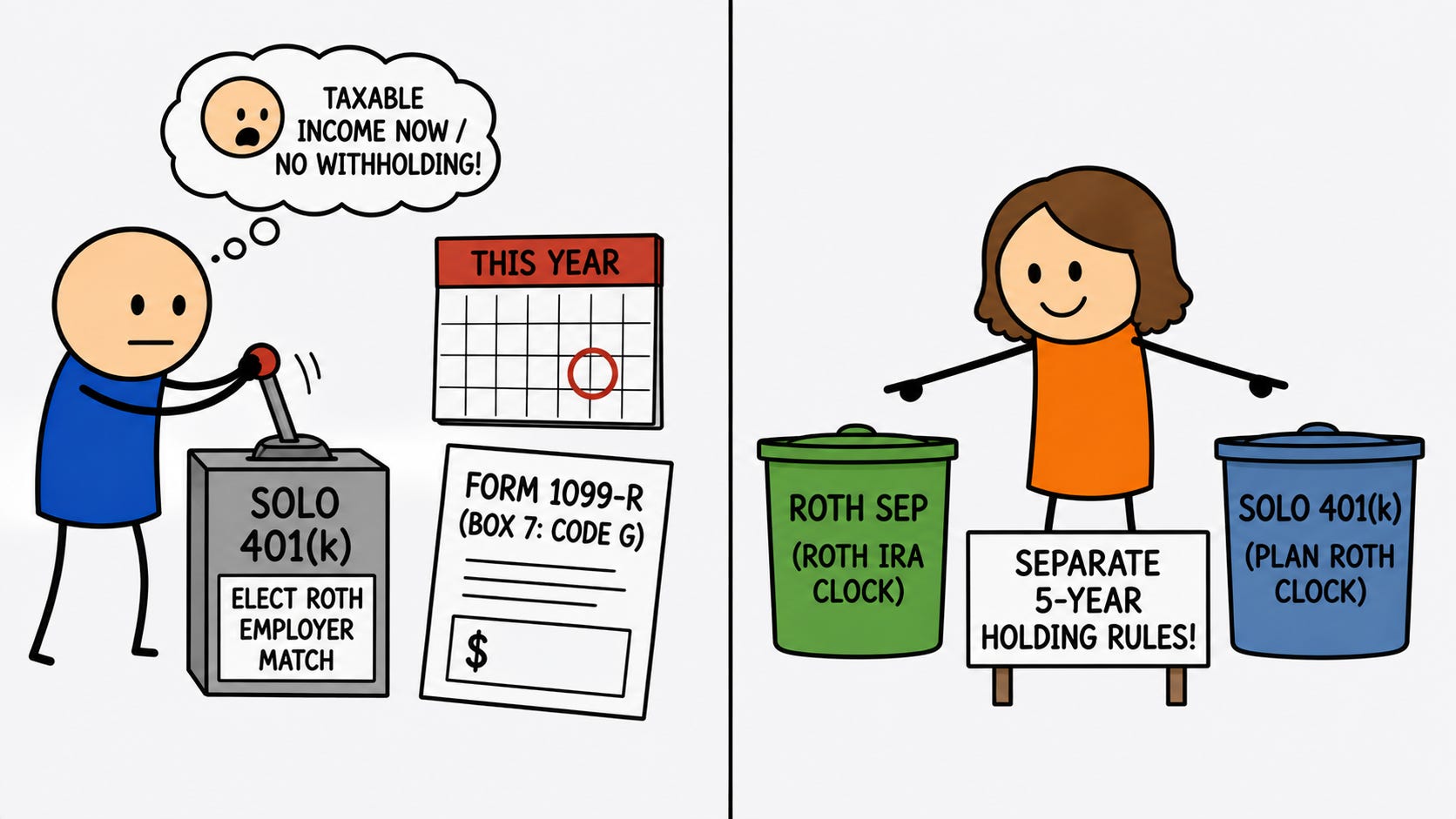
For Roth SEP employer contributions and designated Roth employer contributions to a 401(k), the amount is not subject to federal income tax withholding, Social Security or Medicare tax, or FUTA. The taxable income therefore arrives without withholding against it, which can make estimated tax payments or other withholding adjustments important.
Reporting depends on which Roth door was used. A designated Roth matching or nonelective contribution inside a 401(k) is reported on Form 1099-R for the year it is allocated, with the amount in boxes 1 and 2a and code G in box 7. That reporting mirrors an in plan Roth rollover even though no cash was handed to the participant, which is why the direct rollover code shows up on money that never moved anywhere.
Roth SEP and Roth SIMPLE employer contributions use different reporting. They are reported on Form 1099-R for the year the contribution is actually made to the Roth IRA, with the amount in boxes 1 and 2a, code 2 or 7 in box 7, and the IRA, SEP, and SIMPLE checkbox marked. Anyone who has learned to read that checkbox as a signal for which rulebook applies will find it doing exactly that job here.
For a SEP specifically, the whole conversation is an employer contribution conversation. A SEP has no salary reduction feature outside grandfathered SARSEP arrangements, so there is no employee deferral to make Roth. A solo 401(k) has both doors: the elective deferral, which has been available as designated Roth for years, and now the employer contribution, which is new.
The distinction that catches people later is which Roth regime the money lands under. A Roth SEP or Roth SIMPLE is a Roth IRA and follows the Roth IRA distribution rules, including the Roth IRA five year period that may already have started with an earlier Roth IRA contribution. Roth employer contributions inside a 401(k) land in a designated Roth account within the plan, which generally uses its own five taxable year participation period. These are different Roth systems even though both ultimately can produce tax free qualified distributions.
Consider the sole proprietor with roughly $18,587 of allowable employer contribution on $100,000 of net profit.
Made the ordinary way, that contribution is deducted on Schedule 1 as an adjustment to income, nothing is included in his income now, and everything that comes out decades later is ordinary income to him.
Designated Roth, the picture is more complicated than a simple swap. The employer side of the contribution remains subject to the normal employer contribution and deduction rules. The Roth designation separately causes the same $18,587 to be included in his gross income as the participant. Because he occupies both roles, both consequences land on one return. No withholding is applied to the income inclusion, so his estimated payments during the year needed to account for income that never appeared in a paycheck. In January a Form 1099-R arrives reporting $18,587 in boxes 1 and 2a, with code 2 or 7 and the IRA, SEP, and SIMPLE checkbox marked, describing a distribution he never received.
The important thing that description shows is what this is not. It is not the same as making a nondeductible personal Roth IRA contribution, and the employer side does not simply vanish because the participant side became taxable. The interaction is novel enough that anyone actually doing it has good reason to have a preparer walk through how both sides land on the return before the money moves.
Now consider timing. Suppose he extends his return and funds the prior year SEP in September, electing Roth treatment. The contribution counts for the prior year for plan purposes. The income inclusion lands in the current year, because that is when the contribution was actually made to the Roth IRA. Someone planning around a specific year’s taxable income can be surprised by that split.
The practical version of all this is short, and it runs in an order that surprises people. Ask the custodian first, not last. Whether the plan document or SEP arrangement permits Roth employer contributions is a real question, but it is the second one, because a permitted feature nobody administers is not available. A solo 401(k) at a provider that supports designated Roth employer contributions can put the same choice in reach for someone whose SEP custodian does not offer it, which is a structural difference rather than a preference.
If the feature is available, the mechanics are settled. The amount is included in income in the year the contribution is actually made or allocated, nothing is withheld against it, a Form 1099-R arrives reporting a distribution that never happened, and the money grows under whichever Roth regime it landed in.
Anyone comparing how before tax and Roth treatment behave over time for their own situation can work through it with the Roth versus traditional comparison, and anyone still choosing between plan structures can see how the options differ with the small business retirement plan selector.
Where you stand comes down to a question that did not exist a few years ago. The employer half of your own contribution now has a flavor, and for a self-employed person, both halves of that decision are yours.
I write one of these every day, one retirement rule, explained in plain language and verified against the source. The daily email is free: subscribe here.
Full archive, worksheets, and search live at RetirementNewsRundown.com.
Disclaimer
This article is for educational and informational purposes only. It is not tax, legal, or financial advice and does not create an advisor–client relationship. Always consult appropriate professionals regarding your specific situation.