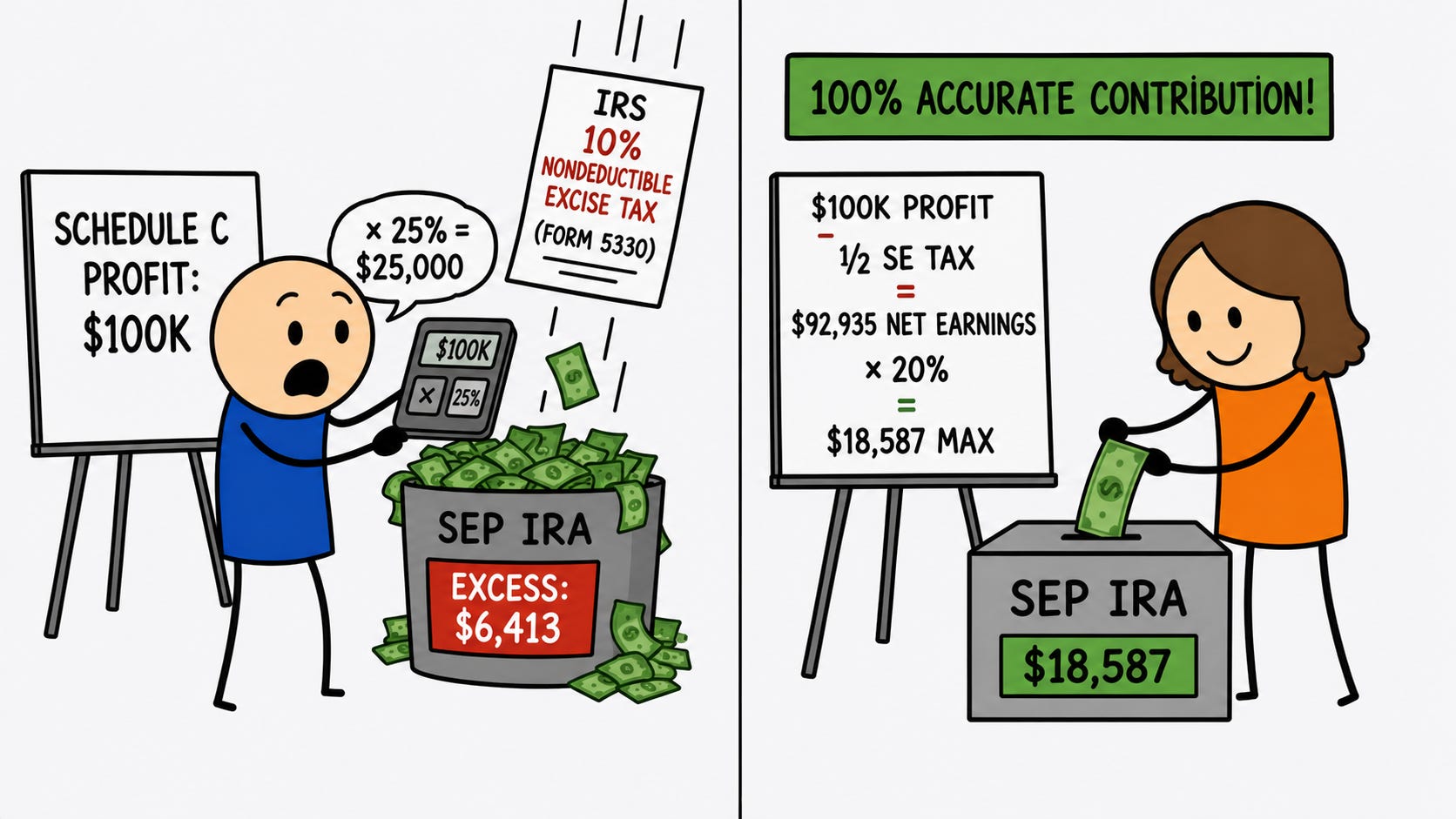
Every description of a SEP says the same thing. You can contribute up to 25% of compensation. A business owner reads that, looks at the profit on his Schedule C, multiplies by a quarter, and funds the account with the result. The sentence he read was accurate. The number he just contributed is too high, often by thousands, and he will not learn that until a preparer runs the worksheet in March or a letter arrives much later.
The reason is that “25% of compensation” is a clean instruction for an employee and an incomplete one for the owner. An employee has compensation printed on a W-2 before anyone decides what to contribute. A self-employed owner does not. His compensation depends on the contribution, and the contribution depends on his compensation, so the number cannot simply be read off a tax form.
Start with the straightforward half. For a common law employee, the employer may contribute up to 25% of that employee’s compensation, subject to the overall ceiling on annual additions and to the cap on how much compensation can be counted. Both of those figures are indexed and change with inflation, but the mechanics do not. Twenty-five percent of a known number, bounded above.
For the owner, compensation means net earnings from self-employment, and net earnings are computed after subtracting two things. One is the deductible portion of self-employment tax. The other is the plan contribution itself. That second subtraction is what creates the problem, because the contribution now appears on both sides of the equation. The IRS describes this plainly as a circular calculation, and the fix is to convert the plan rate into a reduced rate that already accounts for the loop.
The conversion is simple arithmetic. Divide the plan rate by one plus the plan rate. A 10% plan rate becomes 9.0909%. A 25% plan rate becomes 20%. That is where the familiar shorthand comes from, and it is correct as far as it goes.
Where people go wrong is what the 20% gets applied to. It is not Schedule C profit. It is net earnings, which means profit reduced by the deductible half of self-employment tax first. Getting to that figure takes its own small chain. Net profit is multiplied by 92.35% to reach the self-employment tax base. Self-employment tax generally runs at 15.3% on that base until the applicable Social Security wage limit is reached, with the 2.9% Medicare portion continuing above that point. Wages from another job can also use up part of the Social Security wage base, so the exact deduction can differ for someone who has both wages and self-employment income. Half of the resulting tax is deductible, and subtracting that half from net profit produces the earnings figure the 20% actually multiplies.
Two ceilings sit above all of this. Annual additions to the account cannot exceed the lesser of the annual dollar limit or 100% of compensation, and compensation above the annual cap does not count toward the calculation at all. Someone with very high earnings hits the dollar ceiling long before the percentage becomes the binding constraint.
There is a detail about where the deduction goes that changes what the contribution is worth. Sole proprietors and partners deduct their own contribution on Schedule 1, on the line for self employed SEP, SIMPLE, and qualified plans. It does not go on Schedule C. That placement matters because self-employment tax was already computed on Schedule SE using the business profit, before this adjustment appears. A SEP contribution therefore reduces income tax and does not reduce self-employment tax. People who expect it to do both are disappointed in April.
S corporations follow a different rule entirely, and it catches owners who structured the business specifically to reduce payroll. Distributions received as an S corporation shareholder do not constitute earned income for retirement plan purposes. A shareholder employee’s contribution is based on Form W-2 compensation. So an owner who pays himself a modest salary and takes the rest as distributions has, without intending to, capped what his own SEP can hold.
Contributing more than the legal SEP limit creates an excess employer contribution and can trigger more than one tax consequence if it is not corrected. An amount left in the SEP-IRA past the applicable correction period can create the 6% IRA excess contribution tax, and the employer may also face the 10% excise tax on nondeductible employer contributions. IRS SEP correction guidance generally calls for the excess, adjusted for earnings, to be distributed from the SEP-IRA and returned to the employer. The correction is therefore more than simply treating the excess like an ordinary personal IRA overcontribution.
Consider a sole proprietor with $100,000 of net profit on Schedule C, using a SEP with a 25% plan rate. Assume he has no other wages using up part of the Social Security wage base and that the entire self-employment tax base falls below that year’s Social Security limit.
The wrong path takes four seconds. Twenty-five percent of $100,000 is $25,000, and that is what gets contributed.
The right path takes a few more steps. Multiply $100,000 by 92.35% to get $92,350, the self-employment tax base. Self-employment tax at 15.3% on that base is about $14,130. Half of that, roughly $7,065, is the deductible portion. Subtract it from the $100,000 of profit and net earnings come to about $92,935. Apply the reduced rate of 20% and the maximum contribution is roughly $18,587.
The gap between the two paths is about $6,413. That is not a rounding difference. It is a SEP employer contribution above the allowable limit and needs to be corrected under the applicable SEP rules. If it is left unresolved, the participant level 6% excess contribution tax and the employer side nondeductible contribution rules can both become relevant.
Now consider an S corporation owner who pays herself $60,000 in W-2 wages and takes $90,000 in distributions. Her instinct is that the business produced $150,000, so a quarter of that is available. It is not. The distributions are not earned income for plan purposes. Her employer contribution runs on the $60,000 of wages, which puts the ceiling at $15,000. The salary decision she made for payroll tax reasons set her retirement contribution ceiling at the same time.
The useful way to hold the whole thing is that the 25% figure describes what the plan says, not what an owner can personally contribute. For anyone taking a paycheck, 25% of that paycheck is the answer. For a sole proprietor or partner, the working number is 20% of net earnings after the self-employment tax adjustment, which lands closer to 18.6% of raw profit than to 25% of it.
That also explains why the mistake is so common and so consistent in direction. Nobody accidentally under-contributes with this arithmetic. The intuitive method always produces too much, which means the error arrives as an excess rather than as a missed opportunity, and excesses come with their own repair process and their own clock.
Anyone who has already funded a SEP using the wrong base and needs to work out the excess and its earnings can walk through the correction with the small business excess contribution fix, and anyone still choosing a plan structure and wanting to see how the contribution capacity compares can work through it with the small business retirement plan selector.
Where you stand depends on which kind of compensation you have. If someone else computed it and printed it on a form, the percentage is simple. If you compute it yourself, the percentage was never the whole instruction.
I write one of these every day, one retirement rule, explained in plain language and verified against the source. The daily email is free: subscribe here.
Full archive, worksheets, and search live at RetirementNewsRundown.com.
Disclaimer
This article is for educational and informational purposes only. It is not tax, legal, or financial advice and does not create an advisor–client relationship. Always consult appropriate professionals regarding your specific situation.