Search for the best retirement plan for self-employed people and you get comparison charts that line the SEP IRA and the solo 401(k) up side by side as though they were two brands of the same product. They are not. They are built on different premises, and the premise is what determines how much you can actually put away, what happens the day you hire someone, and whether a backdoor Roth conversion works cleanly years later.
A SEP is an employer only plan. A solo 401(k) is a full workplace 401(k) shrunk down to one person who happens to be both the employer and the employee. Almost every practical difference between them follows from that one sentence.
In a SEP, only the employer contributes. There is no salary deferral and no catch up contribution. In most SEPs, including the standard IRS model SEP, employer contributions are allocated as the same percentage of compensation for each eligible participant, including the owner. More specialized SEP documents can use permitted disparity formulas, but the usual SEP structure is uniform percentage funding. Eligibility reaches anyone who has turned 21, has worked for the employer in at least three of the last five years, and earned at least the minimum compensation amount, which is indexed. An employer may use looser requirements than those but never stricter ones. Participant loans are not permitted and plan assets cannot be pledged as collateral. In exchange for that simplicity, an employer generally has no annual filing requirement, though employees still have to receive contribution statements and notices.
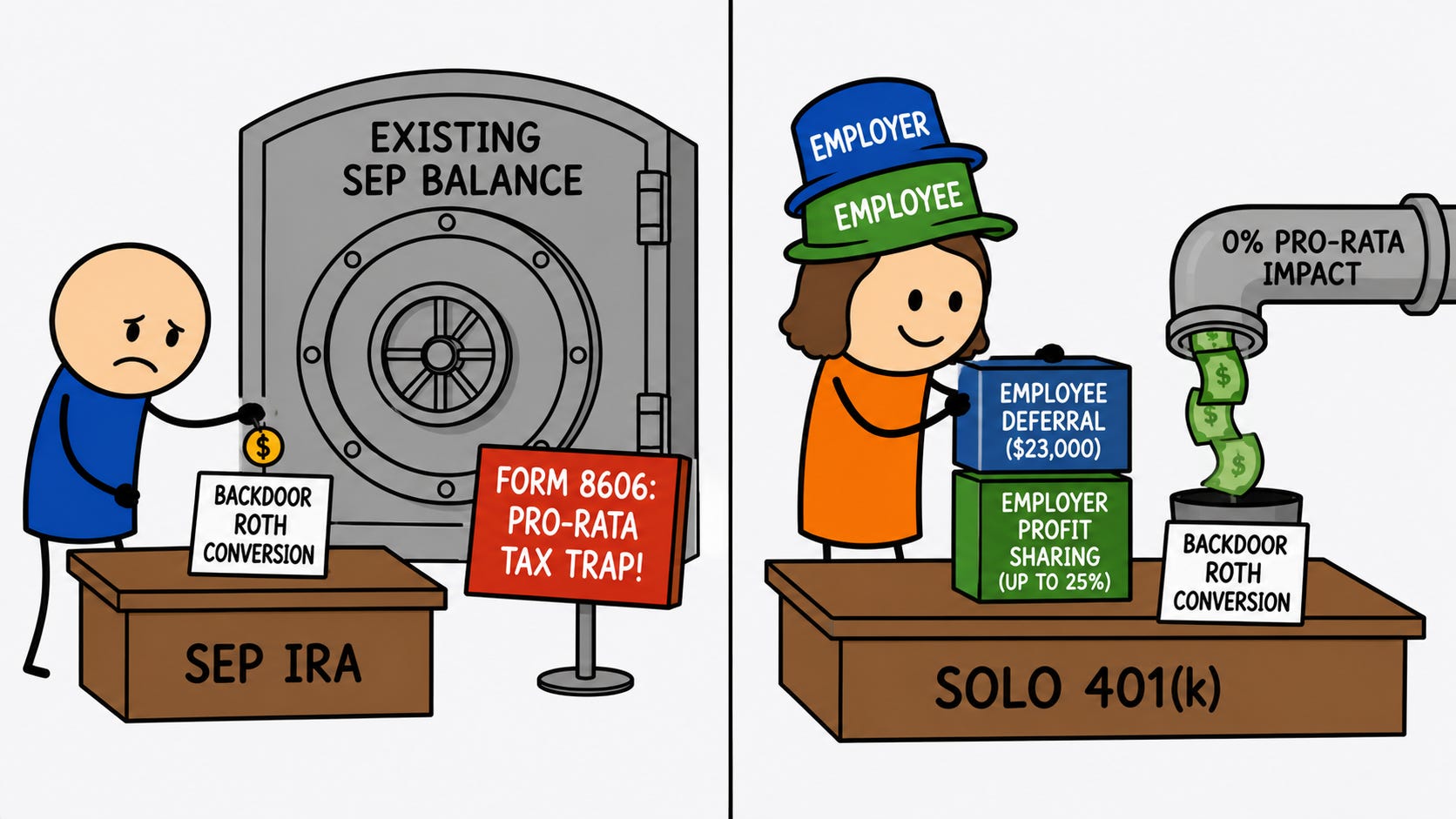
A one-participant 401(k) generally covers an owner with no common law employees, or the owner and spouse, and similar one participant treatment can also apply to partners and their spouses. The owner wears two hats and contributes in two ways. As the employee, an elective deferral of up to 100% of compensation, subject to the annual dollar limit. As the employer, a nonelective contribution of up to 25% of compensation, which for a self-employed person is computed on earned income after subtracting half of self employment tax and the plan contribution itself. Catch up contributions are available to those who qualify by age. The plan can permit loans and designated Roth deferrals if the plan document provides for them.
That structure is the reason the two plans diverge so sharply at ordinary income levels. A SEP contribution rises as a percentage of compensation. A solo 401(k), by contrast, lets the owner use an employee elective deferral first, up to the annual dollar limit but never more than available compensation, and then add an employer contribution on top. At many moderate income levels, that employee deferral layer allows substantially more total contribution than a SEP.
The direction reverses when employees enter the picture. A SEP handles a workforce. It just charges you for the privilege, because uniform percentage funding means contributing for every eligible employee at the same rate you use for yourself. A solo 401(k) does not handle a workforce at all. Once a common law employee becomes eligible, the one participant treatment ends. The employee must be included under the plan’s terms, and nondiscrimination testing can apply unless the plan already uses, or is changed to, a design that qualifies for an exemption such as safe harbor. The simplified administration that made it attractive is what disappears.
Reporting also splits. A one-participant 401(k) generally must file Form 5500-EZ when the combined year end assets of the employer’s one participant plans exceed $250,000. A final return is also required when the plan terminates, regardless of asset size. A SEP has no comparable annual Form 5500 filing requirement.
Then there is the difference nobody mentions in the comparison charts, and it surfaces years later. A SEP IRA is an IRA. When you compute the taxable portion of a conversion, the calculation uses the total year end value of all your traditional, SEP, and SIMPLE IRAs together. A SEP balance therefore sits inside that total and makes any conversion partly taxable in proportion. A solo 401(k) is not an IRA, so its balance stays outside that calculation entirely. For someone who expects to make nondeductible contributions and convert them, that distinction can determine whether a large pre-tax balance enters the pro-rata calculation.
A related mechanic is that a solo 401(k) can accept eligible incoming rollovers if the plan document permits them. Moving eligible pre-tax traditional IRA money into the plan removes that amount from the year end traditional IRA balance used on Form 8606. The receiving plan has to allow the rollover, and not every type of IRA money is eligible to move this way.
Funding timelines differ too. A SEP can be established and funded as late as the due date of the business return including extensions. The special first year rule that lets a sole proprietor adopt a 401(k) after year end runs to the unextended individual return date instead, so an extension helps one plan and not the other.
Consider a consultant with modest net earnings from self employment who is deciding between the two. Under a SEP she can contribute roughly a fifth of her earned income after the self employment tax and contribution adjustments, and that is the whole contribution. Under a solo 401(k), she can first make an employee elective deferral, limited by both the annual deferral cap and her available earned income, and then add the employer contribution on top. At her income, that structure may allow substantially more than the SEP.
Three years later she wants to make nondeductible IRA contributions and convert them. If her money is in the SEP, that balance is part of the year end total of traditional, SEP, and SIMPLE IRAs, and each conversion comes out partly taxable in proportion to it. If that retirement money is in the solo 401(k), the plan balance itself is outside the Form 8606 IRA aggregation calculation. Assuming she has no other year end traditional, SEP, or SIMPLE IRA balances, that can leave a nondeductible contribution and subsequent conversion with little or no pre-tax IRA balance creating pro-rata taxation. Nothing about her income changed. The account type did.
Now consider the same consultant hiring her first full time employee, who eventually meets the age and service requirements. With a SEP, she contributes for that employee at the same percentage she uses for herself, which is a real cost but a workable one. With a solo 401(k), the one participant treatment ends. The employee must be covered, testing can apply depending on the plan’s design, and what was a simple filing becomes an administered plan.
The honest summary is that these two plans are optimized for different situations rather than being better or worse than one another. The SEP is built for simplicity and for employers who may have staff. The solo 401(k) is built to maximize what one person can shelter, and it pays for that with a filing requirement once assets grow, a plan document, and a structure that breaks when the business grows past one person and a spouse.
For anyone deciding today, the questions that actually separate them are whether you have or expect eligible employees, how large your net earnings are relative to the deferral opportunity, and whether a backdoor Roth is part of your longer plan. Those three answers usually decide it before any comparison chart does.
Anyone weighing the two against their own numbers and staffing plans can work through it with the small business retirement plan selector, and anyone trying to see what an existing SEP balance would do to a conversion can run that with the IRA pro-rata calculator.
Where you stand comes down to which problem you are solving. One plan is designed to include other people. The other is designed around the fact that there aren’t any.
I write one of these every day, one retirement rule, explained in plain language and verified against the source. The daily email is free: subscribe here.
Full archive, worksheets, and search live at RetirementNewsRundown.com.
Disclaimer
This article is for educational and informational purposes only. It is not tax, legal, or financial advice and does not create an advisor–client relationship. Always consult appropriate professionals regarding your specific situation.