Almost everyone treats the phrase “the tax deadline” as though it names one date. Inside the retirement system it names at least three, and they do not move together. Some doors close on December 31 with no possibility of reopening. Some stay open until you file in April. Some stretch to the fall, but only for certain kinds of money and only for certain kinds of businesses. The system never announces which door you are standing in front of, and by the time a preparer explains it in March, one of them has usually already shut.
The people this catches hardest are the self-employed, because a single person can be on all three calendars at once for different pieces of the same year.
The first set of deadlines runs on the calendar and ends December 31. A Roth conversion belongs to the tax year in which the conversion actually occurs. Once December 31 passes, you cannot create an additional conversion for that closed year, and conversions made under current law cannot later be recharacterized back to a traditional IRA. Qualified charitable distributions work the same way. Required minimum distributions that are due for a calendar year generally must be taken by December 31, with the exception of a first distribution year, when the first one can be delayed to April 1 of the following year. For ordinary W-2 employees, salary deferrals into a workplace 401(k) generally run through payroll and end with the year’s final payroll opportunity. Self-employed owners have separate election and deposit rules, including the special first year rule discussed below. None of these have an April version. When someone says in February that they want to lower last year’s income with a conversion, the answer is that the opportunity closed six weeks earlier.
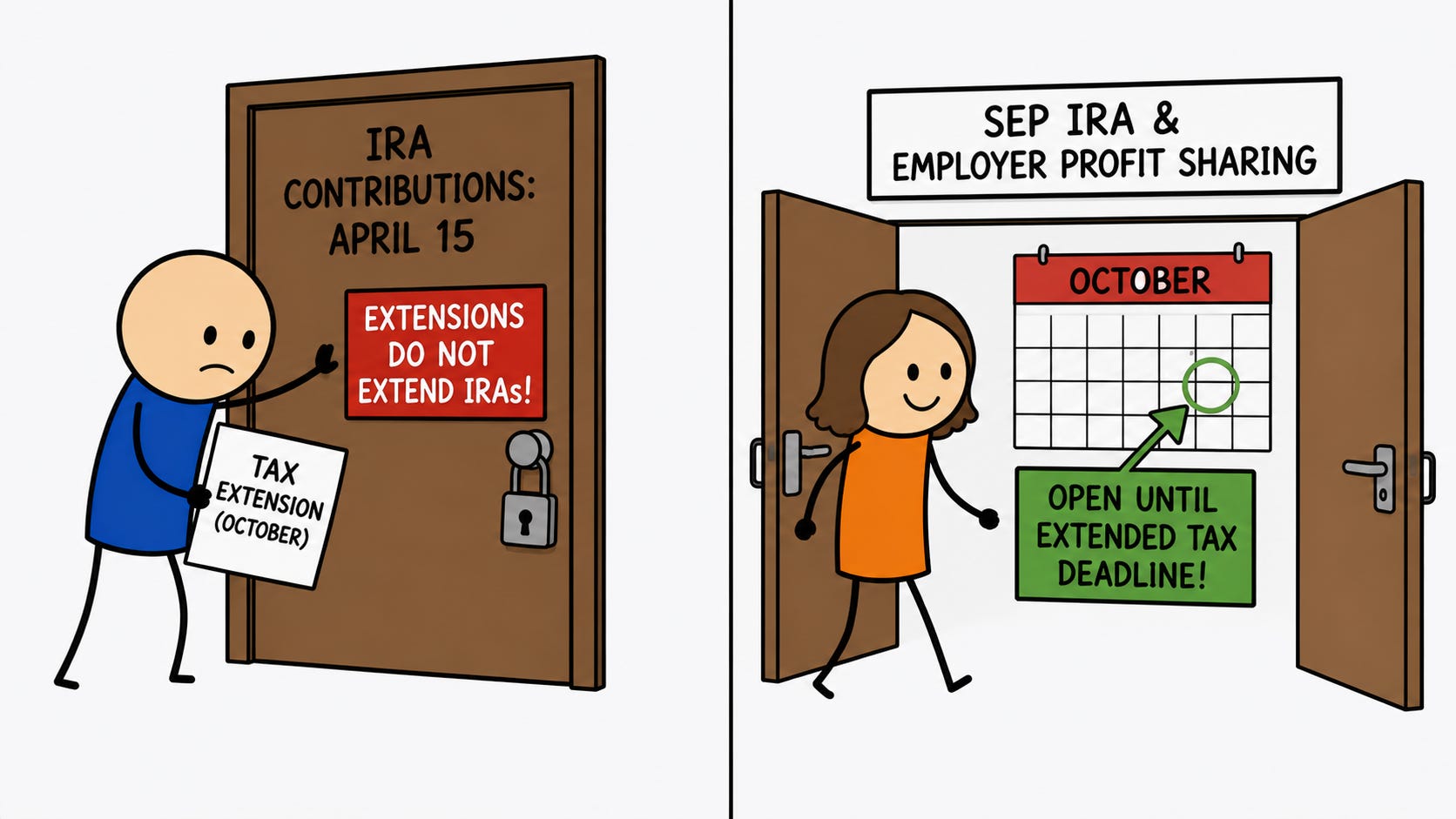
The second set runs on the tax return, and this is where the asymmetry starts. Contributions to a traditional or Roth IRA are due by the due date of your individual return for that year, generally in mid April, and extensions do not extend it. Filing an extension buys you six months to file and zero additional days to fund an IRA. That trips up people who assume every deadline follows the extension.
Employer money follows a different rule. Contributions to a SEP are due by the due date of the business income tax return including extensions, and if you obtain an extension you have until the end of that extension period whether or not you file early. So the same person, in the same year, can have an IRA door that closes in April and an employer contribution door that stays open into September or October.
For a SEP, missing the contribution deadline generally costs the deduction for that tax year rather than creating a standalone late contribution penalty. If no extension was obtained and the contribution is deposited after the filing deadline, IRS guidance allows it to be deducted on the following year’s return instead. Other employer plans have their own deposit and correction rules, so this carry forward treatment should not be generalized beyond the SEP context.
The third set of dates governs when a plan can exist at all, which is separate from when it can be funded. A SEP can be established as late as the due date of the business return for that year including extensions, so a business owner in September can create a plan for the prior year and fund it in the same motion. A SIMPLE plan is stricter. It can be effective on any date between January 1 and October 1 for an employer that never previously maintained one, and a business that came into existence after October 1 can establish one as soon as administratively feasible. If the employer previously maintained a SIMPLE IRA plan, a newly established SIMPLE IRA plan generally must be effective January 1.
SIMPLE IRA money then runs on two separate clocks of its own. Employee salary reduction contributions generally must be deposited within 30 days after the end of the month in which the money otherwise would have been payable in cash. For a self-employed owner with no common law employees, calendar year salary reductions generally must be deposited by January 30 of the following year. Employer matching or nonelective contributions have the later business return deadline, including extensions.
Solo 401(k) plans got a specific fix for a problem that used to make late setup useless. An owner could establish a plan after year end but could not make employee deferrals, because a deferral election had to be in place by the last day of the plan year and the plan did not exist yet. SECURE 2.0 created a special first year rule for an individual who owns the entire interest in an unincorporated business and is the only employee of that business. In that narrow owner only situation, a new 401(k) can be adopted after year end and the owner can make a first year elective deferral election for the prior year as late as the due date of the individual’s return, determined without extensions. Two limits matter. It applies only to the first plan year, and extensions do not extend it.
The fourth set is not really a deadline but a correction window, and it runs later than everything else. Recharacterizing an IRA contribution and timely removing an excess contribution with its earnings generally run to the return due date including extensions. A taxpayer who timely filed without correcting may also qualify for the automatic six month relief period, which for a typical calendar year return often reaches into mid October. These are the repair doors, and they stay open after the funding doors have closed.
One practical detail causes more damage than any of the rules above. A contribution made between January 1 and the April deadline has to be designated for the prior year, and if nobody designates it, the sponsor can treat and report it as a contribution for the current year. Once that is done and reported, undoing it is a correction rather than a phone call.
Consider a self-employed consultant sitting down with his accountant in March, wanting to reduce last year’s tax bill. Four doors, four different answers.
The Roth conversion he was considering is gone. It had to happen by December 31 and nothing available to him in March can create one for a year that has closed.
His IRA contribution is still open. He can fund a traditional IRA for the prior year up to the April due date, and if he asks whether an extension gives him until October, the answer is no. It does not.
His SEP is wide open. He can establish one now for the prior year and fund it, and if he extends his return, he has until the extended due date to deposit the money. That single feature is why the SEP is often the last usable option for someone arriving late.
His solo 401(k) option depends on the details of his business. If he owns the entire interest in an unincorporated business and is its only employee, and he never had a plan, he can adopt one and make a first year deferral election for the prior year, which can provide substantially more contribution capacity than a regular IRA, depending on his business earnings. But filing an extension does not buy additional time for that retroactive first year deferral. It still has to be handled by the unextended due date, while SEP employer contributions can continue to the extended deadline. Choosing to extend therefore changes the practical shape of his options, which is not intuitive.
The useful frame is to stop asking when the tax deadline is and start asking which clock a particular dollar runs on. Money that comes out of an account, meaning conversions, charitable distributions, and required distributions, runs on the calendar year and generally ends December 31. Money you put into an IRA runs to the April filing date without extensions. Money an employer puts into a SEP runs to the business return date with extensions. Repairs run later still.
That framing also explains why arriving late is not always fatal. A person who reaches March with nothing done for the prior year has lost the conversion but still has real options on the contribution side, and those options are frequently larger than the ones they missed.
Anyone weighing which small business plan actually fits their situation and timeline can work through the differences with the small business retirement plan selector, and anyone who wants every date in one place, laid out by when it hits rather than by account type, can work through the retirement account deadlines guide.
Where you stand depends entirely on which door you are looking at. Some of them are already closed. Several of them are not.
I write one of these every day, one retirement rule, explained in plain language and verified against the source. The daily email is free: subscribe here.
Full archive, worksheets, and search live at RetirementNewsRundown.com.
Disclaimer
This article is for educational and informational purposes only. It is not tax, legal, or financial advice and does not create an advisor–client relationship. Always consult appropriate professionals regarding your specific situation.