The Form 1099-R shows up in January or February with a single character in one box that decides whether the IRS thinks you owe a penalty. Nobody sends an explanation with it. The custodian fills out what it can verify from its own records, and then the form goes to you and to the IRS at the same time. Whatever that box says becomes the government’s starting assumption about what you did.
The part that surprises people is how much the form still cannot know. The custodian reports information it can verify from its records, such as the account type, your age, and the transaction it processed. But it often cannot know why you took the money, whether you completed an indirect rollover later, or how much nondeductible IRA basis you have. Even with qualified charitable distributions, where a new optional reporting code now exists, the tax treatment still ultimately has to be reported correctly on your return.
Box 1 is the gross distribution, the full amount that left the account before anything was withheld. Box 2a is the taxable amount. For distributions from a traditional IRA, those two numbers are usually identical, and the box below labeled “taxable amount not determined” is usually checked. That combination is not the custodian telling you the whole thing is taxable. It is the custodian telling you it cannot compute the answer, because it generally is not required to determine how much of the distribution represents nondeductible basis. If you have basis in your IRAs, the actual taxable number comes from your own Form 8606, and the form in your hand will never reflect it.
Box 4 is federal income tax withheld, which matters because withholding on a distribution you intended to roll over creates a shortfall you have to replace out of pocket to complete the rollover. Box 5 is a frequent misreading. It reports after-tax employee contributions, designated Roth contributions, or insurance premiums, depending on the plan. It is not a running record of traditional IRA basis. There is also a checkbox marking the distribution as coming from an IRA, SEP, or SIMPLE, which tells you which set of rules applies before you read anything else.
Then there is the code box, which holds up to two characters. Code 1 means an early distribution with no known exception. Code 2 means an early distribution where an exception applies and the custodian knows it. Code 3 is disability, code 4 is death, and code 7 is a normal distribution. Code G marks a direct rollover and direct payment, and H marks a direct rollover of a designated Roth account distribution to a Roth IRA. For Roth IRAs, code Q means a qualified distribution and code J means an early distribution with no known exception. Code T means a Roth IRA distribution where the participant has reached 59.5, died, or is disabled, but the custodian cannot determine whether the five year holding period has been satisfied. Code S flags an early distribution from a SIMPLE IRA inside its first two years with no known exception.
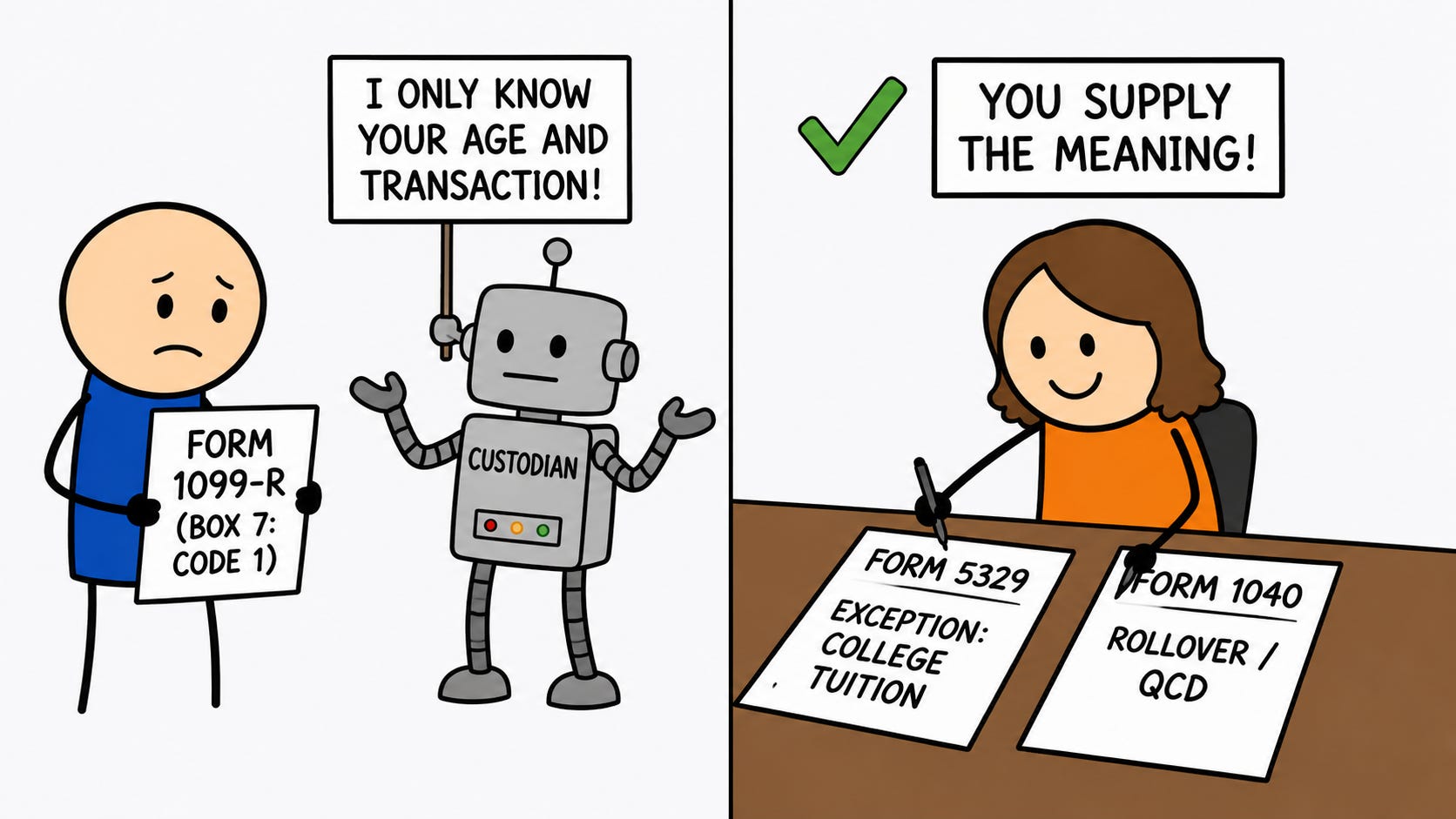
The structural point behind all of it is that the custodian codes what it can verify. It knows how old you are. It does not know that the money paid for qualified higher education, a first home, unreimbursed medical costs, or a qualified birth or adoption. So code 1 lands on a great many distributions that actually qualify for an exception, and that is not an error on anyone’s part. It is the limit of what a payer can see. The exception gets claimed by you, on Form 5329, using the exception number that matches your circumstance.
The correction codes carry their own timing message. Code 8 generally identifies a corrective distribution taxable in the year shown on that Form 1099-R. Code P points backward, indicating the corrective amount is taxable in the prior year or another earlier year. Code N marks a contribution for the current reporting year that was recharacterized during that year, while code R points to a contribution made for an earlier year and recharacterized in the current reporting year. A P or an R is therefore a warning to check a tax year you may have considered finished.
Rollovers split into two very different reporting paths. An indirect sixty day rollover generally has no rollover-specific code on the Form 1099-R. The custodian reports the distribution using the code that otherwise applies, because it cannot know from the original transaction that you later redeposited the money. You report the gross distribution on your return and identify the amount that was rolled over. A direct rollover is different and is generally reported with code G, or code H for a direct rollover from a designated Roth account to a Roth IRA.
Charitable distributions have a newer wrinkle. The IRS added a code marking a qualified charitable distribution, but its use is optional for both the 2025 and 2026 reporting years, so many custodians will not use it. Before that code existed, a QCD came through as an ordinary code 7 distribution with nothing to distinguish it. More important, even when a custodian does use it, the exclusion is not applied at the reporting level. Box 2a is not reduced. The full amount still shows as distributed, and you still have to exclude the qualified portion yourself on your return.
Consider a woman who is 76 and directs her IRA custodian to send money straight to her church, satisfying part of her required distribution through a qualified charitable distribution. In late January she receives a Form 1099-R showing the full amount in box 1, the same amount in box 2a, the “taxable amount not determined” box checked, and code 7 in the code box. Nothing on the form says charity.
If she or her preparer enters that form as it appears and moves on, she pays ordinary income tax on a distribution that was not taxable to her. Nothing was reported incorrectly. The custodian did exactly what the rules permit. The exclusion simply belongs on her return rather than on the form, and no corrected form is coming to rescue it.
Now consider a 57 year old who took a distribution to cover qualified higher education expenses for his daughter. His form arrives with code 1, meaning early distribution with no known exception. His first instinct is to call the custodian and ask them to fix it. They will not, because it is not broken. The custodian never knew what the money was for. He files Form 5329 with the exception number for higher education expenses, and the additional tax comes off there.
The useful way to hold this is that the code in that box is where the conversation starts rather than where it ends. It reflects what your custodian could verify from its own records on the day it processed the transaction. Some of the most consequential facts about a distribution, including your basis, your intent, and what you did with the money afterward, are invisible from that vantage point.
That also tells you when to call and when not to. If the form misstates something the custodian actually knew, such as your age, the account type, or the amount, ask for a corrected form and expect to get one. If the form is simply silent about something the custodian never knew, calling accomplishes nothing and the fix belongs on your return.
Anyone working out how much of a traditional IRA distribution is actually taxable when nondeductible contributions are in the mix can run the numbers with the IRA pro-rata calculator, and anyone staring at a code 8 or a code P after removing an excess contribution can sort out which year the earnings belong to with the excess contribution correction tool.
Where you stand comes down to a simple division of labor. The custodian reports what happened. You report what it meant.
I write one of these every day, one retirement rule, explained in plain language and verified against the source. The daily email is free: subscribe here.
Full archive, worksheets, and search live at RetirementNewsRundown.com.
Disclaimer
This article is for educational and informational purposes only. It is not tax, legal, or financial advice and does not create an advisor–client relationship. Always consult appropriate professionals regarding your specific situation.