The required minimum distribution is the one retirement deadline that arrives without a reminder attached to it. No bill shows up. No notice goes out in November. Your custodian usually calculates the amount and may even print it on a statement, but nothing forces the money out of the account, and December 31 passes the same way it would have if you had taken the distribution. Most people discover the miss months later, in February or March, while assembling tax documents and noticing that a form they expected never arrived.
The fix is procedural and it is available to almost everyone. What makes it feel worse than it is comes from the order of operations. You cannot ask for relief until you have figured out the shortfall, and figuring out the shortfall for a year that has already closed works differently than figuring out the current year’s amount.
Start with the computation for the year you missed, not the year you are standing in. For most IRA and defined-contribution accounts, the required amount for a year starts with the account balance on December 31 of the preceding year, divided by the applicable life expectancy factor. Use the factor for the age you reached during the missed year, taken from the table that applied to your situation in that year. Most owners use the Uniform Lifetime Table. An owner whose sole beneficiary is a spouse more than ten years younger uses the Joint and Last Survivor Table. Beneficiaries of inherited accounts use the Single Life Table. Pulling the current year’s factor for a prior year’s shortfall produces the wrong number, and the number is what everything else depends on.
If you missed more than one year, each year is a separate calculation with its own prior year ending balance and its own factor. Missed years compound the arithmetic, because the money you failed to distribute stayed in the account and raised the December 31 balance that sets the following year’s requirement.
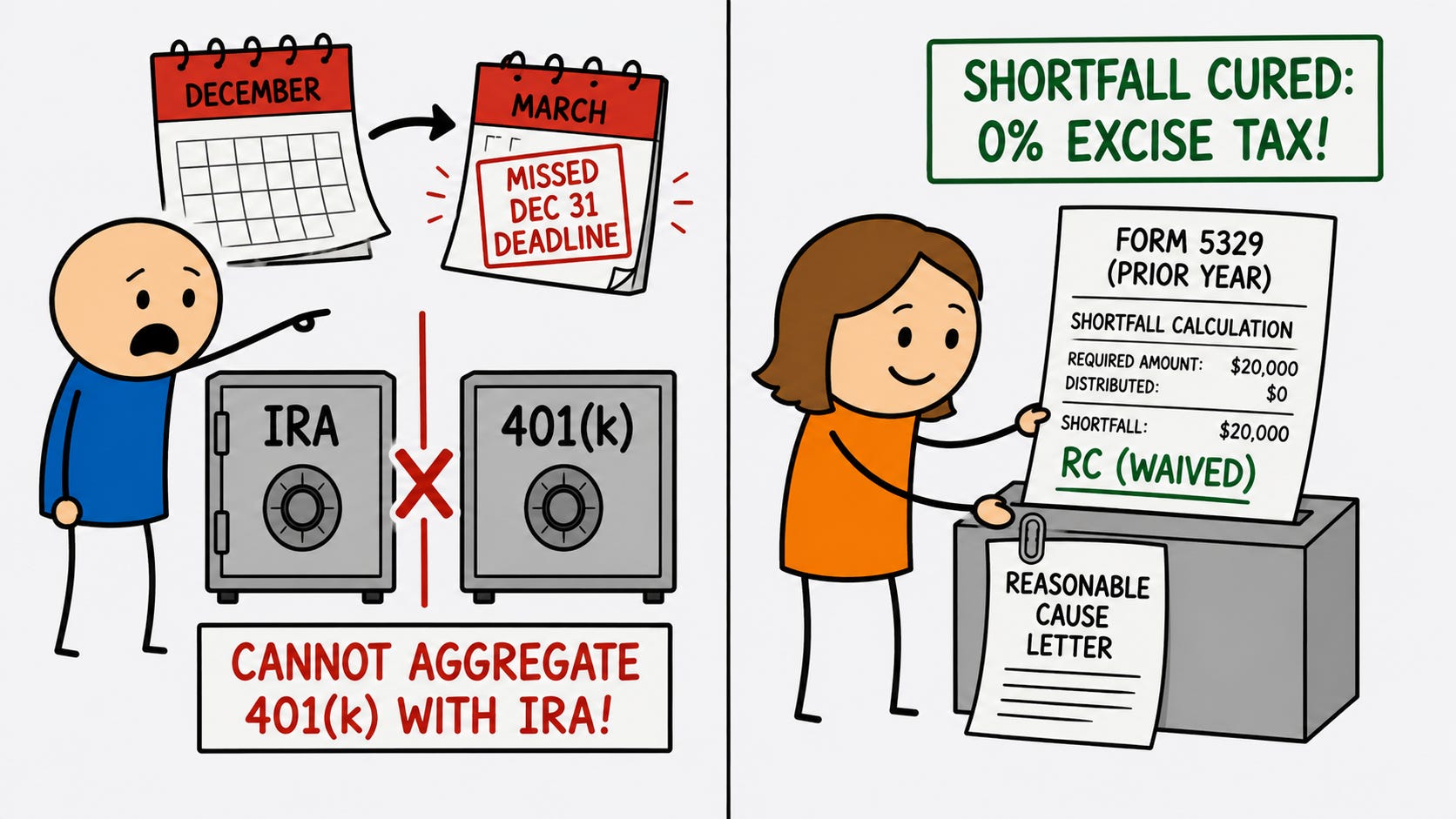
Next, determine which accounts can actually satisfy the shortfall, because this is where corrections go wrong. Traditional IRAs, including SEP and SIMPLE IRAs, are calculated separately for each account, but the total can be withdrawn from any one or more of them. The same aggregation approach applies among 403(b) contracts. Distributions required from 401(k) and 457(b) accounts must be taken separately from each of those plan accounts, with no aggregation and no crossing between plan types. A withdrawal from an IRA does not repair a shortfall in a 401(k), no matter how much larger the IRA withdrawal was. Inherited accounts stand apart from accounts you own, and inherited IRAs may generally be combined for this purpose only when they came from the same person.
Then take the makeup distribution, and understand what year it belongs to. Money taken in a later year to correct the prior-year shortfall is taxable in the year it is actually received and appears on that year’s Form 1099-R. IRS proposed regulations also provide that a corrective distribution for a prior-year missed RMD does not satisfy the RMD for the year in which the correction is made, meaning the current-year RMD must still be taken separately. Those corrective-distribution rules remain subject to pending final regulations, so a person making a current correction should verify the rule applicable to that year.
The reporting step is Form 5329, filed for the year that was missed, using that year’s version of the form rather than the current one. One form per missed year. You report the amount that was required and the amount actually distributed, enter “RC” and the amount you want waived in parentheses next to the shortfall line, subtract it, and pay only the tax remaining after the requested waiver. Attach a short written statement. If you file returns, the form goes with the return. If you are not otherwise required to file an income tax return, Form 5329 can be sent by itself with your address, signature, and date. The mechanics of the form itself, including the parts covering excess contributions, are covered in the Form 5329 walkthrough on the site.
The statement is the part people overthink. Two things belong in it: why the shortfall was a reasonable error, and what you did to remedy it. Administrative failures, a custodian platform change that dropped an automatic instruction, incorrect information you relied on, illness, and confusion over a beneficiary distribution requirement all describe circumstances people actually experience. None of them guarantees relief. The IRS decides. If it denies part or all of the request, it notifies you of the additional tax it believes is owed.
The rate matters to that decision. The excise tax on the shortfall runs 25%. It can drop to 10% when the reduced rate requirements are satisfied during the correction window, which calls for both taking the distribution that caused the shortfall and submitting a return reflecting the reduced additional tax. The correction window ends on the earliest of the mailing of a notice of deficiency, assessment of the tax, or the last day of the second taxable year beginning after the year in which the excise tax arose.
Consider an owner who is 74 and holds two traditional IRAs and an old 401(k) from a former employer. In November he takes a distribution from one IRA large enough to cover the combined requirement for both IRAs, which is permitted. The 401(k) requirement never crosses his mind. December 31 passes.
In March, reviewing tax forms, he sees the 401(k) produced no Form 1099-R. He calculates the missed amount using that plan’s balance as of December 31 two years back, divided by the Uniform Lifetime factor for age 74. He requests the distribution from the plan in March. His large November IRA withdrawal does nothing for this shortfall, because plan accounts are not aggregated with IRAs.
He files a Form 5329 for the prior year on the prior year form, reports the required amount and the zero distributed, writes RC with the full shortfall in parentheses, sends no payment, and attaches a statement describing the oversight and the March corrective distribution. The March distribution is taxable in the current year. Under the IRS’s proposed corrective-distribution rule, that March distribution does not satisfy the current year’s 401(k) RMD, so the current-year amount must also be taken by December 31. Because final guidance on that specific treatment is still pending, the rule should be confirmed for the year of correction.
Beneficiaries need one additional check. Certain beneficiaries subject to the 10-year rule, particularly those who inherited from an owner who had already reached the required beginning date, may also have annual RMDs during that ten-year period. The IRS provided transition relief from the excise tax for specified missed distributions through 2024 while the rules were being finalized. That blanket transition relief has ended, and the final beneficiary rules apply beginning with 2025. A beneficiary therefore needs to confirm whether an annual RMD was actually required before treating a missing distribution as a shortfall.
Before starting any of this, confirm the miss was real. In the first distribution year an owner may delay that first distribution to April 1 of the following year, which means a person who thinks he missed December 31 may simply be inside that extension, with a second distribution due by the following December 31. Employer plans may also allow a participant who is still working and who does not own 5% of the business to postpone distributions from that employer’s plan. No comparable postponement exists for IRAs. A fair number of panicked corrections turn out to be unnecessary.
When the shortfall is real, the sequence is short. Compute the amount using the missed year’s balance and factor, take the money out of an account that can actually satisfy it, file the form for that year, and explain what happened. Anyone reconstructing a required amount for a closed year can rebuild the figure with the required minimum distribution calculator, and a beneficiary working out whether an annual distribution was required at all can map the schedule with the inherited IRA calculator.
What matters is that this correction has a defined path with relief written into it. The excise tax on a missed distribution is one of the few retirement penalties the instructions themselves invite you to ask out of.
I write one of these every day, one retirement rule, explained in plain language and verified against the source. The daily email is free: subscribe here.
Full archive, worksheets, and search live at RetirementNewsRundown.com.
Disclaimer
This article is for educational and informational purposes only. It is not tax, legal, or financial advice and does not create an advisor–client relationship. Always consult appropriate professionals regarding your specific situation.