Every retirement account rule comes with a price for getting it wrong, and the IRS collects most of those prices on one form. Form 5329 carries the title “Additional Taxes on Qualified Plans (Including IRAs) and Other Tax-Favored Accounts,” which is a formal way of saying it is the penalty return. Nine parts, each covering a different way a tax-favored account can go sideways. Most people meet it after the fact, usually when a custodian statement or a tax preparer turns a vague worry into a specific number.
It looks intimidating, but several parts of the form also contain their own exceptions, correction rules, or relief provisions. Knowing which part applies to the mistake is most of the work.
Part I handles the 10% additional tax on distributions taken before 59.5. This is where exception codes go, numbered 01 through 23, with 99 entered when more than one exception applies. There is a quirk worth knowing. If distribution code 1 is correctly shown in box 7 of every Form 1099-R you received and you owe the additional tax on the full amount shown, you generally do not file Form 5329 for that reason alone. The tax goes straight onto Schedule 2. You file the form when you are claiming an exception your custodian did not code, or when the coding on the 1099-R is wrong.
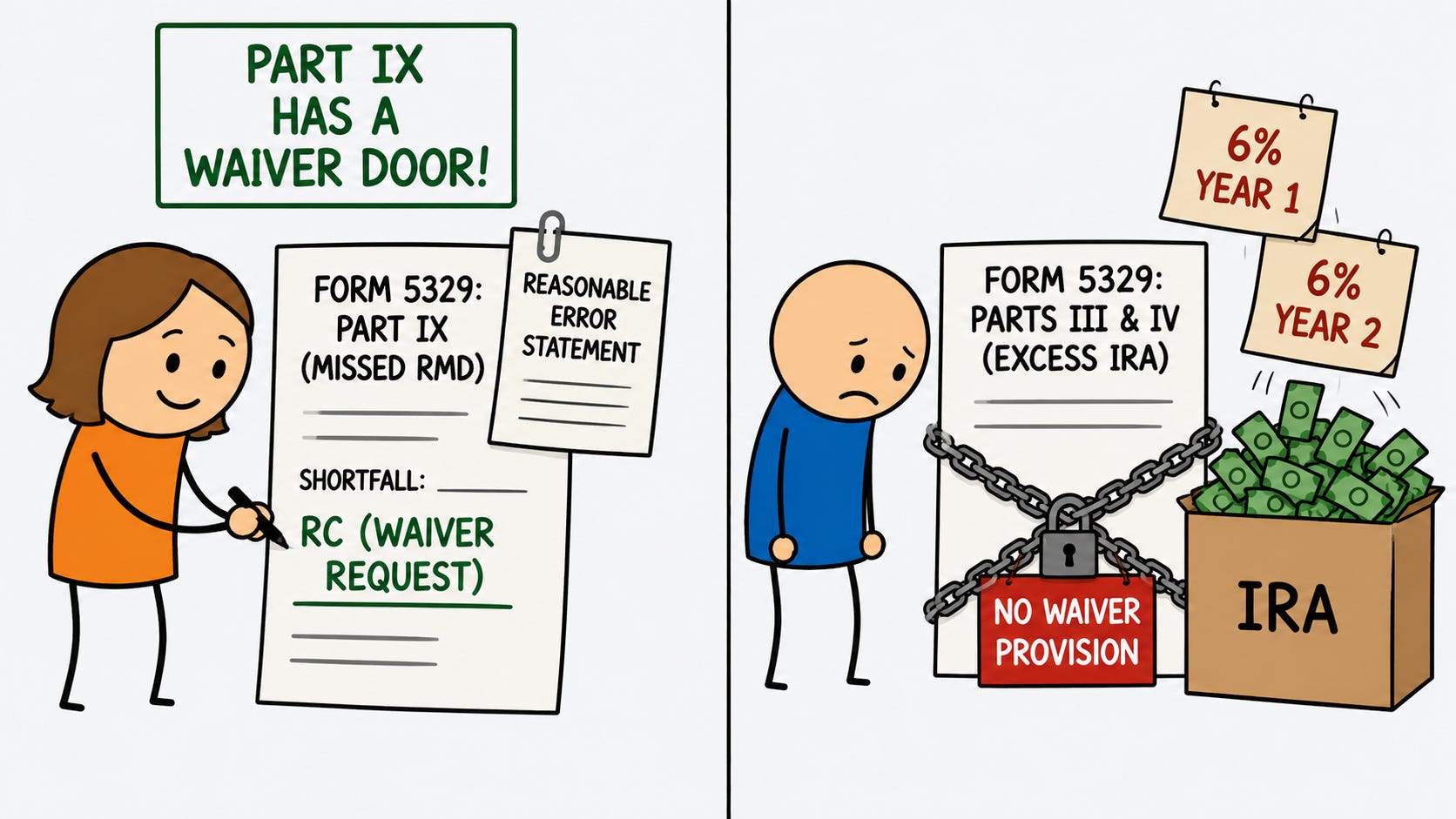
Parts III and IV handle the 6% additional tax on excess IRA contributions. Part III is for traditional IRAs, Part IV for Roth IRAs. Both work the same way. You determine the excess, then apply 6% to the lesser of the excess amount or the value of your IRAs of that type at the end of the year. That second half matters when the account has dropped in value, because the tax base can be smaller than the excess itself.
The 6% is not a one-time charge. It applies again for every year an unresolved excess carries forward. One uncorrected contribution can generate a stack of Form 5329s, one for each year it sat there, and each one must be filed on that year’s version of the form. Prior year filings use prior year forms, not the current one.
Part IX is the section people search for. It covers what the form calls excess accumulation, which is the amount you were required to distribute and did not. The rate is 25% of the shortfall. Older articles still cite 50%, and that rate no longer applies. The 25% rate can drop to 10% when the reduced-rate requirements are satisfied during the correction window. That requires taking the distribution that caused the shortfall and submitting a return reflecting the reduced additional tax. The correction window ends on the earliest of three dates: the mailing of a notice of deficiency, assessment of the tax, or the last day of the second taxable year beginning after the year in which the excise tax arose.
Part IX also contains the reasonable-error waiver, and the mechanics are specific. You report the full required amount and the amount actually distributed on the lines the form provides. Next to the line that computes the shortfall, you write “RC” and, in parentheses, the amount you want waived. You subtract that waived amount and carry the remainder forward, then pay only the tax actually shown on the form after the requested waiver. If you are asking for the entire shortfall to be waived, the remainder is zero and you send no payment with the form. Attach a short statement explaining why the shortfall was a reasonable error and describing the steps you took to remedy it. If the IRS denies part or all of the request, it will notify you regarding the additional tax it believes is owed. Line numbering inside Part IX shifts between form years, so pull the instructions for the specific year you are filing rather than copying line numbers from an article.
Filing mechanics depend on whether you file a return at all. If you file Form 1040, Form 5329 attaches to it and follows the same due date, extensions included. If you are not otherwise required to file an income tax return, Form 5329 can be filed by itself, with your address and the required signature and date, sent to the address where you would have filed Form 1040. A standalone Form 5329 that is not properly signed is not a completed filing.
Timing also affects how long the IRS has to assess these excise taxes, and current law is more forgiving than the old rule. SECURE 2.0 changed the statute of limitations so that, for IRA-related excess-contribution and missed-RMD excise taxes, the taxpayer’s income tax return can start the assessment clock even if Form 5329 was not filed. The general period is three years for the missed-RMD tax and six years for the IRA excess-contribution tax when the income tax return is the operative return. Older tax years can fall under different rules because this change took effect in late 2022, so a prior-year Form 5329 issue should be measured under the law that applies to that particular year.
Consider a retiree, age 76, who takes her required distribution every December through automatic withdrawals. Her custodian changes platforms in October and the automatic instruction does not carry over. December 31 passes with nothing distributed. She notices in late February while gathering tax documents.
She takes the full missed amount in March. She then files Form 5329 for the prior year, using the prior year version of the form, reporting the required amount and the zero she actually received. Next to the shortfall line she writes RC and the full shortfall in parentheses, carries zero forward, and attaches a statement describing the custodian conversion, the failed automatic instruction, and the March corrective distribution.
She sends no payment with the waiver request because the entire shortfall is being requested for waiver. If the IRS grants the request, no excise tax is due. If the IRS denies some or all of it, the IRS will notify her of the additional tax it believes is owed. The separate 10% reduced-rate rules depend on satisfying their own correction-window requirements, so the waiver request should not be treated as an automatic guarantee that the fallback rate will be 10%.
Now consider a different pitfall. A saver contributes to a Roth IRA for two consecutive years, then learns during the third year that his income exceeded the phase-out range in both years. The 6% applied to the first year’s excess, applied again to that same excess in the second year, and applied to the second year’s excess as well. He files a Form 5329 for each affected year on that year’s form, computing the tax in Part IV, and removes the excess to stop the charge going forward. There is no reasonable-error waiver in Part IV. The 6% continues until the carried excess is corrected or otherwise absorbed under the IRA rules.
The useful thing about Form 5329 is that it is the mechanism for asking, not only for paying. Part IX is written with a waiver request built into it, and the instructions themselves explain how to make that request. Reasonable-error requests often arise from ordinary human circumstances, such as administrative failures, illness, incorrect information, or confusion over a beneficiary distribution requirement. None of those facts guarantees a waiver by itself. The taxpayer still has to explain why the shortfall was a reasonable error and what was done to remedy it. Nothing about the request is exotic. It is a form, a notation, and a paragraph.
The 6% side works on different terms, and knowing that difference is what keeps a small mistake from repeating. Part IV offers no equivalent reasonable-error waiver, and every year an unresolved excess carries forward adds another 6%. Anyone sorting through how a specific excess should be removed and what the tax looks like for each affected year can walk through the sequence with the excess contribution correction tool, and anyone rebuilding a distribution figure for a year that was missed can run the numbers with the required minimum distribution calculator.
Where you stand comes down to which part of the form your situation falls under. Part IX has a request procedure written into it, with an outcome the IRS decides. Parts III and IV work on removal, and the 6% keeps applying until the excess is gone.
I write one of these every day, one retirement rule, explained in plain language and verified against the source. The daily email is free: subscribe here.
Full archive, worksheets, and search live at RetirementNewsRundown.com.
Disclaimer
This article is for educational and informational purposes only. It is not tax, legal, or financial advice and does not create an advisor–client relationship. Always consult appropriate professionals regarding your specific situation.