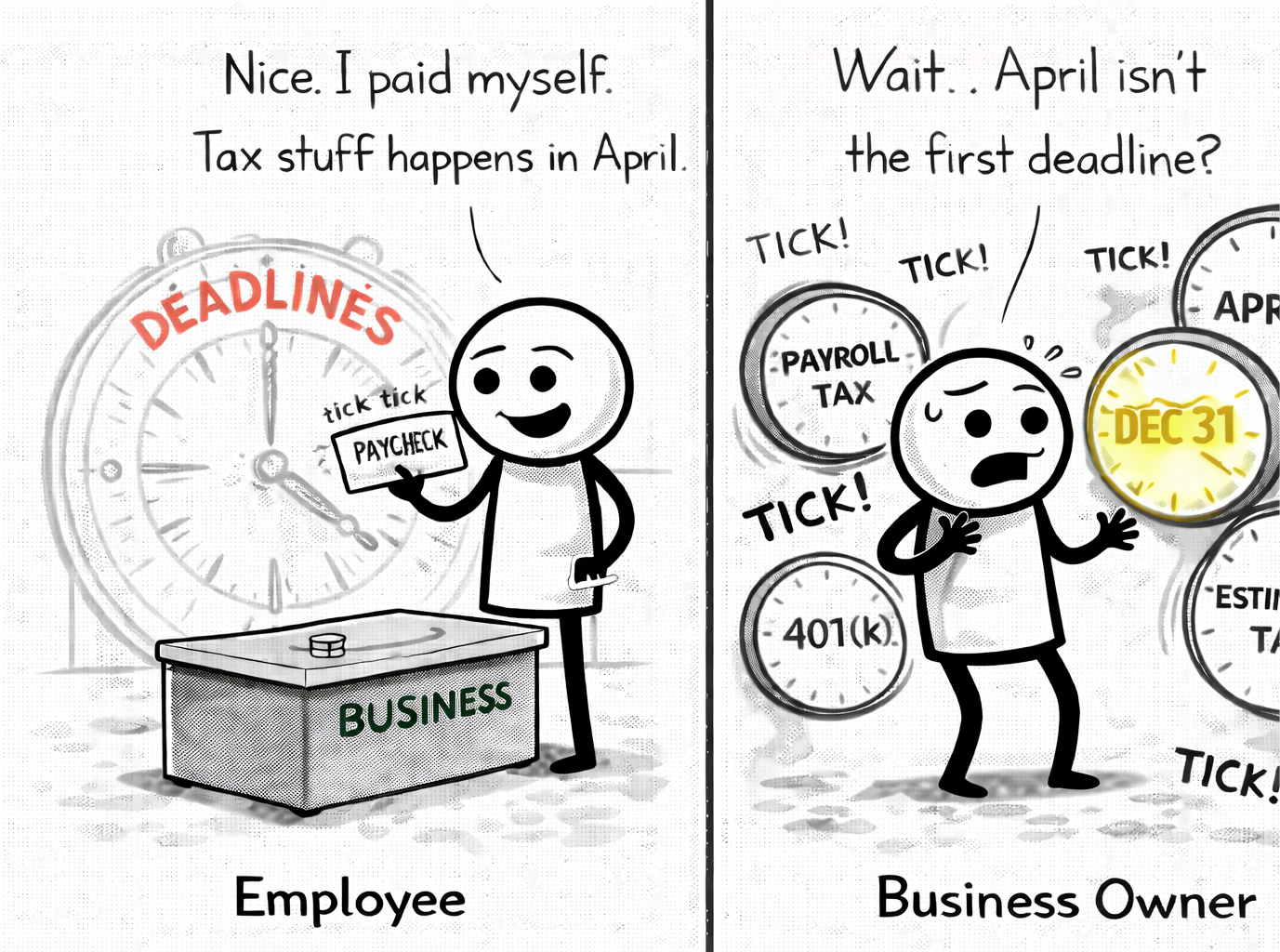
The system starts counting long before April ever shows up.
The moment you pay yourself, something shifts in the background. Money moves from business activity into personal income, and a separate clock begins running. It doesn’t announce itself or set a reminder. It simply tracks time from that transaction forward.
That is what the image at the top is pointing at. Getting paid feels like a reward. In reality, it is also the starting point for deadlines, contribution limits, withholding requirements, and penalty calculations that are tied directly to that paycheck.
Most business owners think of paying themselves as a cash flow decision.
It feels operational. You earned the money. You transfer it. You move on. The assumption is that the real tax conversation happens later when forms are prepared.
The misconception is that taxes begin at filing. They do not. They begin at payment.
The type of business structure determines which rules apply, but the principle is the same. When you pay yourself, you trigger withholding rules, payroll deposit deadlines, retirement deferral limits, and estimated tax considerations. Each of those has its own timing.
What happens if something is handled later instead depends entirely on which of those clocks you activated.
For S corporation owners, payroll starts a very specific chain of events.
Once wages are paid, payroll tax withholding and employer taxes must be deposited according to IRS schedules. Those schedules can be monthly or semiweekly depending on payroll size. Waiting until April to deal with payroll taxes does not work. Deposits are due during the year.
If payroll taxes are deposited late, penalties apply based on how late they are. Filing the annual return on time does not erase late deposit penalties. The clock started when the wages were paid.
Salary deferrals into a 401(k) follow similar timing. Employee deferrals must generally be withheld during the calendar year. Once December 31 passes, you cannot recreate employee deferrals for the prior year if they were not withheld from wages. Doing it later simply increases current year deferrals.
The calendar year governs that decision, not the tax filing deadline.
Sole proprietors experience a different version of the same clock.
They do not run payroll in the same way, but the moment profit exists and is drawn for personal use, estimated tax obligations come into play. The IRS expects quarterly estimated payments based on income earned during the year.
If estimated payments are too low during the year, underpayment penalties can accrue even if the full balance is paid in April. Paying everything at filing may settle the tax bill, but it does not necessarily eliminate penalties tied to earlier quarters.
The clock for estimated taxes starts as income is earned, not when the return is filed.
Retirement plans also follow this structure. A sole proprietor may still establish and fund a SEP IRA or certain Solo 401(k) contributions up to the tax filing deadline or extension window. In that case, paying yourself during the year creates income that can later be sheltered, but only if the filing deadline rules allow it.
If the plan type requires establishment by December 31, and it was not in place, that opportunity is governed by the calendar year. Doing it later may not recreate that option.
Here is how this plays out in real life.
An S corporation owner pays themselves wages throughout the year but does not withhold any 401(k) deferrals. December 31 arrives, and they realize they intended to defer part of their salary.
Because employee deferrals are tied to payroll during the calendar year, that opportunity is closed. They cannot write a check in March and call it last year’s salary deferral. The hidden clock started with each paycheck, and it stopped at year end.
Now consider a sole proprietor who earned strong profits and paid themselves informally during the year. In March, they review their numbers and decide to open a SEP IRA.
If they are within the tax filing deadline or extension window, they may still establish and fund the SEP for the prior year. In that case, the retirement contribution clock is governed by the filing deadline, not the calendar year.
Same act of paying oneself. Two different clocks running simultaneously.
There is also the Medicare and Social Security side of the equation.
Wages paid through payroll trigger FICA taxes immediately. Self employment income triggers self employment tax calculations at filing, but estimated payments during the year are expected. Waiting until April to address those taxes may mean penalties already exist.
The filing deadline settles the calculation. It does not rewind the timing.
Correction windows may apply in limited circumstances if payroll was processed incorrectly, but they do not exist for wages that were never structured properly in the first place. Once income was categorized and paid, certain consequences follow automatically.
This is why business owners often feel blindsided in the spring.
They thought the key decisions would happen during filing. In reality, the critical timing started months earlier when money changed hands.
Paying yourself is not just a transfer. It is the moment the system begins tracking obligations tied to that income.
The confusion comes from assuming that the only important deadline is April. The reality is that several deadlines were triggered the moment the first payment was made.
The resolution here is not anxiety, it’s knowledge.
Most of these clocks are predictable once you know they exist. Payroll deposit schedules are published. Estimated tax due dates are consistent. Retirement contribution windows are clearly defined by either calendar year rules or filing deadlines.
If something is governed by a calendar year deadline, paying yourself during the year means those decisions must be addressed before December 31.
If something is governed by a filing deadline, paying yourself creates income that may still be adjusted within that window.
If a correction window applies, it only matters if something was processed incorrectly, not if it was simply delayed.
By the time you finish reading, you should not feel overwhelmed by hidden traps. You should feel aware that the clock does not begin in April. It begins the moment income moves from business to personal.
Once you understand that, paying yourself feels less mysterious. It becomes what it actually is. A financial event that starts timing rules you can’t see but can absolutely plan around.
I write one of these every day, one retirement rule, explained in plain language and verified against the source. The daily email is free: subscribe here.
Disclaimer
This article is for educational and informational purposes only. It is not tax, legal, or financial advice and does not create an advisor–client relationship. Always consult appropriate professionals regarding your specific situation.