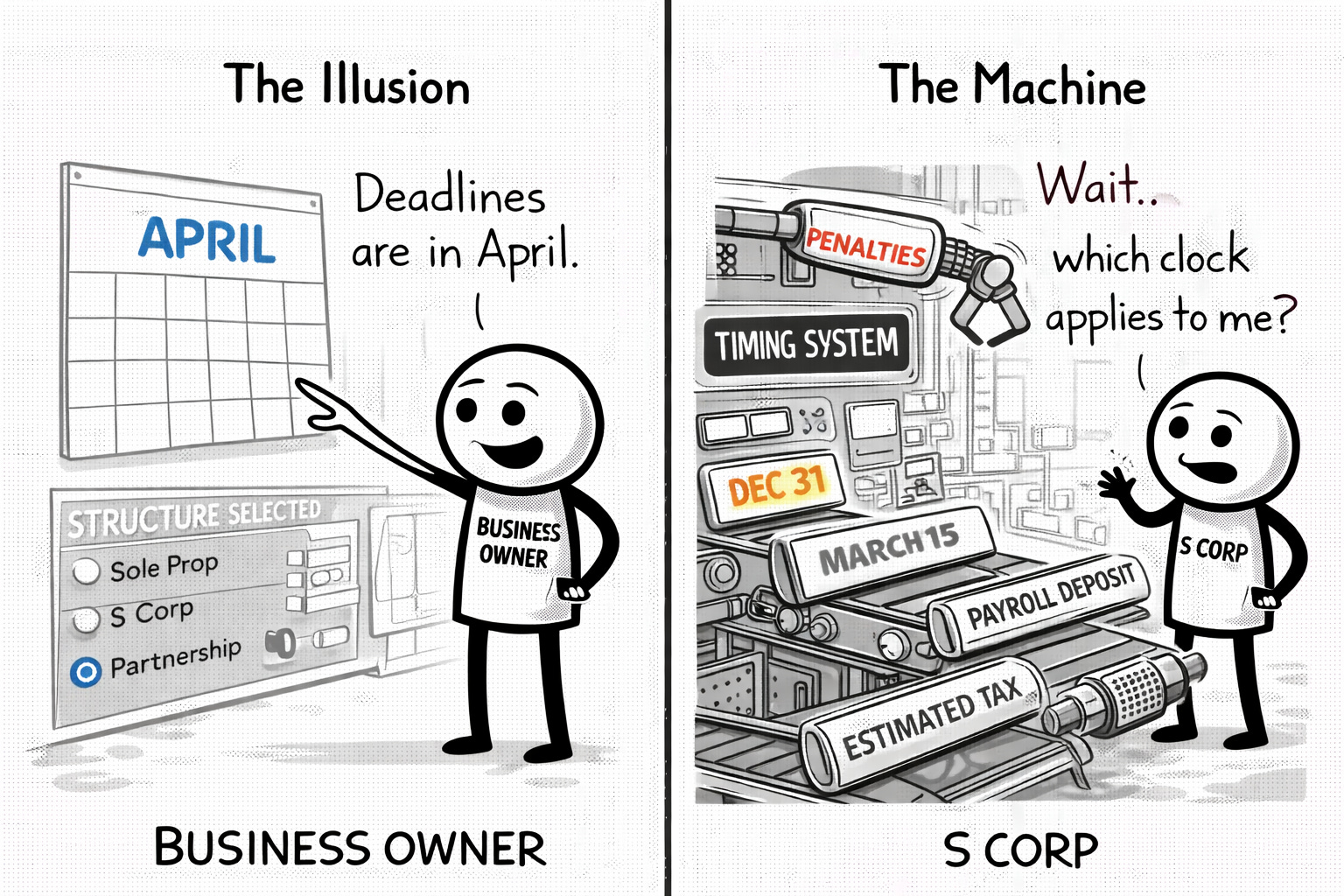
The system does not change the rules. It changes which clock applies.
Two business owners can earn the same income in the same year and face completely different deadlines, penalties, and contribution windows. Nothing about the income itself explains the difference. The structure does.
That is what the image at the top is quietly pointing at. The calendar looks universal. The deadlines are not.
Most people assume deadlines are tied to income.
They think that if two people both made one hundred thousand dollars, they must be dealing with the same tax timing. That assumption works for employees because most of their income flows through payroll systems that handle withholding and reporting automatically.
Business owners operate under a different reality. The moment you choose to be a sole proprietor, an S corporation, or some other entity, you are choosing which timing rules will govern you.
The misconception is that structure is about liability protection or tax rates. It is also about which deadlines matter and when they matter.
Here is the rule underneath all of it.
Calendar year deadlines determine whether an action belongs to a specific tax year. Once December 31 passes, actions governed by the calendar year are final.
Tax filing deadlines determine when reporting and certain contributions can still occur. Those deadlines typically fall in mid-April for individuals and may extend further if an extension is filed.
Correction windows apply only when something was done incorrectly. They do not recreate opportunities that were never exercised.
Your business structure determines which of these clocks controls which decision.
What happens if something is done later instead depends entirely on which clock applies to that structure.
Start with the sole proprietor.
There is no separate payroll unless the owner sets one up. Profit flows directly to the owner’s tax return. Estimated taxes are generally due quarterly, typically in April, June, September, and January.
If estimated payments are too low during the year, underpayment penalties can accrue even if the full balance is paid by the filing deadline. Paying in April settles the tax bill, but it does not erase penalties tied to earlier quarters.
Retirement contributions such as a SEP IRA may be established and funded up to the tax filing deadline or extension window. That means some decisions remain flexible into the spring.
If a retirement plan requires establishment by December 31 and it was not created, that opportunity may be governed by the calendar year instead. Doing it later may not recreate it.
For the sole proprietor, some clocks run with the calendar year. Others run with the filing deadline.
Now consider the S corporation.
The owner must generally pay themselves reasonable compensation through payroll. Once wages are paid, payroll tax deposit schedules apply. Deposit frequency is based on the IRS lookback period total employment tax liability, not payroll size directly.
If payroll taxes are deposited late, penalties apply based on how late they are. Filing the annual return on time does not eliminate late deposit penalties. The clock began when wages were paid.
Employee 401(k) salary deferrals must generally be withheld during the calendar year. If they were not withheld before the year closed, they cannot be recreated later. Doing it in March does not make it a prior year deferral. The calendar year governs that decision.
S corporation distributions are not wages and do not trigger payroll withholding, but reasonable compensation requirements still apply.
Employer contributions may still be possible up to the filing deadline if the plan existed by December 31. That is a different clock.
For the S corporation owner, payroll triggers one set of deadlines. The calendar year triggers another. The filing deadline controls a third.
Partnerships and multi-member entities introduce yet another layer.
Entity tax returns are generally due earlier than individual returns. Missing those filing deadlines can trigger penalties even if no tax is owed at the entity level.
Owners then report income on their personal returns, which follow a different filing deadline.
Doing it later at the entity level may result in penalties before the individual return is even due. Filing an extension may shift reporting deadlines but does not change when certain actions must have occurred during the year.
Again, the structure determines which clock is primary.
Here is a concrete example.
Two business owners each earn the same net income for the year. One operates as a sole proprietor. The other operates as an S corporation.
The sole proprietor reviews their numbers in March and decides to open and fund a SEP IRA for the prior year. Because SEP contributions are generally governed by the filing deadline or extension window, that contribution can still apply to the prior year.
The S corporation owner intended to defer salary into a 401(k) but did not establish payroll deferrals before December 31. March arrives, and they want to make up the missed deferral.
They cannot. Employee deferrals are governed by the calendar year. That opportunity is closed. Employer contributions may still be possible if the plan existed by year end, but the salary deferral is not.
Same income. Same month. Completely different outcome.
The business structure determined which deadline mattered.
This is why tax season feels inconsistent to business owners.
It is not that the rules are changing. It is that the rules attach to different events depending on structure.
Paying yourself as wages triggers payroll deposit deadlines. Earning profit as a sole proprietor triggers estimated tax deadlines. Establishing a plan before year end determines whether certain contributions remain flexible into the spring.
If something is governed by the calendar year, doing it later does not recreate it.
If something is governed by the filing deadline, doing it later may still work within that window.
If something falls under a correction window, it applies only if an action was processed incorrectly, not if it was simply delayed past its allowable period.
Once you see which clock attaches to your structure, the deadlines stop feeling random.
Choosing a business structure is not just about tax rates or liability. It is about timing mechanics. Each structure comes with its own calendar pressure points.
Understanding those pressure points removes most of the confusion.
By the time you finish reading, you should not feel like the system is inconsistent. You should see that it is mechanical. Structure determines timing. Timing determines flexibility. Flexibility determines whether a decision is still available or already final.
Once you know which clock applies to you, every deadline becomes easier to interpret.
I write one of these every day, one retirement rule, explained in plain language and verified against the source. The daily email is free: subscribe here.
Disclaimer
This article is for educational and informational purposes only. It is not tax, legal, or financial advice and does not create an advisor–client relationship. Always consult appropriate professionals regarding your specific situation.