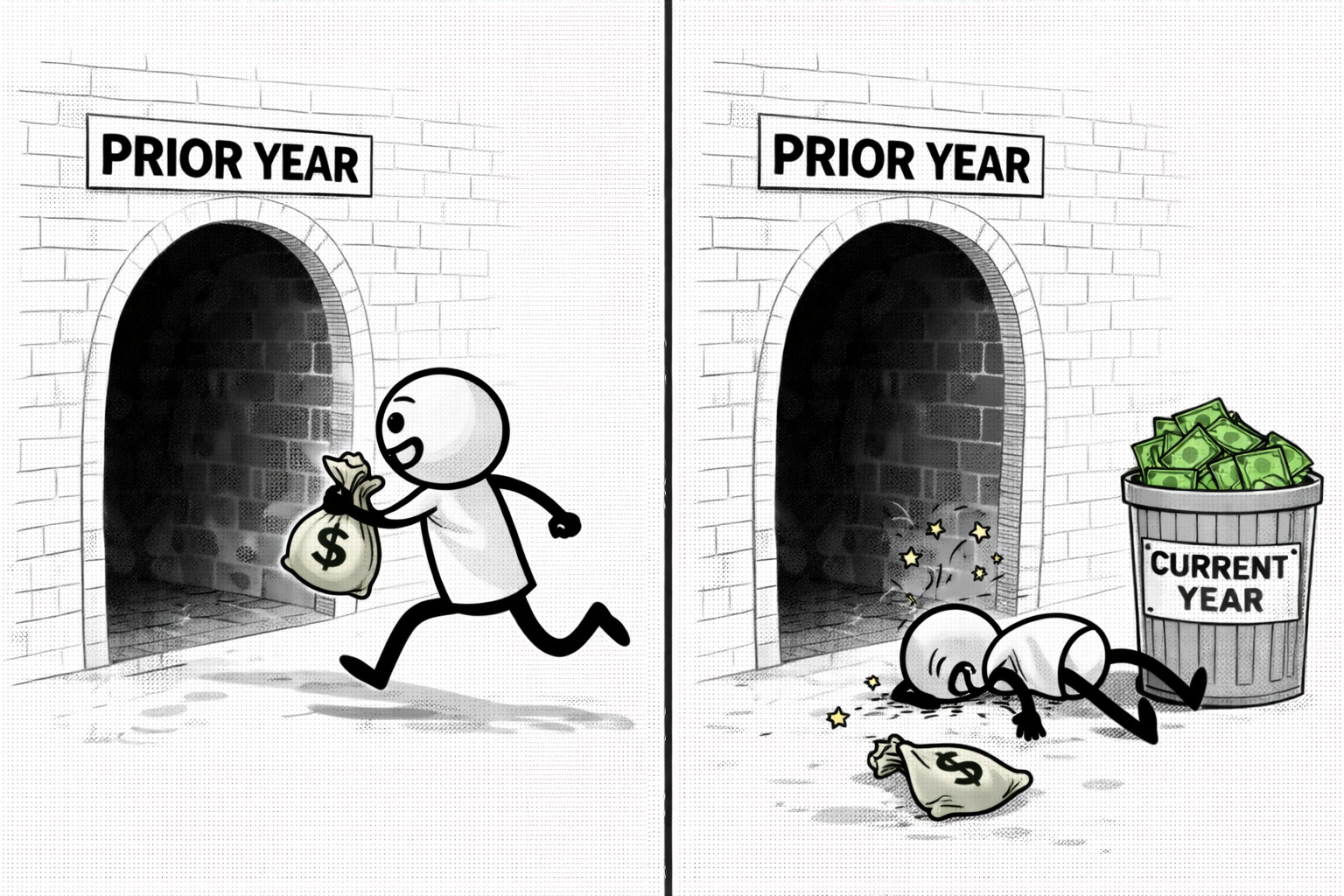
The system does not argue when you miss a window. It just changes the category.
What felt like a strategic contribution, becomes a current year adjustment. What felt like a tax saving move becomes a timing lesson. The money may still move. The deduction may still exist. But the year attached to it is no longer negotiable.
Business owners often assume contributions are flexible until April.
That belief is not irrational. Many retirement contributions are governed by the tax filing deadline. It feels natural to think that as long as filing season is still open, contribution season must be open too.
The problem is that not all business contributions follow the same clock.
Some are governed by the calendar year. Once December 31 passes, those opportunities are locked. Others are governed by the tax filing deadline and may still be available in the spring. A few exist only if a plan was established before the year ended. And correction windows only apply when something was done incorrectly, not when something was never done at all.
The contribution might still be possible. The deduction might still exist. But the year it applies to may already be decided.
Start with employee salary deferrals inside a 401(k).
For an S corporation owner paying themselves wages, salary deferrals must generally be withheld during the calendar year. That means by December 31 of the tax year. If the wages were paid without withholding a deferral, that deferral cannot be recreated later.
Doing it in March does not turn it into a prior year contribution. It becomes a current year deferral instead. The calendar year governs that decision, not the tax filing deadline.
What happens if it is done later instead? The money goes into the plan for the new year. The prior year tax outcome does not change.
The opportunity was not missed in April. It was missed when the year closed.
Employer contributions operate differently.
If a 401(k) plan existed before December 31, employer profit sharing contributions may still be made by the tax filing deadline or extension window. In that case, March or even later may still allow a prior year contribution.
New rules now allow a business to adopt a 401(k) plan after the year ends, generally up to the tax filing deadline, and still make employer profit sharing contributions for the prior year. That flexibility applies to the employer side only. The employee deferral portion is still governed by the calendar year and must have been withheld during the year itself. Once December 31 passes, that deferral door is closed.
Doing it later can still preserve the employer contribution within the filing deadline window, but it will not recreate missed employee deferrals.
What happens if it is done later instead? If the plan existed, the contribution can still apply to the prior year within the filing deadline window. If the plan did not exist, the contribution applies only to the current year.
Same type of plan. Different outcome depending on when the structure was in place.
SEP IRAs often create confusion because they feel generous.
A business owner can generally establish and fund a SEP IRA up to the tax filing deadline or extension window. That means a SEP can often be opened in March and funded for the prior year.
In this case, doing it later still works as long as it is within the filing deadline or extension window. The filing deadline governs the contribution, not the calendar year.
But once that filing deadline passes, the prior year is settled. Writing a check after that point does not attach to the prior year. It becomes a current year contribution.
The window exists. It just does not last forever.
Solo 401(k) plans introduce nuance.
A sole proprietor may still have flexibility to establish and fund certain contributions after year end depending on current rules. However, employee deferral portions are generally tied to the calendar year. Employer portions may follow the filing deadline.
That split is where business owners get tripped up.
What happens if it is done later instead depends on which component is being discussed. Employee deferrals are calendar bound. Employer contributions may be filing deadline bound. The clocks are not the same.
Here is how this plays out in real life.
An S corporation owner earns strong profits and pays themselves wages throughout the year. They intended to defer part of their salary into the company 401(k) but never processed the deferrals before December 31.
March arrives and they realize the oversight. They ask whether they can contribute that amount now and have it count for the prior year.
They cannot recreate the employee deferral. That opportunity was governed by the calendar year and closed when the year ended. They may still be able to make an employer contribution if the plan existed by December 31 and they are within the filing deadline or extension window. But the employee portion is already too late.
Now consider a sole proprietor who did not establish a SEP during the year. In March, they review their income and open a SEP IRA for the first time.
If they are within the tax filing deadline or extension window, the contribution can still apply to the prior year. In that case, the contribution is not too late. It is still within the filing deadline clock.
Two business owners. Two contributions. Same month. Completely different outcomes.
The difference is not effort. It is timing rules tied to structure.
This is why business contributions feel unpredictable in the spring.
The money is available. The intent is strong. The forms are open. But the relevant clock may have already stopped ticking for that specific action.
The system is not inconsistent. It is layered.
Calendar year deadlines determine whether certain contributions were possible at all. Filing deadlines determine whether others can still be funded. Correction windows determine whether mistakes can be repaired, not whether missed opportunities can be recreated.
Once you separate those clocks, the confusion fades.
Missing a contribution window does not mean financial ruin. It means that the decision has shifted forward instead of backward. The stress comes from not knowing whether a contribution is late, unavailable, or simply attached to a different year.
If the contribution is governed by the calendar year, doing it later will not change the prior year.
If it is governed by the filing deadline, doing it later may still preserve the prior year outcome within that window.
If a correction window applies, it only matters if something was processed incorrectly, not if something was never executed.
By the time you finish reading, you should not feel unsure about whether you missed something. You should understand which clock applied and whether that clock is still running.
The check may still be writable. The year may not be.
I write one of these every day, one retirement rule, explained in plain language and verified against the source. The daily email is free: subscribe here.
Disclaimer
This article is for educational and informational purposes only. It is not tax, legal, or financial advice and does not create an advisor–client relationship. Always consult appropriate professionals regarding your specific situation.