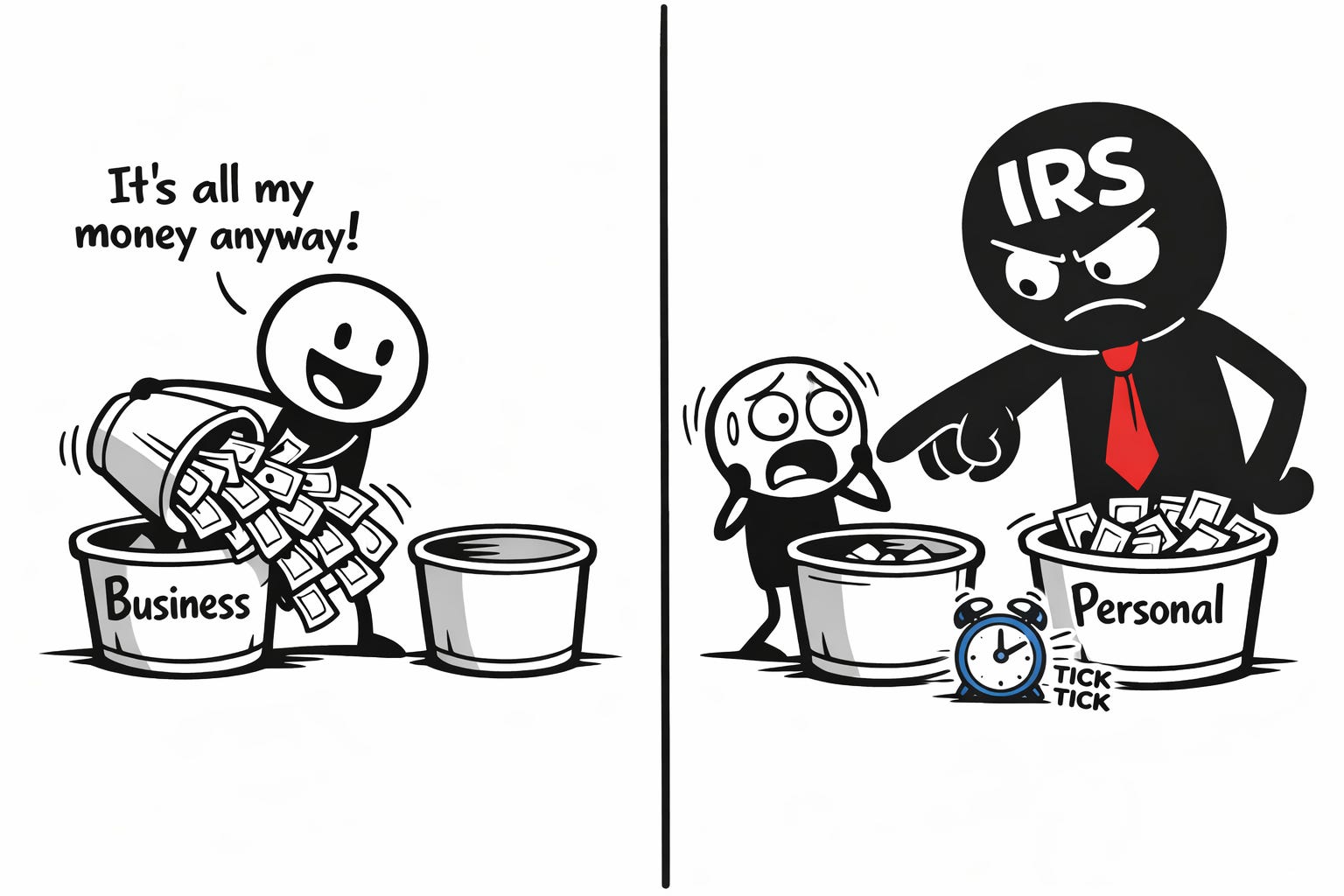
Business accounts and personal accounts may sit under the same login screen, but the system treats them as separate legal worlds. Money does not change identity just because it moves between them. Once income is earned inside a business structure, the rules that govern it are different from the rules that govern personal cash.
That distinction is not philosophical. It is mechanical
A common moment plays out like this.
A business owner looks at the company checking account in March and sees healthy cash. Their personal account looks lighter. They transfer funds over to cover a tax bill or make an IRA contribution and assume the system will sort it out later.
After all, it is all their money.
That instinct makes emotional sense. It does not make structural sense.
Business money and personal money are not interchangeable because the tax code does not treat them as interchangeable. The moment you choose a structure, you choose how money moves and when it counts.
Start with the basic rule.
If you operate as a sole proprietor, business profit flows directly to your personal return. There is no legal separation between you and the business. The income is yours as it is earned. Estimated tax payments are generally due quarterly, typically in April, June, September, and January. Paying late can trigger underpayment penalties calculated quarter by quarter.
If you move money from your business account to your personal account as a sole proprietor, that transfer itself does not create tax. The tax was created when the income was earned. The transfer is just movement of cash.
What happens if you wait to pay estimated taxes until the filing deadline in mid April? You may settle the full tax bill at filing, but penalties for earlier quarters may still apply because those are governed by quarterly deadlines, not the annual filing date.
Now shift to an S corporation.
An S corporation is a separate entity. Profit does not automatically equal personal income in the same way. Owners must generally pay themselves reasonable compensation through payroll. Wages trigger payroll tax deposit schedules. Deposits may be due monthly or semiweekly depending on payroll size.
If you move money from the S corporation account to your personal account outside of payroll, that movement is not wages. It may be treated as a distribution. Distributions have different tax implications and reporting requirements.
If payroll taxes were required and not deposited on time, penalties apply based on how late the deposits were made. Paying everything in April does not erase late deposit penalties. The clock started when wages were paid.
What happens if you decide in March to reclassify prior transfers as wages? The calendar year and payroll reporting deadlines govern that decision. You cannot casually recreate payroll for a closed year without consequences. Reporting follows structure. It does not rewrite it.
Retirement contributions add another layer.
For a sole proprietor, a SEP IRA can generally be established and funded up to the tax filing deadline or extension window. That means business profit can be evaluated in March and still produce a prior year contribution if the filing deadline has not passed.
For an S corporation owner, employee salary deferrals must generally be withheld during the calendar year. If no deferral occurred before December 31, it cannot be recreated in March. The calendar year governs that action. Employer contributions may still be possible by the filing deadline if plan rules allow it, but the employee portion is calendar bound.
What happens if you move personal money into a retirement account assuming it represents a business contribution? The system looks at whether payroll withholding occurred or whether the entity made the contribution. The source and timing matter. Money that enters an account does not automatically become the type of contribution you intended.
Here is a practical scenario.
A business owner operates as an S corporation. During the year, they take several transfers from the business account to their personal account to cover household expenses. Payroll was run, but no 401(k) salary deferrals were withheld.
March arrives. The owner wants to maximize retirement savings and assumes they can deposit funds personally into the 401(k) and count it as last year’s salary deferral.
They cannot. Employee deferrals are governed by the calendar year and must be withheld from wages during that year. Depositing money now does not convert prior distributions into deferrals.
If the plan existed before December 31, the corporation may still be able to make an employer contribution by the filing deadline. That is a different clock.
Now compare that to a sole proprietor with similar income. No payroll exists. In March, they open a SEP IRA and contribute for the prior year. That works because the filing deadline governs SEP contributions.
Same income. Same month. Different result.
The structure determines whether business money can still shape the prior year or whether the door already closed.
There is also the issue of commingling.
When business and personal accounts are blurred, recordkeeping becomes messy. For sole proprietors, commingling may not destroy the entity, but it complicates tracking deductions and substantiating expenses.
For S corporations and other entities, commingling can undermine the legal separation that structure was meant to create. It also creates audit risk. The IRS does not assume every transfer is harmless. It asks what the transfer represents.
What happens if this is cleaned up later? Records can sometimes be reconstructed, but reconstruction is not the same as clean compliance. Correction windows exist for certain operational errors, not for ignoring structural boundaries.
None of this is meant to create anxiety.
It is meant to create clarity.
Business money is governed by entity rules. Personal money is governed by individual rules. When you move funds between them, the question is not whether the money is yours. The question is which clock applies to the action you are taking.
If the action is governed by the calendar year, waiting until the filing deadline may not preserve it.
If the action is governed by the filing deadline, there may still be flexibility within that window.
If a correction window applies, it usually requires that something was done incorrectly, not that it was casually delayed.
Once you understand which structure you are operating under and which clock governs the decision, the confusion disappears.
The money is not interchangeable because the rules are not interchangeable.
And once you know which set of rules you are inside, you can see exactly where you stand.
I write one of these every day, one retirement rule, explained in plain language and verified against the source. The daily email is free: subscribe here.
Disclaimer
This article is for educational and informational purposes only. It is not tax, legal, or financial advice and does not create an advisor–client relationship. Always consult appropriate professionals regarding your specific situation.