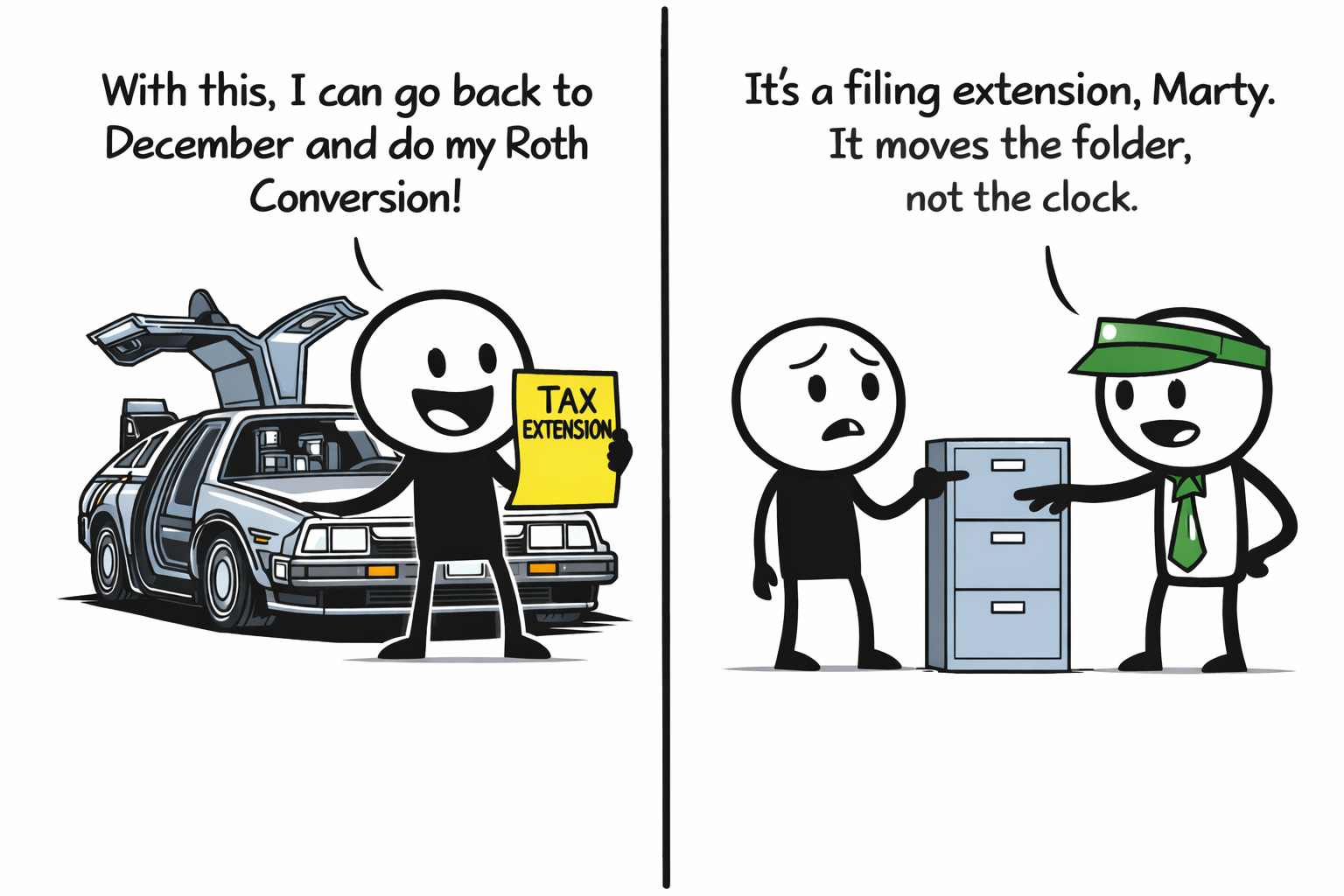
The system treats extensions as paperwork relief, not time travel.
When you file an extension, the calendar does not reset. The year does not reopen. Decisions that were governed by December 31 remain governed by December 31. What moves is the reporting deadline, not the underlying rule.
That distinction sounds subtle. It is not.
Every spring, someone discovers the word extension and assumes it means extra time for everything.
Extra time to decide on a Roth conversion.
Extra time to take an RMD.
Extra time to fix a missed 401(k) deferral.
Extra time to avoid penalties.
The logic feels reasonable. If filing is extended, surely the system is extending the entire year’s flexibility.
That is not how it works.
An extension typically gives you more time to file the return. It does not usually give you more time to pay tax owed. It does not reopen calendar-year decisions. And it does not recreate actions that were required to happen during the year itself.
Understanding what extensions actually help with is the difference between calm control and unnecessary panic.
Here is the rule that matters.
Calendar-year deadlines govern actions that must occur during the tax year itself. Once December 31 passes, those decisions are closed. An extension filed in the spring does not reopen them.
Tax-filing deadlines govern when returns are due and when certain contributions can still be made. An extension generally moves the filing deadline later into the year, often into the fall, but it does not change when tax payments were due. Interest and certain penalties may accrue from the original filing deadline even if the return is extended.
Correction windows apply only when something was done incorrectly. They may allow relief if the issue is corrected promptly, but they do not convert a missed action into a timely one.
If something is done later instead, the result depends entirely on which clock applied.
If it was governed by the calendar year, doing it later simply places it in the new year.
If it was governed by the filing deadline, doing it later may still work within that extended window.
If it falls under a correction program, relief may reduce penalties but not erase the fact that timing was missed.
Consider Roth conversions.
A Roth conversion is governed by the calendar year. It must occur during the tax year to count for that year. Filing an extension in April does not allow you to go back and create a conversion for the prior year.
If you perform the conversion later, it belongs to the current year. The tax impact shifts forward. The extension did not preserve the prior year. It only delayed reporting.
Now consider IRA contributions.
Traditional and Roth IRA contributions are governed by the original tax filing deadline, generally mid-April. Filing an extension does not extend the deadline for making a prior year personal IRA contribution. Once the original filing deadline passes, that opportunity closes. Contributing later simply applies to the current year.
By contrast, SEP IRA and Solo 401(k) employer profit-sharing contributions may follow the extended filing deadline if a proper extension is filed. That flexibility applies to the employer side. A Solo 401(k) owner wearing their “employee” hat is generally bound by the calendar year for deferral elections, and the original filing deadline for depositing those deferrals. The extension preserves the business contribution window. It does not reopen the employee deferral window.
The difference is not whether money goes into a retirement account. It is which rule governs that specific contribution.
Required minimum distributions are another area of confusion.
Most RMDs must be taken by December 31. Filing an extension does not change that deadline. If the distribution was not taken by year end, it is late.
Taking it later does not make it timely. It may reduce the accumulation of penalties, and relief may be available in certain circumstances, but the extension does not erase the calendar-year requirement.
Again, the extension moves paperwork. It does not move the rule.
Estimated tax payments follow a similar pattern.
Quarterly estimated taxes are typically due in April, June, September, and January. Filing an extension for your annual return does not eliminate penalties for underpayment in earlier quarters. Those penalties are calculated based on when payments were due during the year.
If you wait until the extended filing deadline to pay everything, you may settle the final balance, but interest and underpayment penalties may already have accrued.
The extension did not change the quarterly clock.
Here is a practical example.
A business owner finishes the year with strong income but incomplete bookkeeping. In April, they file an extension for their individual return. They assume this gives them more time to decide on retirement contributions and address potential shortfalls.
If they operate as a sole proprietor and are considering a SEP IRA, the extension may help. SEP contributions are generally governed by the filing deadline or extension window. Funding later in the year can still apply to the prior year if the extension is in place.
If they operate as an S corporation and failed to withhold 401(k) salary deferrals during the calendar year, the extension does not help. Employee deferrals are governed by the calendar year. That opportunity closed on December 31.
If they underpaid estimated taxes during the year, the extension does not stop interest from accruing from the original filing deadline. Payment timing still matters.
Same extension. Different outcomes.
The extension helps with reporting and certain filing-deadline governed contributions. It does not help with calendar-year governed actions or quarterly payment penalties.
This is why extensions feel both powerful and disappointing.
They provide breathing room for paperwork. They allow thoughtful preparation of returns. They may extend the window for specific contributions.
But they do not rewrite the timeline of the year that just ended.
They do not convert missed deferrals into timely ones. They do not convert late distributions into on-time distributions. They do not erase underpayment penalties that began accumulating earlier.
Once you see that distinction, extensions stop feeling mysterious.
The resolution here is clarity, not urgency.
An extension is not a failure. It is a tool. It helps when the action is governed by the filing deadline. It does not help when the action was governed by the calendar year or quarterly payment schedule.
If the decision required action before December 31, the extension does not change that.
If the contribution is tied to the filing deadline and an extension is properly filed, the window may still be open.
If a correction program applies, relief may reduce penalties but does not undo the original timing.
By the time you finish reading, you should know whether an extension gives you more time or simply more paperwork.
The system is consistent.
Extensions move reporting.
They do not move history.
I write one of these every day, one retirement rule, explained in plain language and verified against the source. The daily email is free: subscribe here.
Disclaimer
This article is for educational and informational purposes only. It is not tax, legal, or financial advice and does not create an advisor–client relationship. Always consult appropriate professionals regarding your specific situation.