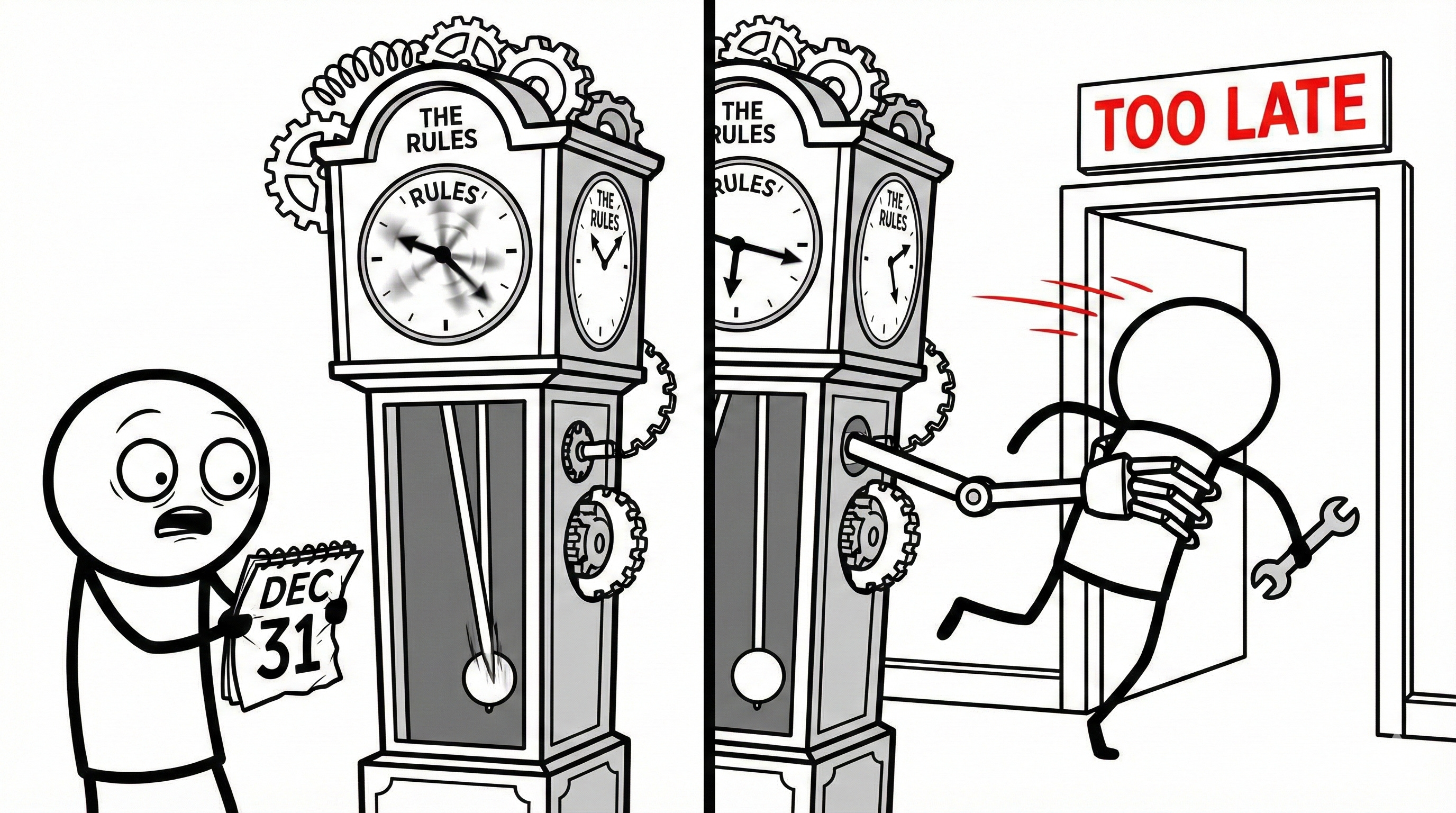
The system does not care whether you meant to contribute.
It cares whether the clock that governed that contribution was still running.
This is the mechanics version.
This is the timing rules and where they harden.
The Three Clocks Framework
Every retirement contribution is governed by one of three clocks. If you identify the clock correctly, you know whether something is still fixable or already final.
Calendar-Year Clock
This clock runs from January 1 through December 31 of the contribution year.
It governs anything that requires compensation to be deferred during the year itself. Most commonly, that means employee 401(k) salary deferrals.
The clock starts on the first day wages are paid in the year. It ends on December 31 of that same year.
“Later” does not mean April 15. It does not mean October 15. It means you are too late.
If December 31 passes and the deferral did not occur through payroll, you cannot retroactively create it. The wages were paid. The deferral did not happen. The opportunity is closed.
Once this clock stops, it does not reopen.
Dealing with an excess IRA contribution?
The Excess Contribution Correction Tool calculates your exact corrective withdrawal using the official IRS NIA formula — covering timely and untimely corrections, investment gains and losses, and multi-year penalty exposure. Includes a personalized PDF to share with your custodian or accountant.
I write one of these every day, one retirement rule, explained in plain language and verified against the source. The daily email is free: subscribe here.