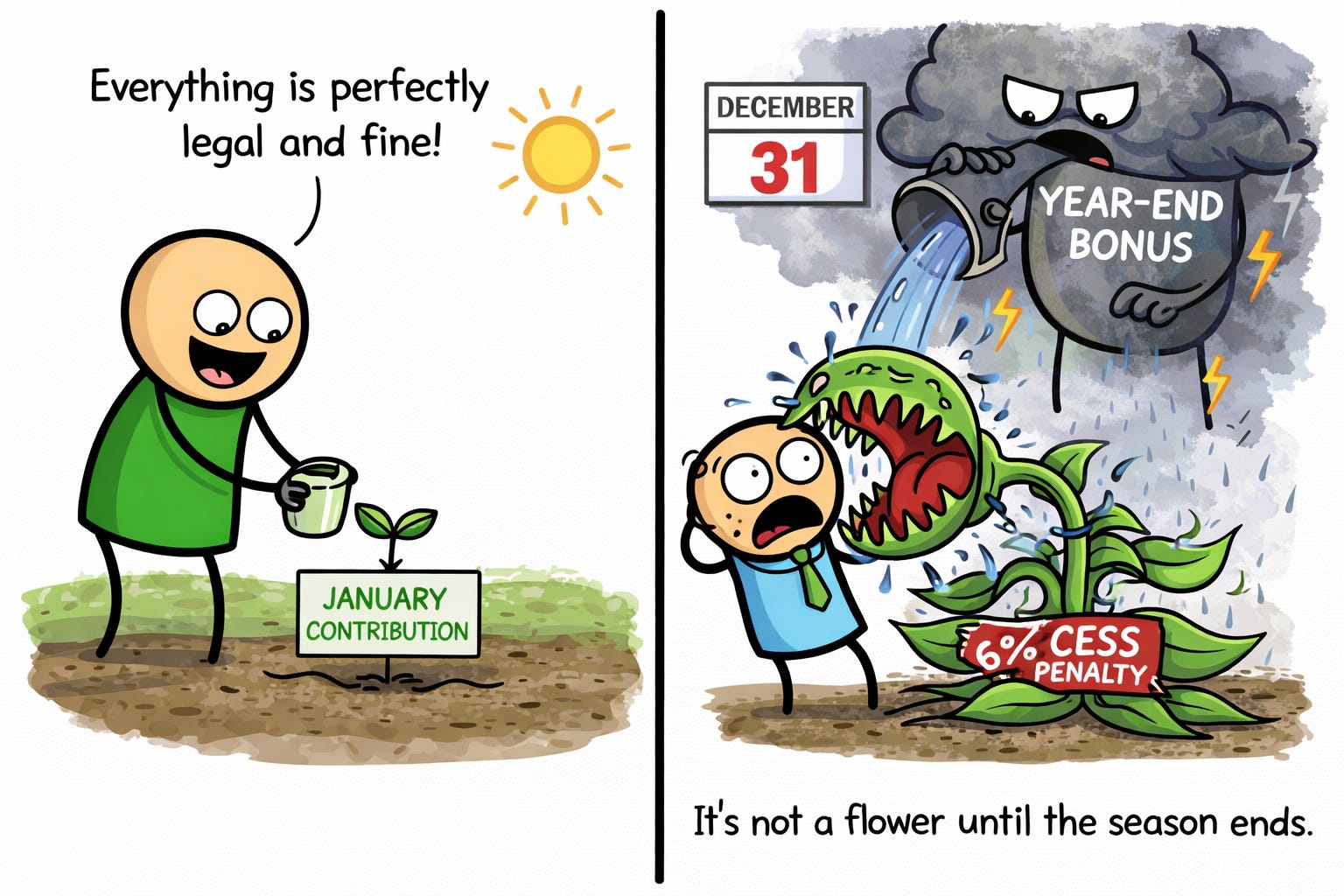
You made a Roth IRA contribution in February. At the time, your income was on track, the amount was within the limit, and your custodian accepted it without issue. Six months later, nothing about that contribution has changed. The same dollars sit in the same account.
But the contribution just became excess. Not because you did anything wrong in February. Because something changed between then and now.
An IRA contribution exists in a provisional state from the moment it is made until the tax year closes. The IRS does not evaluate the contribution at the time of deposit. It evaluates the contribution based on conditions that exist at year-end and on information reported on the tax return. Until those conditions are final, the contribution is neither valid nor invalid. It is pending.
This is why a Roth contribution made in January can become excess in December. The contribution was fine when you made it. Your MAGI had not been finalized yet. A bonus, a stock sale, a Roth conversion, a K-1 from a partnership, rental income that materialized in Q4: any of these can push your MAGI past the Roth phase-out range and retroactively reduce or eliminate your allowable contribution.
The moment the tax year ends, the provision resolves. If your final MAGI is within the limit, the contribution was always valid. If your MAGI exceeds the limit, the contribution was always excess, even though it was perfectly reasonable when you made it.
The same logic applies to earned income. You contribute $7,500 to a Traditional IRA in March based on a job you expect to hold all year. In August, you are laid off. Your total earned income for the year ends up at $4,000. Your maximum IRA contribution is now $4,000. The other $3,500 is excess. The contribution became excess the moment December 31 passed and your earned income was finalized.
If you had found a new job in October and earned enough to cover the full $7,500, the contribution would have remained valid. The status of the contribution was in flux the entire year. It was not locked in until the year closed.
The correction deadline adds another layer to this timing. Excess contributions can be corrected without penalty if you remove the excess plus allocable earnings by your tax filing deadline, including extensions. For most people, that means April 15 or October 15 of the following year.
Here is where the timing creates a gap. You contribute in January 2026. Your MAGI becomes a problem in November 2026. You discover the excess when preparing your return in March 2027. Your correction deadline is April 15, 2027 (or October 15, 2027 with an extension).
That is a 15-month window from the moment the contribution became excess to the penalty-free correction deadline. But only if you catch it. If you file your return in February 2027 without noticing the excess, and you did not file an extension, your correction window closes April 15. After that, the 6% penalty applies.
The contribution did not become excess on January 1, 2026 when you contributed. It did not become excess on November 15, 2026 when the bonus arrived. It became excess on December 31, 2026 when the tax year closed and the final numbers were locked. Everything before that was a projection.
This matters because it changes how you should think about timing your contributions.
Contributing early in the year maximizes time in the market. But it also maximizes the risk that an income change later in the year creates an excess. Contributing later in the year, when you have a better sense of your final MAGI, reduces that risk but sacrifices months of potential growth.
There is no universally correct answer. A salaried employee with stable W-2 income and no side business has low risk of a surprise MAGI change. Contributing in January makes sense. A self-employed person with variable income, capital gains exposure, or partnership K-1s has a much higher risk. Waiting until Q4, or even early the following year before the April 15 deadline, might be the safer approach.
The contribution itself is a neutral event. It is a deposit. It becomes valid or excess based on facts that may not exist yet. The people who get penalized are not the ones who contributed wrong. They are the ones who did not check the final numbers before the correction window closed.
An excess contribution is not made. It is revealed.
I write one of these every day, one retirement rule, explained in plain language and verified against the source. The daily email is free: subscribe here.
Full archive, worksheets, and search live at RetirementNewsRundown.com
Run your own numbers with the Excess Contribution Correction Tool
Disclaimer This article is for educational and informational purposes only. It is not tax, legal, or financial advice and does not create an advisor-client relationship. Always consult appropriate professionals regarding your specific situation.