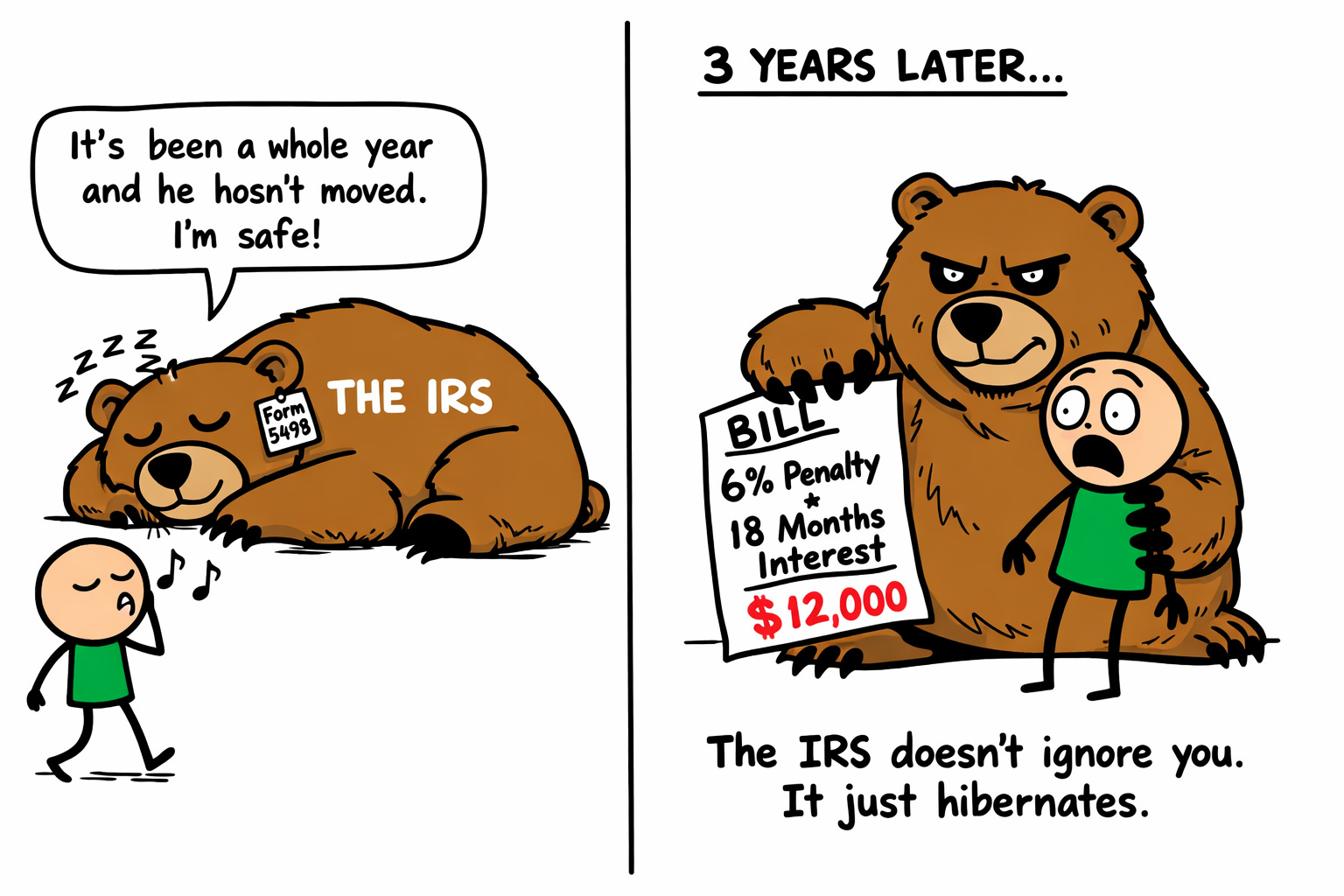
You made an excess contribution. Your custodian accepted it. You filed your return. No red flags, no notices, no phone calls. Months pass. You start to assume everything is fine.
It might be. Or the IRS might not have gotten to your file yet.
The IRS does not monitor IRA contributions in real time. There is no system that watches deposits flow into your account and compares them against your income or contribution limits as they happen. The enforcement is retroactive. It happens through form matching, and form matching happens on its own schedule.
The primary form is Form 5498. Your custodian files this with the IRS by May 31 of the year following the contribution (June 1 in 2026, since May 31 falls on a Sunday). It reports the total amount contributed to your IRA for the tax year, the fair market value of the account as of December 31, and whether a required minimum distribution is due for the current year.
The IRS receives a Form 5498 from every custodian where you have an IRA. If you contributed to IRAs at three different custodians, the IRS gets three forms. It adds them up. If the total exceeds the annual limit, the IRS has a data point that does not match.
But that is only one trigger. The more common matching happens between Form 5498 and your Form 1040.
If you claimed a Traditional IRA deduction on your tax return, the IRS compares the deduction amount against what your custodian reported. If the numbers do not match, a notice follows. If you claimed a deduction for a contribution your custodian did not report, the IRS wants to know why.
If you contributed to a Roth IRA and your MAGI exceeds the phase-out range, the IRS can cross-reference your adjusted gross income on the 1040 against the Roth contribution reported on Form 5498. This cross-reference is not instant. The IRS processes millions of returns and millions of 5498 forms. The matching runs in batches, and some batches take longer than others.
The timeline for receiving a notice varies widely. Some people receive a CP2000 or CP2501 notice within 12 months of filing. Others do not hear anything for two or three years. The IRS has three years from the filing date to audit a return under the standard statute of limitations, or six years if they suspect a substantial understatement of income (defined as understating income by more than 25%).
An excess contribution does not automatically trigger the six-year window. But if the excess is large enough, or if it leads to other discrepancies on the return, the extended window can apply.
The absence of a notice in the first year does not mean the contribution was valid. It means the IRS has not matched the forms yet. People who assume silence equals approval sometimes discover the problem three years later when the penalties have been compounding the entire time.
There is a second detection path that most people do not think about: Form 5329.
If you have an excess contribution and you know about it, you are supposed to file Form 5329 with your tax return to calculate and pay the 6% excise tax. If you correct the excess before the filing deadline, you do not owe the penalty and do not need to file Form 5329 for the excess.
But if you do not correct it and do not file Form 5329, the IRS eventually figures it out through the Form 5498 data. When they do, they assess the 6% penalty themselves and add interest from the original due date. The penalty you would have owed on April 15, 2027 now comes with 18 months of interest tacked on because the IRS did not send the notice until October 2028.
Filing Form 5329 yourself, even if you missed the correction deadline, starts the statute of limitations running on that specific issue. Not filing it leaves the door open indefinitely.
The third detection path is Form 1099-R.
When you remove an excess contribution through a corrective distribution, your custodian reports it on Form 1099-R with a distribution code of P (return of excess for a prior year) or 8 (return of excess for the current year). The IRS receives this form and expects to see a corresponding entry on your tax return.
If the IRS receives a 1099-R coded as a return of excess but your tax return does not reflect the removal, they notice. If they receive a 5498 showing a large contribution but no 1099-R showing a removal and no Form 5329 showing a penalty payment, they notice that too. The paper trail points in one direction: money went in, nothing came out, no penalty was reported.
Here is what the detection timeline typically looks like.
Year one: You contribute in January 2026. Custodian accepts it. No immediate flags.
May 2027: Custodian files Form 5498 reporting the 2026 contribution. The IRS receives it.
June to December 2027: The IRS runs automated matching between Form 5498, your 1040, and any 1099-R forms. If the match finds a discrepancy, it enters a queue for review.
2027 to 2029: If the discrepancy is flagged, the IRS generates a notice. CP2000 notices (proposed changes based on information the IRS received from third parties) are the most common for contribution mismatches. The notice proposes additional tax, the 6% penalty, and interest.
The gap between the contribution and the notice can be one year or four years. The IRS does not have a fixed timeline. It depends on processing backlogs, the type of mismatch, and whether your return was selected for additional review.
The practical takeaway is this. If you have an excess contribution and you know about it, fix it before the deadline. Do not wait to see if the IRS notices. They will. The question is not whether. It is when. And every year between the excess and the notice is another 6% penalty plus interest that could have been avoided.
If you are unsure whether a past contribution was excess, pull your Form 5498 for that year and compare the reported contribution against your allowable limit based on your income and filing status. If the numbers do not match, the correction window for the current year may still be open. For prior years, the 6% penalty applies but can be stopped by removing the excess now.
The IRS is slow. But the paper trail is permanent.
I write one of these every day, one retirement rule, explained in plain language and verified against the source. The daily email is free: subscribe here.
Full archive, worksheets, and search live at RetirementNewsRundown.com
Disclaimer This article is for educational and informational purposes only. It is not tax, legal, or financial advice and does not create an advisor-client relationship. Always consult appropriate professionals regarding your specific situation.