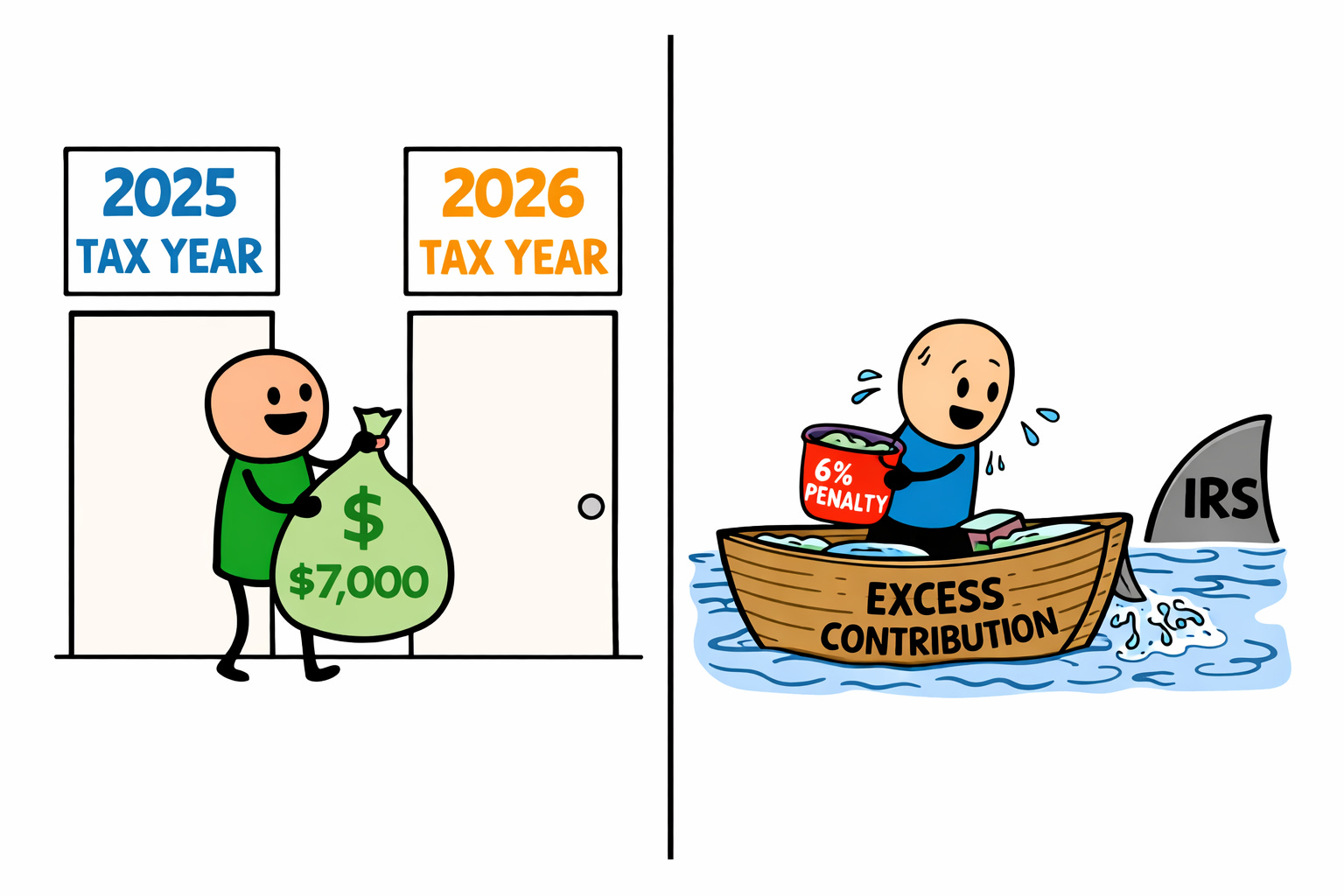
Between January 1 and April 15, every IRA contribution exists in a gray zone. You can designate it for the current year or the prior year. Both are legal. Both are allowed. But they are not the same decision.
A $7,000 contribution made on March 10, 2026 could be a 2025 contribution or a 2026 contribution. The money is identical. The tax consequences are not.
If it is designated as a 2025 contribution, it counts against the 2025 limit. It gets reported on the 2025 tax return. The deductibility depends on 2025 income, 2025 filing status, and whether the taxpayer had access to an employer plan in 2025.
If it is designated as a 2026 contribution, all of those variables shift to 2026 numbers.
The custodian asks you which year. That is the entire guardrail. There is no automated check. No income verification. No flag that says this person already maxed out the prior year. You pick a year, the custodian records it, and the money goes in.
This is where excess contributions are born.
Someone maxed out their IRA in 2025. They forget. In February 2026 they make another contribution and designate it for 2025. The custodian accepts it. The account now holds $14,000 in 2025 contributions against a $7,000 limit. The excess sits there quietly earning returns and racking up a 6% penalty every year it is not corrected.
The custodian did nothing wrong. They are not required to track whether you are over the limit. That is your job.
The designation also matters for Roth IRA eligibility. The Roth income limits are different every year. Someone whose MAGI was $148,000 in 2025 might have been eligible for a full Roth contribution. If their MAGI jumps to $165,000 in 2026, they might not be eligible at all.
Making a contribution in March 2026 and designating it for 2025 is fine if the 2025 income supports it. Designating it for 2026 could create an excess contribution the moment it lands.
The tax return is where this gets locked in. Once you file and report the contribution for a specific year, changing it requires an amended return, a corrective distribution, and the net income attributable calculation. None of that is simple.
The rule is straightforward. Between January 1 and the tax filing deadline, you choose which year a contribution belongs to. After the filing deadline, the designation is final.
The problem is that most people treat this like an afterthought. They contribute first and figure out the year later. By the time they realize the wrong year was selected, the deadline has passed and the correction window has narrowed.
Pick the year before you move the money. Not after.
I write one of these every day, one retirement rule, explained in plain language and verified against the source. The daily email is free: subscribe here.
Full archive, worksheets, and search live at RetirementNewsRundown.com
Check out the Tools Page
Disclaimer This article is for educational and informational purposes only. It is not tax, legal, or financial advice and does not create an advisor-client relationship. Always consult appropriate professionals regarding your specific situation.