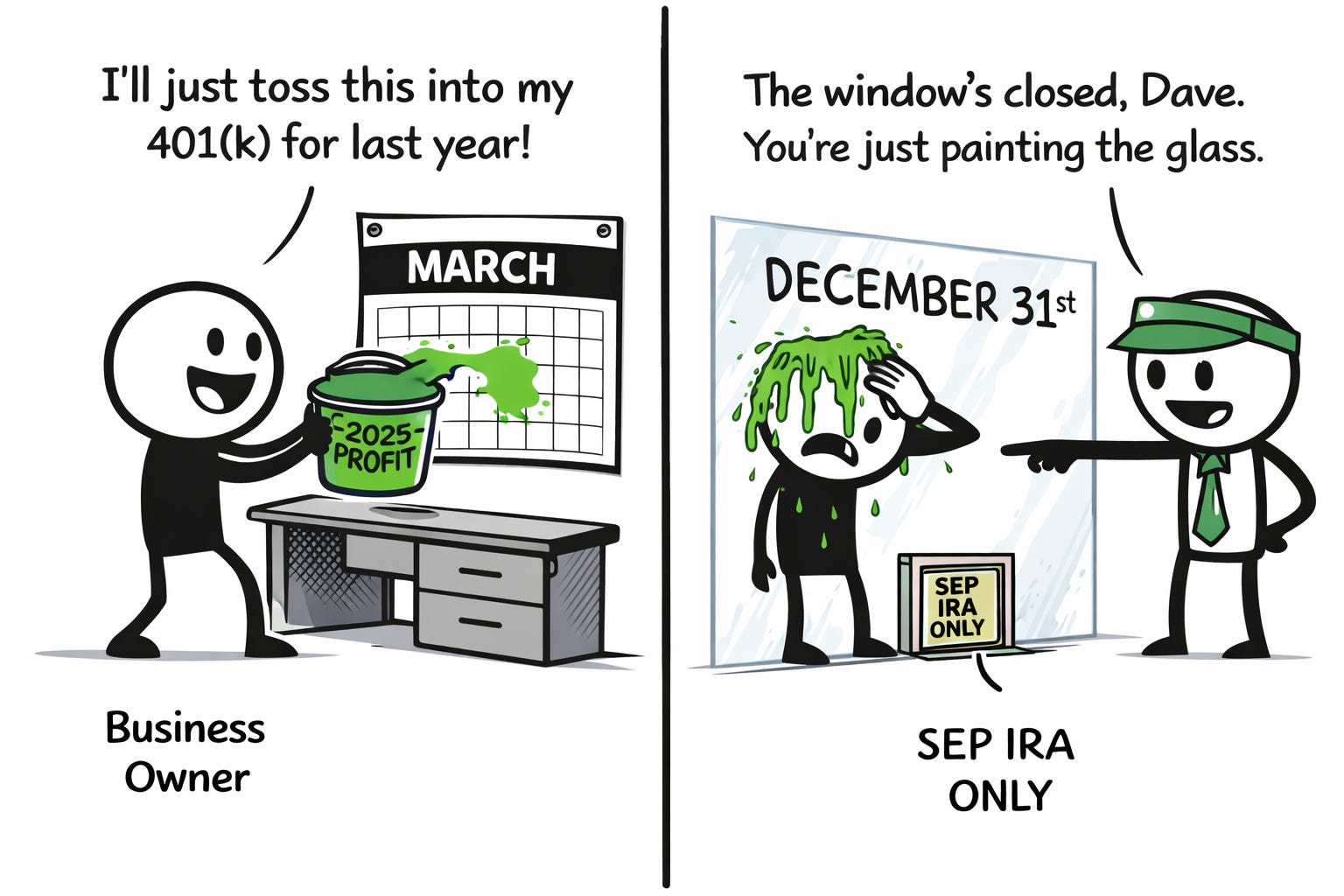
The system allows hesitation in March. It does not allow reversal.
By the time business owners sit down with their numbers in late winter or early spring, the prior year feels recent. The bank balance is still visible. The income is still fresh. The assumption is that decisions are still flexible.
Then they discover which clock was actually running.
And that is the moment March becomes permanent.
March is when clarity arrives. It is also when boundaries show up.
A business owner reviews profit and realizes they did not run enough payroll to maximize retirement contributions. Or they forgot to set up salary deferrals. Or they assumed an extension would reopen something that quietly closed on December 31.
The numbers are clear. The cash is there. The intent is strong.
The calendar is not interested.
The misconception is that March is still part of last year. It feels close enough to adjust. In reality, March sits inside a different set of rules.
Here is what governs that moment.
Calendar-year deadlines control actions that had to occur during the tax year itself. Once December 31 passes, those actions are fixed. Employee 401(k) salary deferrals are generally governed by the calendar year. If they were not elected and withheld during the year, they cannot be recreated later. (Note: if this is the very first year you opened a Solo 401(k) as a sole proprietor, there may be a narrow window to make that initial deferral election up to the original filing deadline. That is a first-year exception, not a year-two strategy.)
Tax-filing deadlines control reporting and certain employer contributions. Those deadlines generally fall in mid April for individuals, and may extend into the fall if a proper extension is filed. Some employer contributions, such as SEP IRA or Solo 401(k) profit-sharing contributions, may follow this filing deadline clock.
Correction windows apply when something was processed incorrectly. They do not reopen decisions that were never made.
If something is done later instead, the outcome depends entirely on which clock applied.
If it was calendar-year bound, doing it later simply makes it a current year action.
If it was filing-deadline bound and the window remains open, doing it later may still preserve the prior year.
If it was missed entirely and not eligible for correction, later action may reduce damage but not eliminate it.
That distinction becomes painfully clear in March.
Consider an S corporation owner.
Throughout the year, they paid themselves wages. They meant to defer part of that salary into their Solo 401(k) but never processed the deferral election. Payroll ran. No withholding occurred.
March arrives. Profit was strong. They want to contribute the maximum.
Employee deferrals are governed by the calendar year. If they were not elected and withheld before December 31, they cannot be recreated. Depositing money in March does not convert prior wages into prior year deferrals.
What happens if they contribute now? It applies to the current year. The prior year tax outcome is unchanged.
Now consider the employer portion.
If the Solo 401(k) plan existed before the year ended, employer profit-sharing contributions may follow the tax filing deadline. If a proper extension is filed, that deadline may move later into the year. In that case, March does not close the employer window.
Same plan. Two clocks.
March reveals which one was running.
Now look at a sole proprietor.
No payroll exists. Profit flows directly to the personal return. In March, they evaluate income and decide to open a SEP IRA for the prior year.
SEP IRA contributions are generally governed by the tax filing deadline or extension window. If that deadline has not passed, the contribution can still apply to the prior year.
What happens if they wait beyond that filing deadline? The prior year window closes. Contributions made after that point apply only to the current year.
In this case, March still allows flexibility because the filing-deadline clock is still running.
Same month. Different outcome. Structure determines which deadline matters.
Estimated tax payments create another March realization.
Quarterly estimated taxes are typically due in April, June, September, and January. If payments during the year were insufficient, underpayment penalties may accrue quarter by quarter.
Filing an extension does not eliminate those penalties. Paying the full balance in April may stop further accumulation, but it does not erase what accrued earlier.
What happens if the business owner waits until the extended filing deadline to pay? Interest and penalties may continue from the original filing deadline because the extension moves paperwork, not payment obligations.
March often reveals that the penalty clock started long before the return was prepared.
This is why March feels unforgiving.
The numbers are final. The year is closed. The owner sees clearly what could have been done. The flexibility that seemed available in December no longer exists in the same way.
But it is not arbitrary.
March does not remove options. It simply shows which options expired on December 31 and which ones remain open until the filing deadline.
Calendar-year deadlines close at year end.
Tax-filing deadlines close in the spring, or later if extended.
Correction windows apply only to operational mistakes, not missed decisions.
Once you understand which clock governed the action, the frustration softens.
The resolution here is not regret.
Business ownership involves timing decisions. Some decisions are locked by the calendar year. Others remain adjustable into the filing season. Some can be corrected if processed incorrectly. Others cannot be recreated.
The moment business owners realize they cannot undo March is not a failure. It is a clarity point.
If the action required payroll withholding during the year, March will not reopen it.
If the contribution is governed by the filing deadline and that window remains open, March may still allow movement.
If the issue involves underpayment penalties, March may reveal what accrued, but it also marks the point where forward planning begins.
The system is consistent. It is mechanical. It responds to structure and timing, not intention.
By the time you finish reading, you should not feel blindsided by March.
You should know which clock applied to your decision, and whether it is still running.
March does not undo the year.
It just tells you which parts are already written.
I write one of these every day, one retirement rule, explained in plain language and verified against the source. The daily email is free: subscribe here.
Disclaimer
This article is for educational and informational purposes only. It is not tax, legal, or financial advice and does not create an advisor–client relationship. Always consult appropriate professionals regarding your specific situation.