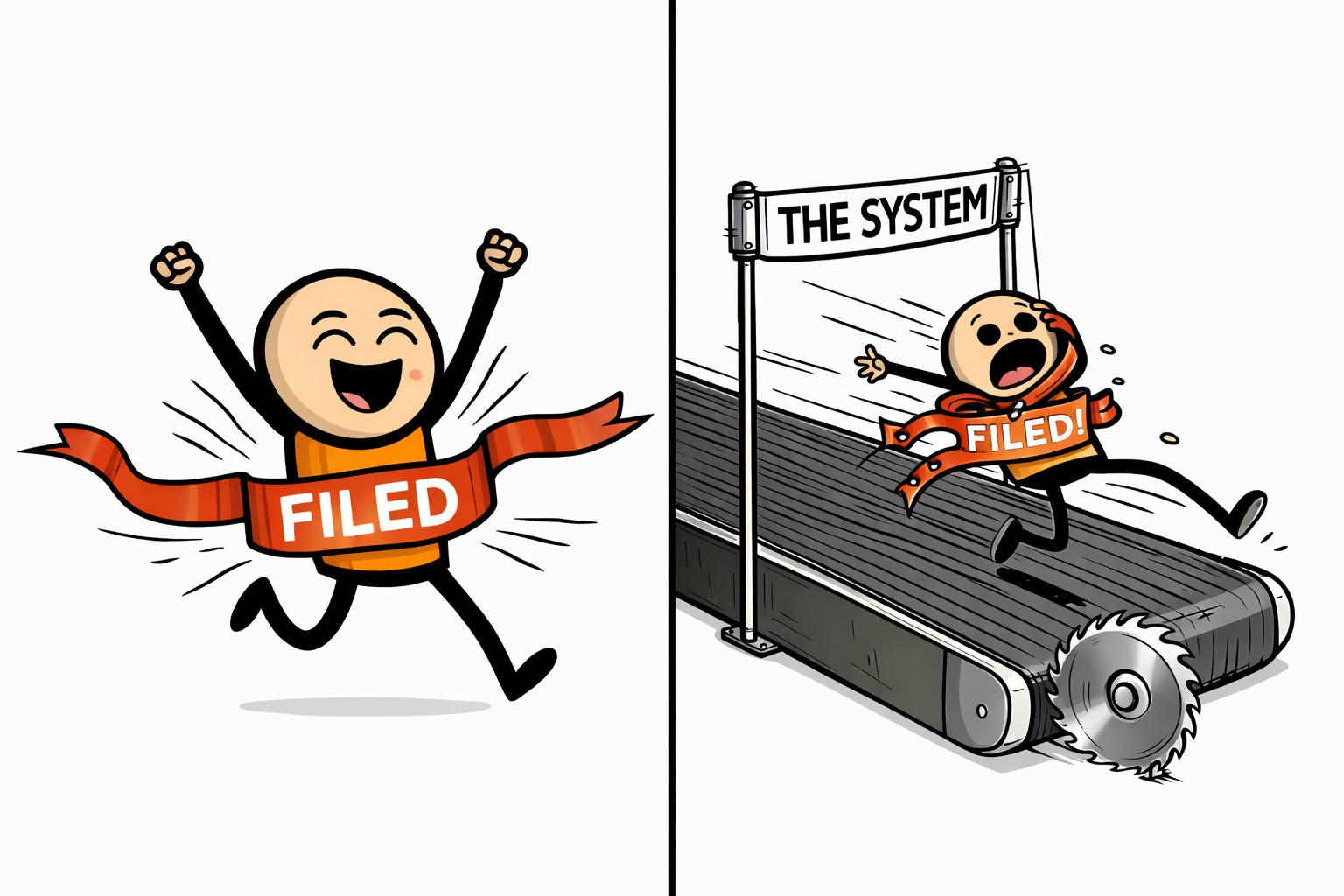
The system treats filing like a receipt, not a reset.
You submit the return. It’s accepted. You get a refund or a balance due. Your brain gets the satisfying sensation of closure. A task is complete. A year is finished. You can stop thinking about it.
Then something happens in May, or August, or two years from now, and you realize filing did not end anything. It just moved the paperwork to the next stage.
A lot of people experience tax filing as a finish line.
They gather documents. They answer questions. They hit submit. The return is filed. The year feels sealed. They assume whatever decisions were still open must now be locked in, and whatever was locked in must now be safe forever.
That feeling is understandable. It’s also the exact place people get blindsided.
The misconception is that the filing event controls the year. It does not. The filing event reports the year. The calendar year controlled most of the decisions that mattered, and other clocks keep running even after the return is filed.
Here is the rule that makes the confusion so persistent.
Some actions are governed by the calendar year. Those are decided by December 31 of the tax year, regardless of when you file.
Some actions are governed by the tax filing deadline, generally mid-April unless extended. Those can still be influenced up to that point, but not beyond it unless the rules explicitly allow extension-based timing.
Some situations involve correction windows. Those apply when something was done incorrectly. They do not recreate actions that never happened.
Filing your return interacts with all of these, but it controls only one thing: reporting.
What happens if something is done later instead depends on which clock actually governed the action in the first place.
Roth conversions are a clean example of a clock that filing does not touch.
A conversion is a calendar year event. It either occurred during the tax year or it did not. Filing early in February does not preserve the option. Filing late in October does not reopen it.
If you convert later instead, it belongs to the current year. The tax impact shifts forward. Nothing about filing changes that.
People often discover this the hard way. They file their return, see their tax bracket, and then decide they should have converted income the prior year. Filing did not close that door. The calendar closed it. Filing simply makes the reality visible.
Required minimum distributions work the same way.
Most RMDs must be taken by December 31. Filing a return does not change that deadline. If it was missed, taking it later does not make it timely. It may limit how much worse the situation gets, and relief may be available in some circumstances, but the filing event did not control the requirement.
If you take it later instead, it is still late. Filing does not rewind the calendar.
Personal IRA contributions are where filing and timing get misunderstood.
Traditional and Roth IRA contributions for individuals are governed by the original tax filing deadline, generally mid-April. Filing an extension does not extend this deadline for personal IRA funding.
If you contribute later instead, it applies to the current year. It does not retroactively become a prior year contribution because your return was extended or filed late.
This is a common trap because it feels like an extension should buy more time across the board. It does not. Extensions move filing. They do not automatically move every contribution window.
SEP IRAs and certain employer plan contributions are where filing actually can matter.
SEP IRA contributions may be established and funded up to the filing deadline, including the extension window if a proper extension is filed. Certain employer profit-sharing contributions may also follow that extended deadline depending on plan rules.
If you fund later instead and you are still inside that filing deadline window, the contribution can still apply to the prior year. Once that deadline passes, the prior year window closes and later funding becomes current year activity.
This is why business owners experience tax filing differently. For some contributions, filing is not just reporting. It is the outer edge of the contribution window.
Filing also does not end penalty clocks.
Estimated tax payments are typically due quarterly in April, June, September, and January. Underpayment penalties are calculated quarter by quarter. Filing your return in April does not erase penalties that accrued because payments were light in June or September.
If you pay later instead, you may settle the balance, but penalties tied to earlier quarter underpayments may still exist.
Payroll deposits behave similarly. Filing the annual forms does not erase late deposit penalties if payroll taxes were deposited late during the year. Those penalties attach to deposit deadlines, not the day you filed the return.
Filing is paperwork closure. Penalty clocks are timing closure. They are not the same.
Here is a scenario that shows why filing does not feel like an ending once you understand the system.
A small business owner files their return early. They feel ahead of the game. In March, they learn that a SEP IRA contribution could still reduce their prior year taxable income because they are still inside the filing deadline window.
They assume filing early means they missed the opportunity. They did not. For a SEP, the filing deadline clock governs the contribution. They may still be able to contribute even though the return was already filed, because the return can be amended if needed and the rules still allow the contribution.
Now flip the scenario.
Another business owner is an S corporation paying themselves W-2 wages. They filed early and then realized they never withheld 401(k) salary deferrals during the year. They want to “fix it” in March.
They cannot recreate prior year employee deferrals because that action is governed by the calendar year and payroll timing. Contributing later instead simply applies to the current year.
Same filing behavior. Two different outcomes. The difference is not effort. It is which clock governed the action.
This is why filing your return does not end anything.
It ends one thing: the act of reporting what already happened.
It does not end the IRS ability to question it later. It does not end the reality that some clocks were running long before you filed. It does not end contribution windows that are still open until the filing deadline. It does not end penalty clocks that were already accumulating.
The system is quiet about this because it is not trying to give you closure. It is trying to record events and calculate consequences based on timing rules.
The resolution here is not fear.
Filing is still important. Filing is still progress. It is still the right kind of closure for paperwork.
The mistake is expecting it to function like a reset button.
If an action was governed by the calendar year, filing does not reopen it.
If an action is governed by the filing deadline, filing does not necessarily close it, and it may not even be the final step if the law still allows action within that window.
If a correction window applies, it exists because something was processed incorrectly, not because filing created a second chance.
By the time you finish reading, you should not feel paranoid about filing. You should feel oriented.
Filing your return does not end anything because the system is not designed around feelings. It is designed around clocks. Once you know which clock governs which action, you stop expecting filing to be the finish line.
It is a checkpoint.
I write one of these every day, one retirement rule, explained in plain language and verified against the source. The daily email is free: subscribe here.
Full archive, worksheets, and search live at RetirementNewsRundown.com.
Disclaimer
This article is for educational and informational purposes only. It is not tax, legal, or financial advice and does not create an advisor–client relationship. Always consult appropriate professionals regarding your specific situation.