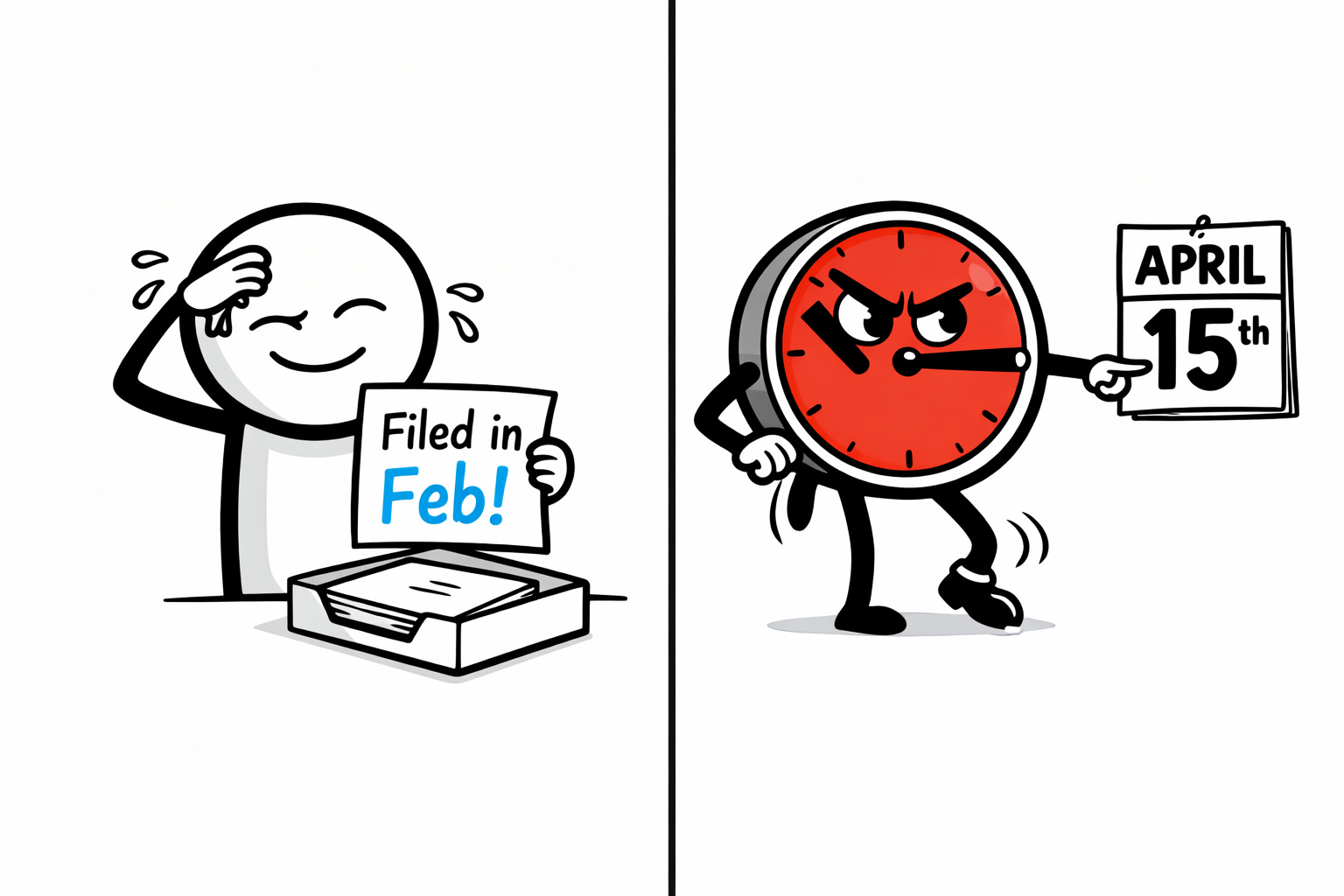
The system treats filing your tax return as the beginning of several processes, not the end of the year.
Once the return is submitted and accepted, people tend to feel a sense of completion. The paperwork is finished. The numbers are locked. The year feels officially closed.
The tax system does not see it that way. Filing does not shut the door on the year. In several important ways, it quietly opens the next phase of the process.
Many people experience filing as the final step in a long administrative chore. They gather documents, answer questions, and submit the return. Once the confirmation arrives, the assumption is that everything connected to that year is now settled.
That assumption is where confusion begins.
Filing a return does not end the system’s involvement with that year. In many cases it starts clocks that determine how long something can be reviewed, corrected, questioned, or adjusted.
Someone files in March and assumes the year is complete. Then months later a notice arrives asking for clarification. A contribution opportunity still exists until the filing deadline. A mistake that was made earlier can still be corrected. In other situations, an action that never happened during the year remains permanently closed no matter how early the return was filed.
The act of filing did not finalize those outcomes. It simply started the next phase of the system.
The rule that creates this confusion is that filing controls reporting, but many other processes operate on separate clocks.
Some decisions are governed by the calendar year. These lock on December 31 of the tax year. Filing early or late does not change that deadline.
Other actions are governed by the tax filing deadline, generally mid April unless an extension is filed. Those actions can still occur after the year ends, but only until that filing deadline arrives.
A third category involves correction windows. These apply when something happened incorrectly and the system allows a limited period to fix the error.
Filing interacts with each of these clocks in a different way. Sometimes it starts a clock. Sometimes it leaves another clock still running.
What happens if something is done later instead depends entirely on which clock governed the action in the first place.
If the action was tied to the calendar year, doing it later simply moves it into the next year. The original year cannot be recreated.
If the action is governed by the filing deadline, doing it later may still count for the prior year as long as that deadline has not passed.
If a correction window applies, doing it later may fix an error but it does not recreate an action that never happened.
Understanding that distinction explains why filing sometimes feels like the end of the process and other times feels like the beginning of new questions.
Consider how filing interacts with review timelines.
Once a return is filed, the statute of limitations for review eventually begins. Under normal circumstances the IRS generally has three years to review a filed return.
The timing of that clock depends on when the return is considered filed under the law.
If a return is filed early, for example in February, the IRS treats that return as if it were filed on the official due date, usually April 15. The review clock begins on that due date rather than the earlier submission.
If the return is filed later instead, such as under extension in October, the review clock begins on the actual filing date.
Filing early does not create a head start on the statute of limitations. Filing late pushes the clock back.
In other words, filing starts the review process, but the system determines when that clock actually begins.
Now look at contribution timing.
Traditional and Roth IRA contributions for individuals are governed by the original tax filing deadline, usually mid April. Filing your return earlier does not close that contribution window.
Someone can file their return in March and still make a prior year IRA contribution in early April if the deadline has not yet passed. If they contribute later instead, after that April deadline, the contribution simply applies to the current year.
If the contribution occurs after the return has already been filed, the reporting may need to be updated. Depending on the situation, that can involve amending the return or filing additional reporting forms.
Filing the return does not close the contribution window. The filing deadline controls it.
Business plans operate a little differently. SEP IRA contributions and certain employer profit sharing contributions may be funded up until the filing deadline including extensions if a proper extension is filed.
What happens if those contributions are made later instead? If they occur before the extended filing deadline, they may still count for the prior year. Once that deadline passes, the opportunity closes and the contribution becomes a current year event.
Again, filing did not end the contribution window. It simply reported the year while the window remained open.
Correction rules provide another example of how filing starts processes.
If a retirement account distribution was processed incorrectly, or if a rollover was handled improperly, the system often provides correction procedures that can be used within a defined window.
Those correction windows are tied to the event itself, not the filing of the return. Filing simply reports the event.
What happens if the correction is attempted later instead? If the correction window has already closed, the error may no longer be fixable through the standard process. If the window is still open, the correction can still occur even though the return has already been filed.
The system separates the act of reporting from the act of correcting.
A simple scenario illustrates how these clocks overlap.
Imagine someone files their tax return on March 10, 2026 for the 2025 tax year.
At that moment several things are true at the same time.
The calendar year decisions are already final because December 31, 2025 has passed. If they wanted to perform a Roth conversion for 2025, that opportunity is already gone. Doing it later instead simply creates a 2026 conversion.
Their IRA contribution window for 2025 remains open until the mid April 2026 filing deadline. If they contribute on April 5, 2026 it can still count for 2025. If they wait until May instead, it becomes a 2026 contribution.
The statute of limitations clock for IRS review will begin on April 15, 2026 because the return was filed early. If the return had been filed later instead, under extension in October, the review clock would begin on that October filing date.
And if a processing error occurred in a retirement account transaction during 2025, the correction window may still be open depending on the specific rule involved.
The resolution is not to treat filing as something mysterious or threatening.
Filing a return is still the correct step. It organizes the record of the year and establishes the official reporting of what occurred.
The confusion comes from assuming that filing is the final moment that determines everything connected to that year.
In reality the retirement and tax systems operate on multiple clocks at the same time. Calendar year deadlines determine when certain actions must occur. Filing deadlines determine how long some contributions can still be made. Correction windows determine whether mistakes can still be fixed.
Filing interacts with those clocks, but it does not replace them.
When people understand that filing often begins review timelines while other clocks continue running independently, the system stops feeling unpredictable.
It becomes a set of timelines that simply need to be recognized.
By the time the return is filed, some decisions were already final months earlier. Others may still remain open until the filing deadline. A few situations may still allow correction if something was handled incorrectly.
Once you can identify which clock applies, the confusion fades and the process becomes easier to navigate.
I write one of these every day, one retirement rule, explained in plain language and verified against the source. The daily email is free: subscribe here.
Full archive, worksheets, and search live at RetirementNewsRundown.com.
Disclaimer
This article is for educational and informational purposes only. It is not tax, legal, or financial advice and does not create an advisor–client relationship. Always consult appropriate professionals regarding your specific situation.