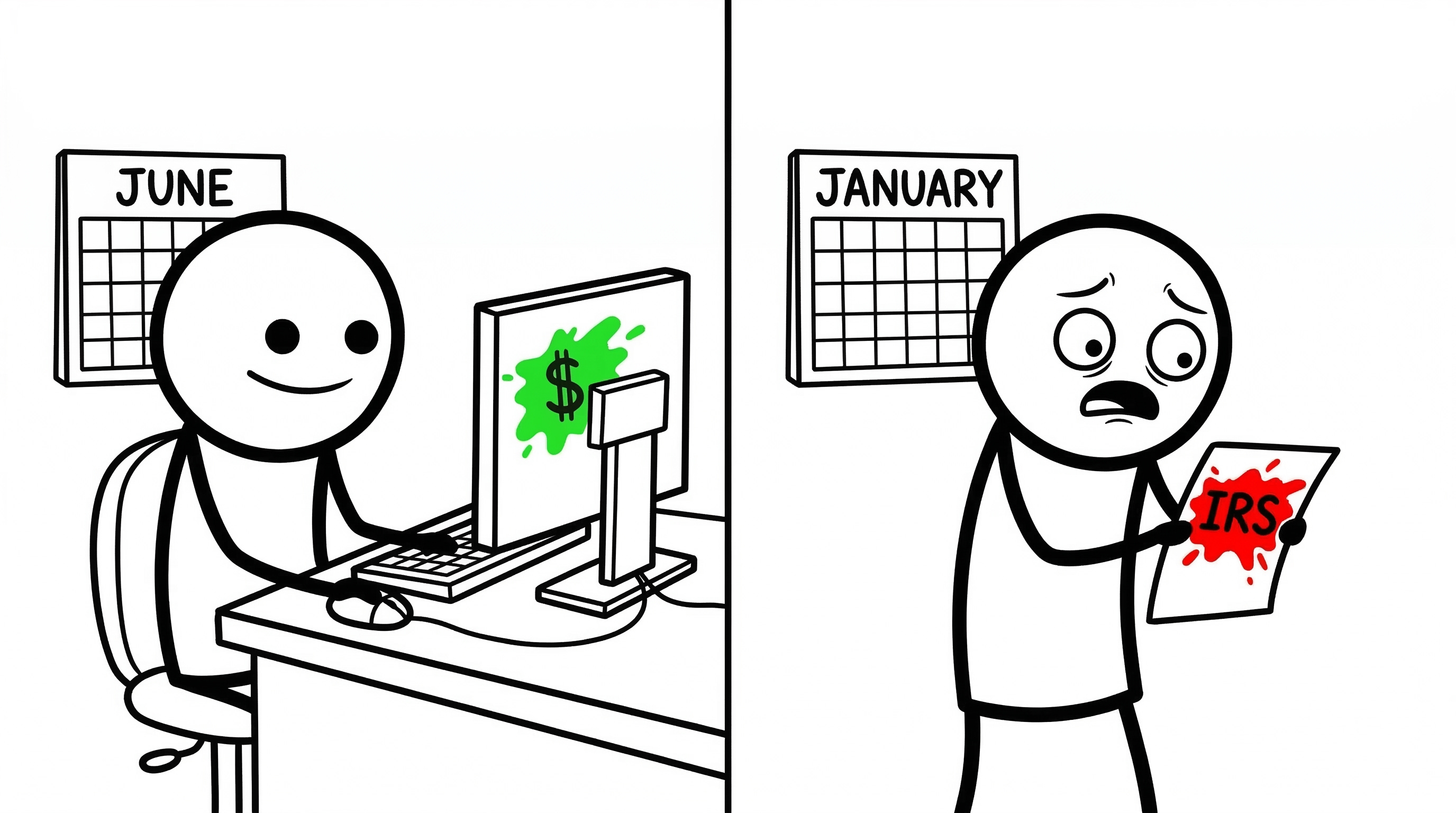
Most retirement transactions feel strangely quiet when they happen.
You move money from one account to another.
You deposit a contribution.
You take a distribution.
The custodian processes the request. The system says “completed.” The balance updates.
And nothing happens.
No warning. No correction. No message that something might be wrong.
So people naturally assume everything must be fine.
This is where a lot of retirement confusion begins. The transaction already occurred, the system accepted it, and weeks or months pass without any indication that anything unusual happened.
Then a year later someone receives a tax form they were not expecting.
That is usually the moment people believe the IRS suddenly noticed something.
In reality the IRS did not suddenly begin paying attention. The system had already recorded everything when the transaction happened.
The difference is that reporting finally caught up.
The retirement system does not work in real time.
Most retirement transactions are recorded immediately by the custodian but are only reported to the IRS after the calendar year closes. The reporting cycle is what determines when the IRS actually becomes aware of the transaction.
For distributions, this typically happens through Form 1099-R. Custodians issue those forms after the calendar year ends, usually in January of the following year.
For contributions and certain account information, reporting happens through Form 5498. That form is issued later, often in May.
This means a transaction that happened in March of one year might not show up on an IRS information report until ten or twelve months later.
Nothing about the system is hidden. It is simply delayed.
The calendar year controls when the transaction occurred.
The reporting cycle controls when the IRS sees it.
And those are two very different clocks.
If the transaction itself created a problem, the IRS does not need to intervene immediately. The reporting system will surface it eventually.
The system tracks everything.
Consider a simple example involving an indirect rollover.
An employee leaves a job in June and receives a $100,000 distribution from their former employer’s 401(k) plan. Because the payment was made directly to them instead of to another retirement account, the plan withholds 20 percent for federal taxes. The employee receives an $80,000 check.
They now have 60 days to complete an indirect rollover.
If they deposit the full $100,000 into another retirement account within that window, the transaction is treated as a rollover rather than a taxable distribution.
If they deposit only the $80,000 they received, the remaining $20,000 becomes a taxable distribution for that calendar year.
Nothing in this process triggers an immediate IRS review.
The custodian issuing the distribution records the transaction when it occurs in June. At the end of the year they prepare a Form 1099-R showing the $100,000 distribution and the $20,000 tax withholding.
That form is issued the following January.
The IRS now has a record of the distribution.
If the individual successfully completed a rollover, their tax return will show that the distribution was rolled over. If they kept the $20,000 or missed the 60-day window entirely, the return will reflect that as taxable income.
Either way, the system lines up the reporting.
The transaction happened in June.
The IRS learns about it the following January.
That delay is normal.
The same timing pattern appears across many retirement rules.
Take excess IRA contributions as another example.
Someone contributes $7,000 to a Roth IRA during the calendar year but later realizes their income was too high to qualify. At first nothing seems wrong. The account accepted the contribution. The balance grows normally.
The calendar year ends.
Months later the custodian issues Form 5498 showing that the $7,000 contribution occurred.
Now the reporting system has created a record of the contribution tied to that specific tax year.
If the excess is corrected before the tax-filing deadline, including extensions, the issue can typically be resolved without penalty. If the correction happens later, a six percent excise tax may apply for each year the excess remains in the account.
Again the IRS did not suddenly discover the problem.
The system recorded the contribution the moment it happened.
The reporting cycle simply made it visible.
Calendar year timing determined when the contribution occurred.
The tax-filing deadline determined the correction window.
Two different clocks operating on the same transaction.
This delayed awareness explains why retirement rules sometimes feel mysterious or unpredictable.
A person may complete a transaction, move on with their life, and not think about it again for months. Then a tax form arrives that seems to bring the issue back from the past.
What actually happened is much simpler.
The retirement system processed the transaction immediately.
The reporting system revealed it later.
Nothing about that process implies wrongdoing or danger. It is simply how the infrastructure works.
Most retirement activity does not attract any attention at all. The reporting system simply matches transactions with tax returns and moves on.
But when timing rules are involved, the delay between the transaction and the reporting cycle can create the illusion that the IRS suddenly began paying attention.
In reality the system was paying attention from the start.
It just speaks on its own schedule.
I write one of these every day, one retirement rule, explained in plain language and verified against the source. The daily email is free: subscribe here.
Full archive, worksheets, and search live at and on Substack at Retirement News Rundown.
Dealing with an excess IRA contribution?
The Excess Contribution Correction Tool calculates your exact corrective withdrawal using the official IRS NIA formula — covering timely and untimely corrections, investment gains and losses, and multi-year penalty exposure. Includes a personalized PDF to share with your custodian or accountant.
Disclaimer
This article is for educational and informational purposes only. It is not tax, legal, or financial advice and does not create an advisor–client relationship. Always consult appropriate professionals regarding your specific