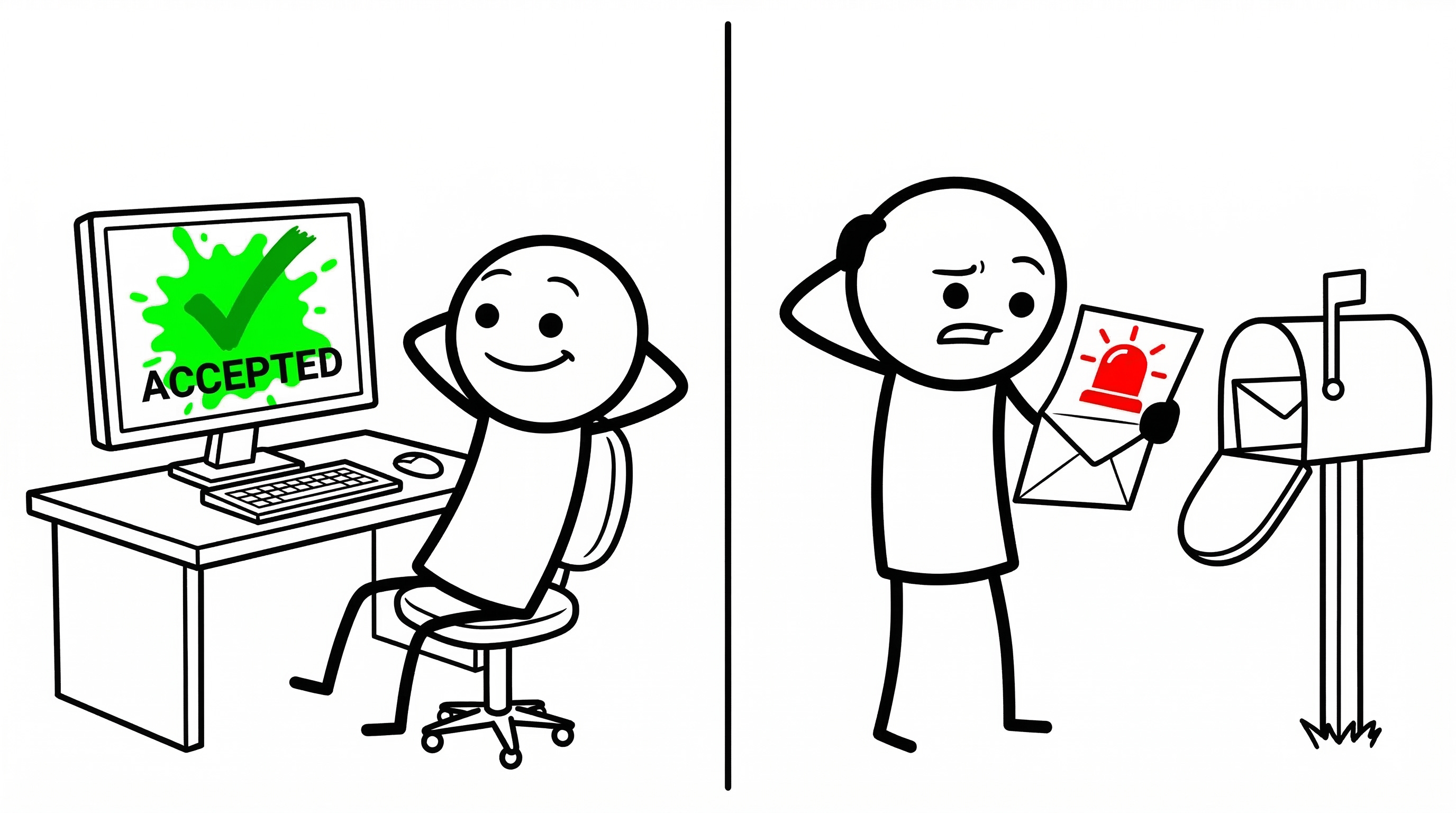
For many people, the moment their tax software says “accepted” feels like the finish line.
The return was transmitted. The IRS acknowledged receiving it. The status screen turns green. The confirmation email arrives.
Accepted.
Most people interpret that word the same way they would in everyday life. Accepted means approved. Accepted means finished. Accepted means everything checked out.
In the retirement system and the tax system, that assumption is not how the machinery works.
Acceptance simply means the system received the submission and it passed a basic intake check.
It does not mean the information has been fully reviewed. It does not mean the numbers have been verified. It does not mean every reporting document has been matched.
It means the system has opened the envelope.
When a tax return is transmitted electronically, the IRS first runs a series of automated intake checks.
The system confirms that the Social Security numbers are valid. It verifies that the return format is correct. It checks that the same taxpayer has not already filed another return using the same identifying information.
If those checks pass, the return is accepted.
This process usually happens within minutes or hours of submission.
But the deeper comparison work, the part where the system begins matching reported income, retirement distributions, and contributions against the information sent by custodians and employers, occurs much later.
That is because most of the information documents the IRS relies on arrive separately.
Forms like W-2s and 1099s are sent to the IRS by employers, brokerages, and retirement plan custodians on their own reporting schedules. Retirement distributions, for example, are reported on Form 1099-R.
Those forms may not arrive until weeks after the return itself was accepted.
So the acceptance message does not represent a full review. It represents the moment the return entered the system.
The verification process happens as the rest of the reporting data arrives and is compared.
Retirement accounts create a particularly clear example of this timing gap.
Imagine someone takes a distribution from an IRA in March. The custodian processes the withdrawal and sends the funds. The transaction is complete from the account’s perspective.
Months later, the taxpayer files their tax return and reports the distribution.
The IRS system accepts the return.
At that moment, the IRS may not yet have the Form 1099-R from the custodian showing the distribution. Those forms are typically issued after the end of the calendar year and transmitted on their own reporting timeline.
So the return can be accepted before the system finishes matching the retirement reporting.
The acceptance step simply means the return entered the pipeline.
The reconciliation happens afterward.
This timing pattern is why some tax notices arrive long after a return was filed and accepted.
The IRS operates large automated matching programs that compare the income and distribution information reported by taxpayers against the information provided by employers, brokerages, and retirement custodians.
If a mismatch appears after those reports are processed, the system generates a notice.
From the taxpayer’s perspective, this can feel sudden. The return was accepted months ago. The refund may even have already been issued.
But the acceptance stage was never meant to represent the end of the review process.
It only marked the beginning.
Consider a simple example involving a retirement distribution.
A taxpayer withdraws $25,000 from a traditional IRA in July. The distribution is taxable, but when filing their return the following spring they accidentally omit it.
The return is transmitted electronically and accepted within minutes.
At that point the IRS system may not yet have processed the Form 1099-R sent by the custodian reporting the $25,000 distribution.
Later in the year the matching system compares the taxpayer’s return with the 1099-R information received from the custodian.
The system now sees a difference.
The return reported zero IRA distributions. The custodian reported $25,000.
The IRS generates a notice explaining the mismatch and recalculates the tax owed.
Nothing about the acceptance message prevented this process. The acceptance simply confirmed that the return entered the system successfully.
The comparison occurred later, once the reporting data was available.
The same concept appears across many parts of the retirement system.
A rollover request may be accepted by a custodian even if the taxpayer later discovers a timing problem. A contribution may be accepted into an IRA before the income limits are evaluated during tax preparation.
Acceptance simply means the transaction cleared the initial operational step.
The deeper rules, the ones governed by contribution clocks, reporting deadlines, and correction windows, operate on their own timelines.
Those clocks do not stop running just because something was accepted.
Understanding this difference removes a surprising amount of anxiety.
The word accepted sounds final, but in reality it represents the beginning of the system’s work rather than the end.
Returns are accepted so they can be processed.
Transactions are accepted so they can be recorded.
Verification, comparison, and reconciliation happen afterward as the reporting system catches up.
Once you understand that sequence, many of the surprises people experience months after filing start to make more sense.
The system was never saying everything was cleared.
It was simply saying the envelope arrived.
I write one of these every day, one retirement rule, explained in plain language and verified against the source. The daily email is free: subscribe here.
Full archive, worksheets, and search live at Retirement News Rundown.
Disclaimer
This article is for educational and informational purposes only. It is not tax, legal, or financial advice and does not create an advisor–client relationship. Always consult appropriate professionals regarding your specific situation.