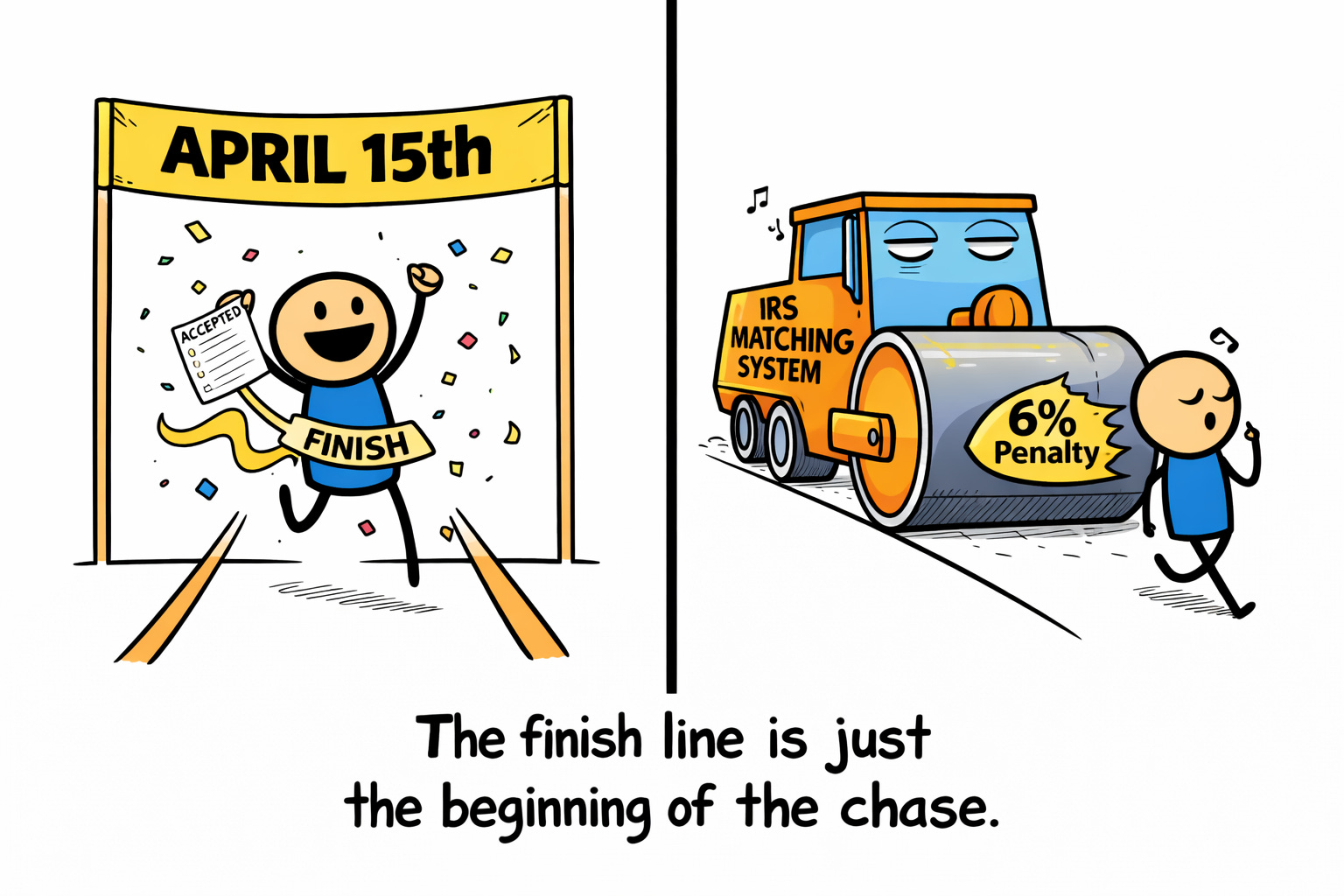
The system separates actions from consequences, sometimes by months, sometimes by years. Filing a return does not close a loop. It opens one.
That gap is where most confusion lives.
You file your tax return in March. It gets accepted quickly. Maybe you even get a refund within a couple of weeks.
From your perspective, the process feels finished. The year is behind you. The paperwork is done. You move on.
Then June shows up with a letter. Or August. Or November.
Now something that felt resolved suddenly isn’t.
A retirement distribution is being questioned. A contribution doesn’t line up. A form you never thought about is now front and center.
The reaction is almost always the same. “Why is this happening now? I already filed.”
The system does not treat filing as the end of anything.
Filing is a reporting event. It tells the IRS what you believe happened. It does not confirm that what happened was correct.
There are three different clocks running at the same time, and they do not move together.
The calendar-year clock governs when transactions occur. Contributions, distributions, conversions. These are tied to the year they happen.
The tax-filing clock governs when you report those transactions. That typically runs into the following year, often ending in April, or later if extended.
Then there is the correction and enforcement window, which runs independently. That is where matching, verification, and consequences live.
When you file your return, you are stepping into the second clock. The first clock has already closed. The third clock has barely started.
That is the gap.
For example, a retirement distribution taken in 2024 belongs to the 2024 calendar year. It will be reported on a Form 1099-R issued in early 2025. You then report it on your 2024 tax return when you file in 2025.
If everything matches perfectly, nothing happens.
If it doesn’t, the system does not immediately reject your return. It processes it based on what you submitted. The verification happens later, once all reporting documents are fully in the system.
That is why something can feel fine in March and become a problem in August.
If something is done later instead, the system does not go back and adjust the original transaction. It applies the rule to the timing that actually occurred.
A late correction is still late, even if the filing was on time.
An incorrect report that is filed on time is still incorrect, even if it was accepted.
Acceptance is not validation. It is acknowledgment.
Let’s walk through a simple scenario.
A taxpayer takes a $50,000 distribution from a former employer plan in December 2024. They intend to complete a 60-day rollover.
The calendar-year clock records a distribution in 2024. That is locked in.
They receive the funds, but only deposit $40,000 into an IRA within the 60-day window. The remaining $10,000 is kept.
In early 2025, they receive a Form 1099-R showing a $50,000 distribution.
They file their 2024 tax return in March 2025 and report the rollover as if the full $50,000 was rolled over.
The return is accepted.
At this point, everything feels complete.
But the system continues.
Later in the year, the IRS matching system compares the reported rollover against the distribution and the rollover documentation.
The numbers do not match. Only $40,000 was actually rolled over within the allowed window.
The remaining $10,000 is treated as a taxable distribution for 2024.
The consequence shows up later, often as a notice assessing additional tax, and potentially a penalty depending on age.
Now consider what happens if the taxpayer tries to “fix it later.”
If they attempt to roll over the remaining $10,000 after the 60-day window has passed, the system does not reclassify the original distribution.
The rollover window is a separate clock. Once it closes, the opportunity is gone unless a specific exception applies.
The late deposit does not undo the earlier distribution. It becomes a new transaction, not a correction of the old one.
This is where the gap becomes visible.
The filing was on time. The return was accepted. But the consequence was governed by a different clock that continued running.
This same structure shows up across retirement rules.
Contributions follow the calendar-year clock but often have a tax-filing deadline extension. You can make a prior-year IRA contribution up until the filing deadline.
If that contribution is made after the deadline, it does not go back and count for the prior year. It becomes a current-year contribution instead.
The filing clock cannot pull a transaction backward once the calendar-year deadline has passed.
Excess contributions follow yet another timeline. If corrected before the tax-filing deadline, the system treats it one way. If corrected after, it treats it differently, often with additional penalties.
Again, filing does not control the underlying transaction. It reports it.
The correction window determines whether the system still allows adjustments.
If something is done later instead, the system applies the rule that corresponds to that later timing. It does not retroactively apply the earlier rule just because the intent was there.
The discomfort people feel in this area comes from a mismatch in expectations.
Filing feels like completion. The system treats it as communication.
People expect immediate feedback. The system operates on delayed verification.
People assume acceptance means accuracy. The system assumes accuracy will be confirmed later.
Once you see the separation, the confusion starts to fade.
The calendar-year clock determines what happened.
The filing clock determines when you reported it.
The correction window determines whether you can still change it.
The enforcement process determines when consequences show up.
Those are four different movements, not one.
That time gap is not a flaw. It is how the system is designed.
It allows transactions to occur, gives time to report them, and then reviews them once all information is available.
It is patient.
That patience is why something can feel settled and then resurface months later. Not because anything changed, but because the system finally caught up.
Understanding that removes a lot of unnecessary stress.
If something appears later, it does not mean the system suddenly changed its mind. It means the timing of verification finally aligned with the timing of the transaction.
You are not going backward. The system is just finishing what it started.
I write one of these every day, one retirement rule, explained in plain language and verified against the source. The daily email is free: subscribe here.
Full archive, worksheets, and search live at RetirementNewsRundown.com
Disclaimer
This article is for educational and informational purposes only. It is not tax, legal, or financial advice and does not create an advisor–client relationship. Always consult appropriate professionals regarding your specific situation.