The system does not respond to retirement transactions in real time. It responds when information from multiple sources lines up.
That delay is not a flaw.
It is how the system is designed to work.
Someone makes a move with their retirement account and nothing happens.
Weeks go by. Then months.
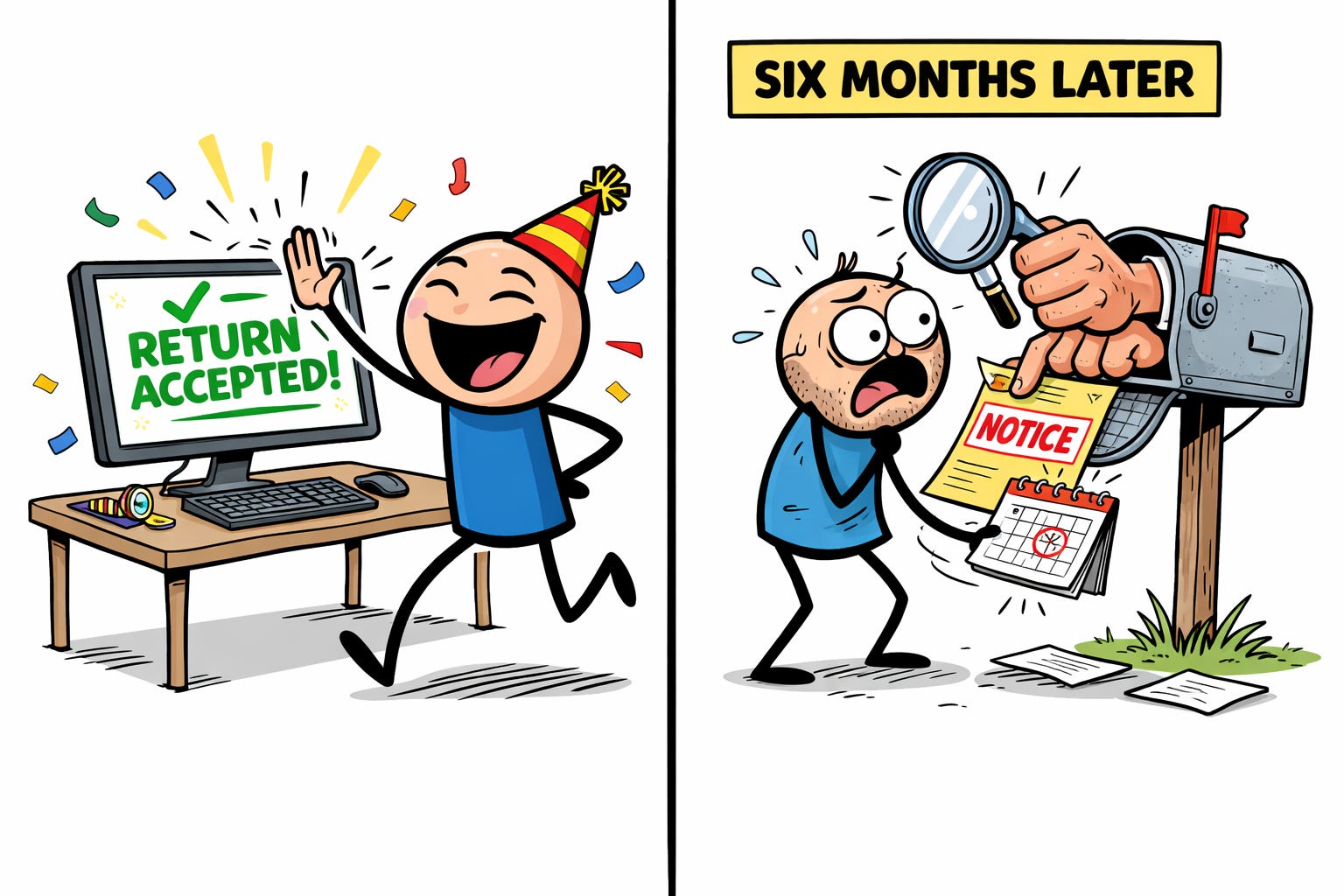
The return gets filed. It gets accepted. Life moves on.
Then, out of nowhere, a notice shows up.
From the outside, it feels like something changed.
In reality, nothing changed. The system just reached the point where it could evaluate what already happened.
This is where most confusion begins.
People assume that if something were a problem, it would show up right away.
That assumption makes sense in most parts of life.
It does not apply here.
Retirement rules are tied to when a transaction occurs, not when it is noticed.
The system records events first. It evaluates them later.
Those are two separate steps.
When money moves in or out of a retirement account, a clock starts.
That clock depends on the type of transaction.
A rollover has a fixed number of days to be completed.
A contribution is tied to a specific tax year and its associated filing deadline.
A correction window allows certain mistakes to be fixed within a defined period.
Each of these timelines begins when the transaction happens.
None of them wait for your tax return.
Calendar-year deadlines determine which year something belongs to.
If a distribution is taken on December 31, it belongs to that year. Reporting it later does not move it into a different year.
Tax-filing deadlines determine when certain actions can still be taken for a prior year.
IRA contributions, for example, can often be made up until the tax-filing deadline for that year.
Correction windows operate separately.
If an excess contribution is identified, there is a limited period to remove it along with any associated earnings in order to avoid ongoing penalties.
Each clock has its own purpose.
They do not extend each other.
If something is completed after the applicable deadline, the treatment changes.
A rollover completed outside the allowed window is treated as a distribution.
A contribution made after the filing deadline applies to a different year.
An excess that is not corrected within its window may be subject to a recurring penalty for each year it remains.
The system does not adjust the rule to match the timing.
It applies the rule to the timing.
What makes this difficult is that none of this is evaluated immediately.
There is no instant feedback telling you that something fell outside the allowed window.
Instead, the system waits.
It waits for reporting from custodians.
It waits for forms to be issued.
It waits until it has enough information to compare what was reported with what actually occurred.
That is when problems appear.
Not when the action happens.
Not when the return is filed.
When the data lines up.
Consider a situation involving a rollover.
An individual takes a $40,000 distribution from a retirement plan on January 5.
They intend to move the funds into an IRA.
The rollover window begins when they receive the funds and runs for a fixed number of days.
That window closes in early March.
If the funds are deposited within that window, the transaction is treated as a rollover.
If the deposit happens after that window has closed, the transaction is treated as a distribution.
Now look at how this unfolds.
The individual deposits the funds a few days late.
From their perspective, the money still ended up in an IRA. It feels like the goal was achieved.
They file their return the following year and report the transaction as a rollover.
The return is accepted.
Nothing appears to be wrong.
Months later, the system receives the reporting from the plan showing the distribution.
It evaluates whether the rollover was completed within the required timeframe.
It was not.
The transaction is treated according to the rules that applied when the distribution occurred.
The $40,000 becomes taxable income for that year. If applicable, an additional penalty may apply as well.
The delay between the action and the outcome creates the appearance that the problem showed up later.
In reality, the outcome was determined when the window closed.
A similar pattern applies to contributions.
An IRA contribution intended for a prior tax year must be made by that year’s tax-filing deadline.
If it is made after that deadline, it belongs to the current year instead.
If that creates an excess contribution, a correction window begins.
If the excess is removed within that correction window, it is handled one way.
If it is removed after that window has closed, the treatment changes and may involve a recurring penalty.
Again, the timing determines the result.
What makes retirement problems feel unpredictable is the gap between action and evaluation.
There is often a period where everything appears settled.
No alerts. No warnings. No indication that anything needs attention.
Then, once the system has all the information it needs, the rules are applied.
By that point, the original transaction is already fixed in time.
Understanding this removes much of the surprise.
The system is not reacting late.
It is reacting on its own timeline.
Filing a return does not trigger immediate validation.
Acceptance does not confirm that everything was handled correctly.
It confirms that the information was received.
Evaluation happens later, once all relevant data has been reported and matched.
The key is recognizing that the outcome of a retirement transaction is determined when the rules apply to the timing of that transaction.
Everything that happens afterward is simply the system catching up to that moment.
I write one of these every day, one retirement rule, explained in plain language and verified against the source. The daily email is free: subscribe here.
Full archive, worksheets, and search live at RetirementNewsRundown.com.
Disclaimer
This article is for educational and informational purposes only. It is not tax, legal, or financial advice and does not create an advisor–client relationship. Always consult appropriate professionals regarding your specific situation.