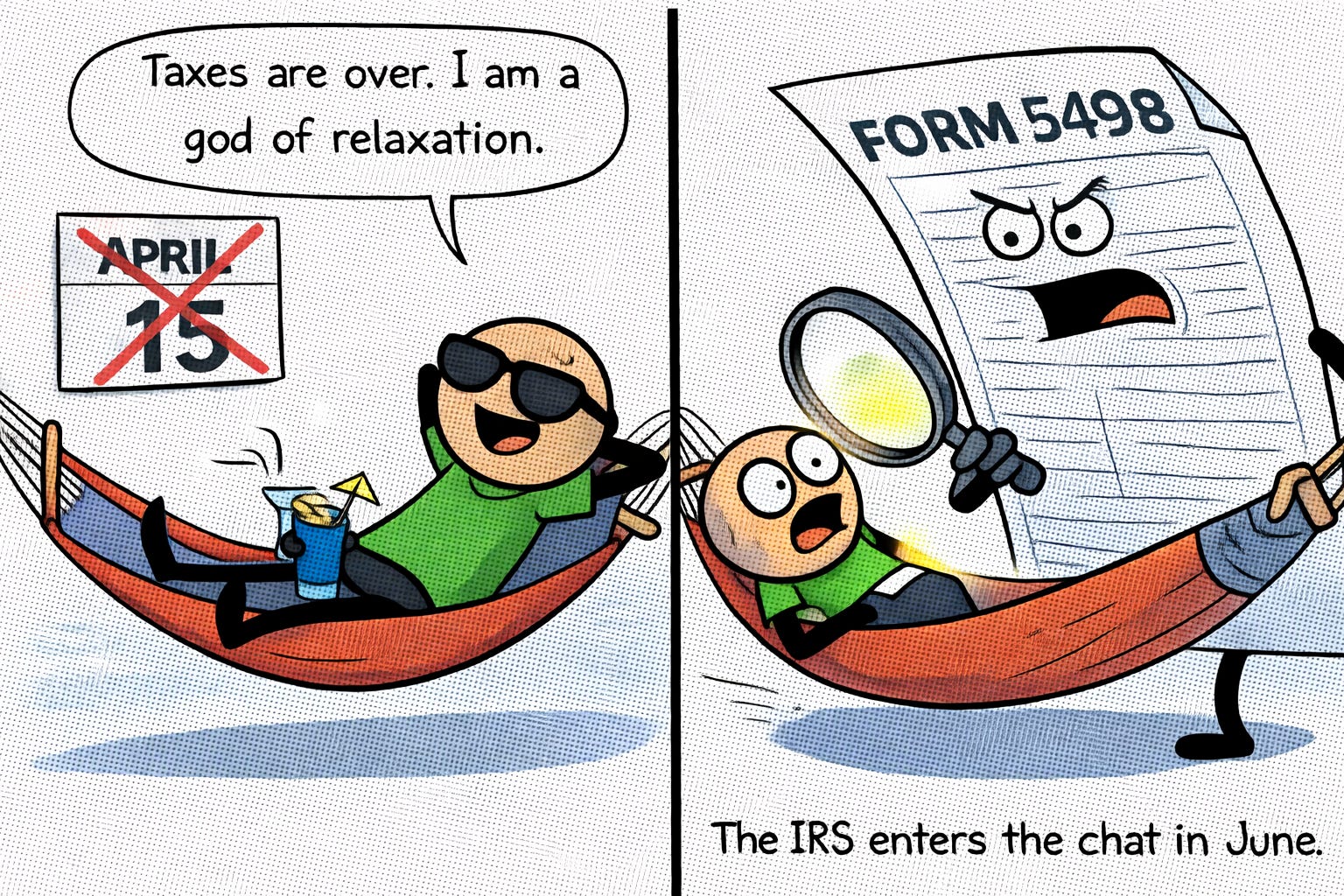
April 15 is the date everyone knows. Calendar reference: Retirement Account Deadlines (Form 5498 and post-April-15 dates). It is the date the IRS markets, the date employers remind you about, the date accountants circle in red. When it passes, the collective sigh is audible. Tax season is over.
It is not.
Tax season is when you file. The tax system runs year-round. And for anyone with retirement accounts, some of the most important events of the year happen after April, not before.
The first thing that arrives after tax season is Form 5498. Your IRA custodian files this with the IRS by May 31. It reports your total contributions for the prior year, your year-end fair market value, and whether an RMD is required for the current year. You do not file this form. Your custodian does. But the IRS uses it to check your work.
If you reported a $7,000 IRA contribution on your return but your custodian reports $8,000 on Form 5498, that discrepancy triggers a notice. If the form shows an RMD was required and your 1099-R does not show a corresponding distribution, the IRS knows you missed it. These cross-references happen quietly, months after your return was accepted, and they are the reason problems you thought were invisible eventually surface.
Most people never look at their Form 5498. That is a mistake. It is the receipt for everything that happened in your IRA during the year. If the numbers on it do not match what you reported, you want to know before the IRS tells you.
October 15 is the next date that matters. If you filed an extension, your return is due. But October 15 is also the final correction deadline for excess IRA contributions made for the prior year. If you contributed too much to your Roth IRA for 2025 and filed an extension, you have until October 15, 2026 to remove the excess plus allocable earnings and avoid the 6% penalty entirely. If you filed without an extension, that window closed on April 15. The extension is not just about the return. It is about preserving correction flexibility.
SEP IRA contributions also follow this deadline. A self-employed person who filed an extension can make their 2025 SEP contribution as late as October 15, 2026. That is six additional months of contribution runway that disappears if you file on time without an extension. For someone whose income fluctuates, those six months can be the difference between maximizing the contribution and leaving thousands on the table.
Estimated tax payments run on their own quarterly schedule that has nothing to do with April 15 as a finish line. The four due dates for 2026 estimated payments are April 15, June 15, September 15, and January 15, 2027. If you did a Roth conversion in the first quarter of 2026, the estimated payment covering that income is due April 15. If you converted in the third quarter, the payment is due September 15. Miss a quarterly payment and the underpayment penalty accrues from that quarter’s due date forward, not from April 15.
People who do conversions or sell assets with capital gains and treat April as the only tax date end up with penalties they could have avoided by paying quarterly. The system expects you to pay as you earn, not in one lump at the end.
December 31 is the real finish line for retirement accounts. It is when the current year’s RMD must be taken (except for the first-year exception, which allows April 1 of the following year). It is when Roth conversions must be processed to count for the current tax year. It is when employer plan deferrals must be withheld from payroll. It is when the calendar-year clock stops.
A Roth conversion processed on December 30 counts for 2026. A conversion processed on January 2 counts for 2027. There is no grace period, no extension, no workaround. The same applies to charitable distributions from an IRA. A Qualified Charitable Distribution must leave the account by December 31 to count for that tax year. The check must be issued, not just requested.
December 31 governs more retirement account decisions than April 15 does. But it gets almost no attention because it falls outside of what people think of as tax season.
The real end of tax season depends on what you own and what you did during the year. For someone with a simple W-2 and no retirement accounts, April 15 might genuinely be the end. For anyone with an IRA, a 401(k), conversions, or RMDs, the relevant deadlines are scattered across the entire calendar. May for Form 5498. June, September, and January for estimated payments. October for extensions and corrections. December for conversions, distributions, and RMDs.
Tax season is a marketing concept. The tax system is a 12-month operation. The people who understand that are the ones who do not get surprised by a notice in August about something they thought was settled in February.
I write one of these every day, one retirement rule, explained in plain language and verified against the source. The daily email is free: subscribe here.
Full archive, worksheets, and search live at RetirementNewsRundown.com
Disclaimer This article is for educational and informational purposes only. It is not tax, legal, or financial advice and does not create an advisor-client relationship. Always consult appropriate professionals regarding your specific situation.