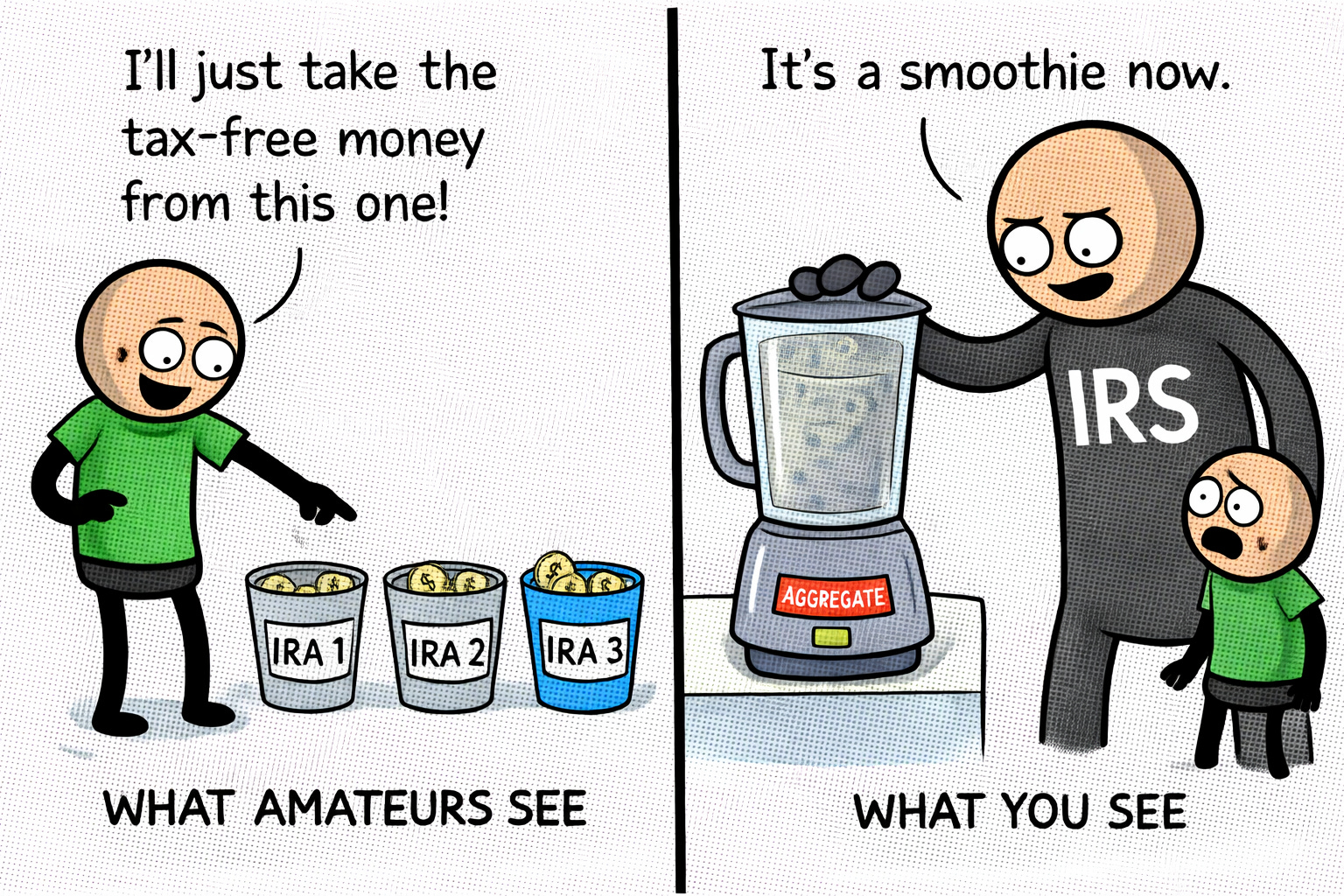
Open a Traditional IRA at Fidelity. Open another at Schwab. Roll an old 401(k) into a third at Vanguard. Your statements show three separate accounts with three separate balances. You manage them independently. You think of them independently.
The IRS does not.
For tax purposes, the IRS aggregates all of your Traditional IRA balances into a single pool. It does not matter how many accounts you have, where they are held, or when you opened them. When you take a distribution or convert any amount to a Roth, the IRS calculates the tax based on the combined balance across every Traditional IRA you own. Not just the one you pulled the money from.
This is the IRA aggregation rule, and it governs every distribution, every conversion, and every rollover involving Traditional IRA money. It applies automatically. You do not elect into it. You cannot opt out of it. And most people do not realize it exists until it changes the tax outcome of a transaction they thought was straightforward.
The rule is codified in IRC Section 408(d)(2). It says that all Traditional IRAs (including SEP IRAs and SIMPLE IRAs that have satisfied the two-year holding period) are treated as a single contract for distribution purposes. When you withdraw or convert, the IRS applies a ratio: the percentage of your total Traditional IRA balance that consists of after-tax (nondeductible) contributions determines how much of any distribution is tax-free. The rest is taxable.
This ratio is called the pro-rata rule, and it applies regardless of which account you touch.
Here is how it works. Say you have three Traditional IRAs:
Account A at Fidelity: $50,000 (all pretax, from deductible contributions and growth) Account B at Schwab: $30,000 (all pretax, from a 401(k) rollover) Account C at Vanguard: $20,000 (all after-tax, from nondeductible contributions)
Your total Traditional IRA balance is $100,000. Of that, $20,000 is after-tax money (the nondeductible contributions in Account C). That means 20% of your total IRA balance is after-tax.
Now you convert $10,000 from Account C to a Roth IRA. You chose Account C specifically because it is all after-tax money. You expect the conversion to be tax-free.
It is not.
The IRS does not care which account the $10,000 came from. It applies the 20% ratio across the board. So $2,000 of your $10,000 conversion is treated as after-tax (tax-free), and $8,000 is treated as pretax (taxable). You owe income tax on $8,000.
You tried to cherry-pick the after-tax money. The aggregation rule said no.
This calculation is reported on Form 8606, which tracks your nondeductible IRA contributions and calculates the taxable portion of any distribution or conversion. If you have ever made a nondeductible Traditional IRA contribution and later take a distribution or convert, Form 8606 is required. Skipping it does not make the rule go away. It just means the IRS catches the discrepancy later.
The form uses your total Traditional IRA balance as of December 31 of the year you take the distribution or convert. Not the date of the transaction. December 31. That means if you convert in January and then roll a $500,000 401(k) into a Traditional IRA in November, that $500,000 is included in the December 31 balance and changes your pro-rata ratio for the conversion you did ten months earlier.
The timing matters. The December 31 snapshot governs the entire year.
The aggregation rule does not apply to Roth IRAs. Your Roth accounts are tracked separately. It also does not apply to employer plans like 401(k)s, 403(b)s, or 457(b)s while the money remains in the plan. Those balances are not included in the Traditional IRA aggregation. But the moment you roll employer plan money into a Traditional IRA, it joins the pool and becomes part of the calculation.
That distinction is why some people roll Traditional IRA money into an employer plan before doing a backdoor Roth conversion. Moving the pretax balance out of the IRA system and into a 401(k) removes it from the aggregation. The only money left in the Traditional IRA is the nondeductible contribution, which can then be converted tax-free. This is sometimes called “clearing the deck,” and it only works if your employer plan accepts incoming rollovers.
The IRS does not track your IRAs by custodian. It tracks them by owner. Every Traditional, SEP, and qualifying SIMPLE IRA in your name is one pool. The sooner you see your accounts the way the IRS sees them, the fewer surprises you get at tax time.
I write one of these every day, one retirement rule, explained in plain language and verified against the source. The daily email is free: subscribe here.
Full archive, worksheets, and search live at RetirementNewsRundown.com
Disclaimer This article is for educational and informational purposes only. It is not tax, legal, or financial advice and does not create an advisor-client relationship. Always consult appropriate professionals regarding your specific situation.