People hear “pro-rata rule” and assume it is running in the background at all times, silently governing their IRA like some passive tax algorithm. It is not. The pro-rata rule does nothing until you trigger it. And the trigger is specific: money leaving a Traditional IRA.
Until that moment, your pretax and after-tax money can sit side by side in the same account for decades without the rule ever applying.
The pro-rata rule activates on two events: a distribution (you take money out) and a conversion (you move money to a Roth IRA). There is an important exception for rollovers to employer plans. When you roll Traditional IRA money into a 401(k), the IRS actually lets you separate the pretax and after-tax portions. You can roll the pretax money into the 401(k) and leave the after-tax money behind in the IRA. This is the one time the IRS allows you to peel off the pretax from the after-tax. It is also the mechanical reason the "clearing the deck" strategy works: roll the pretax into your 401(k), leave only the nondeductible contributions in the IRA, and convert the remainder to a Roth essentially tax-free. Contributing money to a Traditional IRA does not trigger it. Rebalancing investments inside the IRA does not trigger it. Transferring your entire IRA from one custodian to another does not trigger it, as long as the money stays in the Traditional IRA system.
The rule exists to prevent you from separating pretax and after-tax money when it leaves the account. The IRS wants every dollar that exits a Traditional IRA to carry a proportional share of the tax burden. You do not get to send the after-tax money out first and leave the pretax money behind.
The calculation is straightforward. Take the total after-tax (nondeductible) contributions across all your Traditional IRAs. Divide that by the total balance of all your Traditional IRAs as of December 31 of that year. The result is the percentage of any distribution or conversion that is tax-free. The rest is taxable.
The formula:
Tax-free percentage = Total nondeductible contributions / Total Traditional IRA balance (Dec 31)
If you have $30,000 in nondeductible contributions and a total Traditional IRA balance of $300,000, your tax-free percentage is 10%. Convert $50,000 to a Roth and $5,000 is tax-free. The other $45,000 is taxable income.
That ratio applies to every dollar that leaves your Traditional IRAs during the year. Not per account. Not per transaction. The same ratio governs all distributions and conversions for the entire calendar year.
Here is where the timing creates problems.
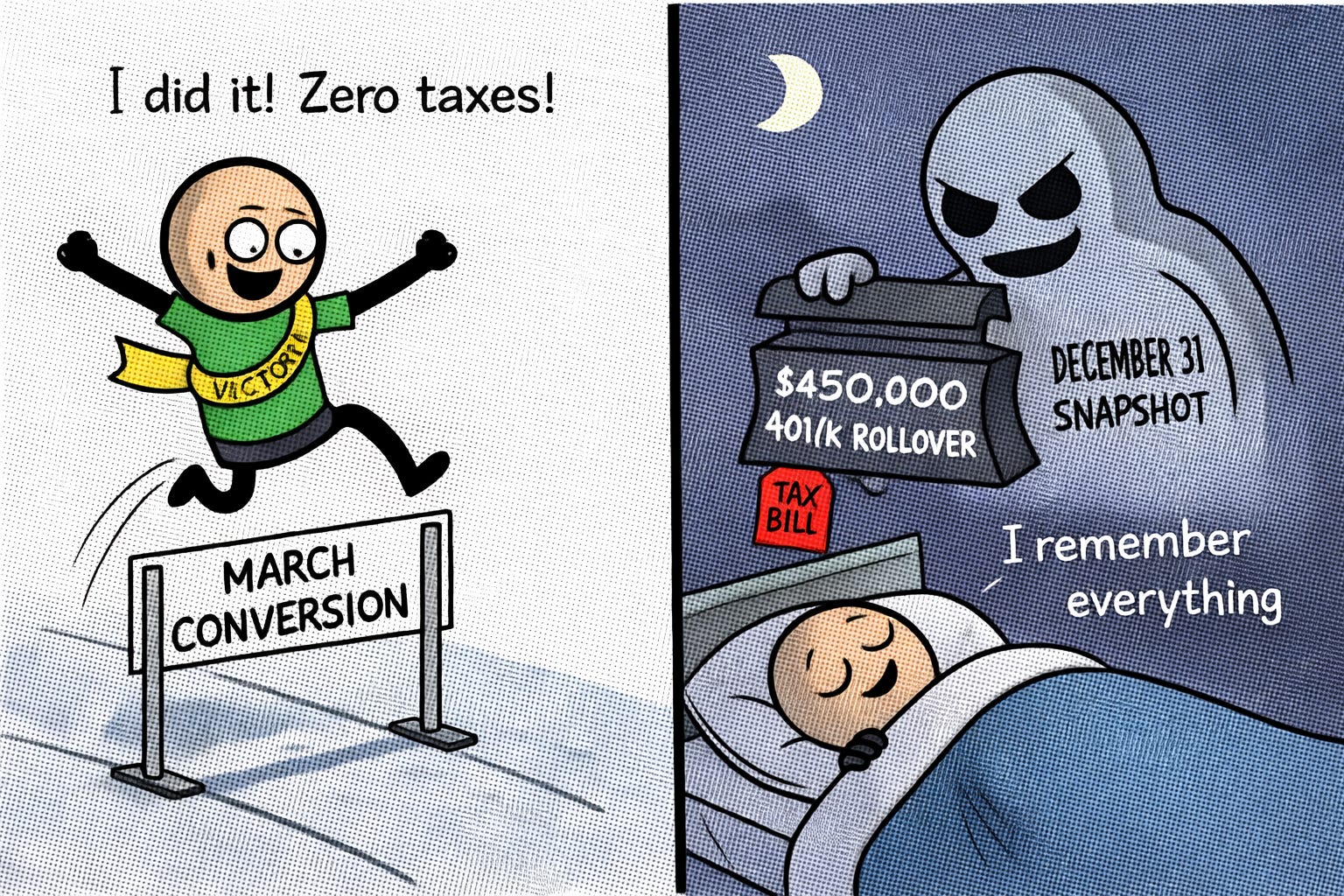
Marcus has a Traditional IRA with $50,000 in nondeductible contributions and no other IRA balance. He does a $50,000 Roth conversion in March. At that moment, 100% of his Traditional IRA balance is after-tax. He expects the entire conversion to be tax-free.
In September, Marcus changes jobs and rolls his old 401(k) into a new Traditional IRA. The rollover is $450,000, all pretax.
On December 31, Marcus has $450,000 in his Traditional IRA (the rollover). His nondeductible contributions are still $0 in the current accounts because he converted all $50,000. But the December 31 balance is what governs the calculation, and Form 8606 uses the year-end numbers.
Wait. Marcus converted before the rollover happened. Does the March conversion get recalculated based on the December balance?
Yes. The pro-rata ratio is determined by the December 31 balance, regardless of when during the year the conversion occurred. The $450,000 rollover that arrived in September retroactively changes the tax treatment of the March conversion.
Marcus now has $50,000 in nondeductible contributions divided by $450,000 in total Traditional IRA balance (the rollover, since the converted amount is already gone). His tax-free percentage drops to about 11%. Of his $50,000 conversion, roughly $5,550 is tax-free. The remaining $44,450 is taxable.
Marcus expected a tax-free conversion. He owes tax on $44,450. The rule did not apply in March. It applied on December 31, retroactively.
This is why the December 31 snapshot matters more than the transaction date. You can do a conversion in January and have the tax treatment change based on something that happens in December. The IRS does not care about the sequence of events during the year. It cares about where things stand when the year ends.
The practical implication is this: if you are planning a Roth conversion and you have any possibility of rolling employer plan money into a Traditional IRA later that year, the conversion math could change dramatically. A conversion that looks clean in April can become mostly taxable by December.
The pro-rata rule also applies to distributions you take for any reason, not just conversions. If you withdraw $10,000 from your Traditional IRA to cover an expense, the same ratio determines how much is taxable. If your after-tax percentage is 10%, then $1,000 is tax-free and $9,000 is taxable. You cannot instruct your custodian to distribute “only the after-tax money.” The ratio is applied automatically on your tax return.
This catches people who made nondeductible contributions years ago and forgot about them. They take a distribution, assume the full amount is taxable, and overpay. Or they assume the nondeductible portion comes out first, underpay, and get a notice. Neither assumption is correct. The ratio governs.
The pro-rata rule is not complicated. It is one fraction applied to every dollar that leaves your Traditional IRAs. But it only matters the moment money moves. Until then, your accounts sit quietly. The second you convert, distribute, or roll out, the calculation runs. And it uses the December 31 balance to do it.
Know the trigger. Know the snapshot date. The rest is arithmetic.
I write one of these every day, one retirement rule, explained in plain language and verified against the source. The daily email is free: subscribe here.
Full archive, worksheets, and search live at RetirementNewsRundown.com
Disclaimer This article is for educational and informational purposes only. It is not tax, legal, or financial advice and does not create an advisor-client relationship. Always consult appropriate professionals regarding your specific situation.