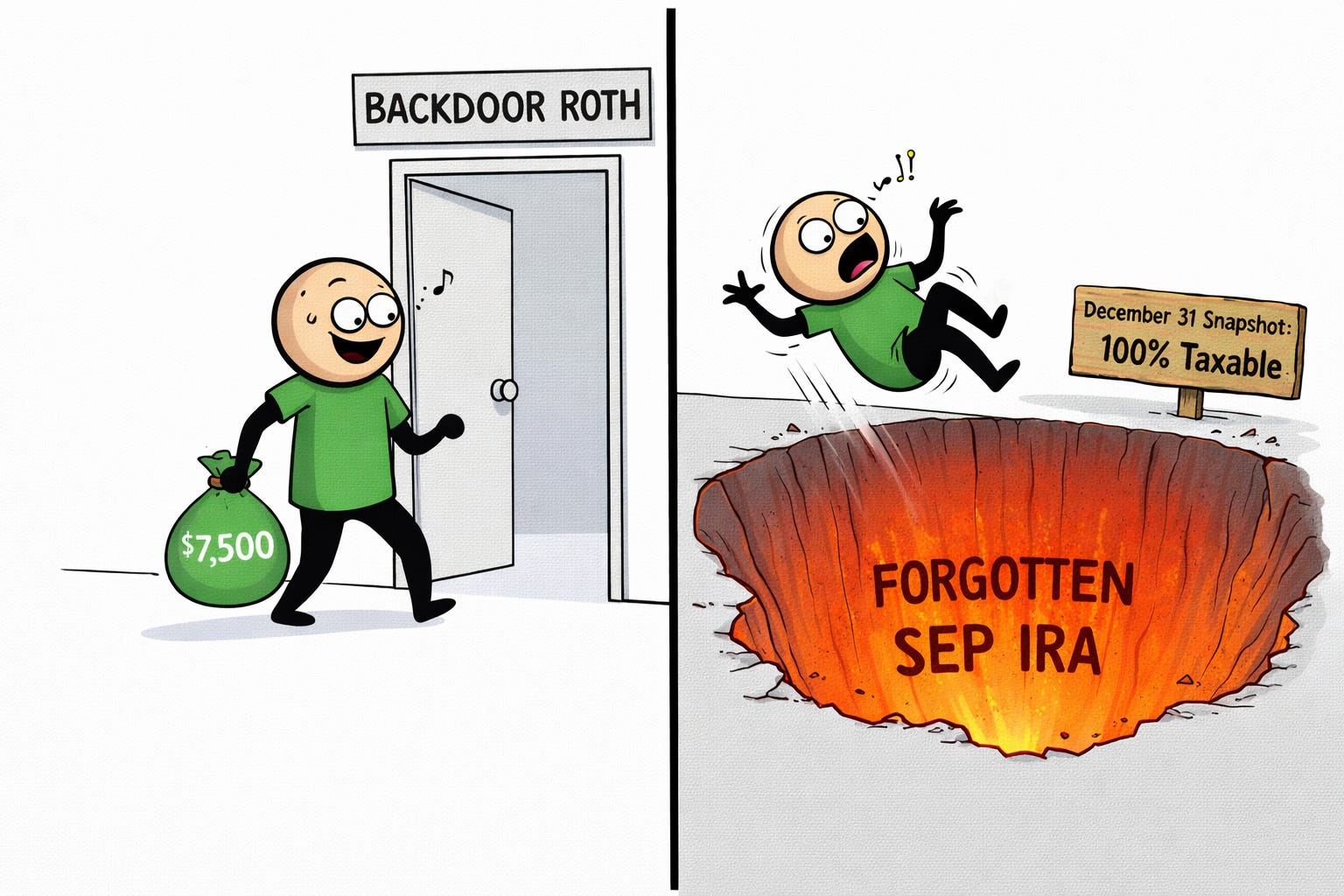
The backdoor Roth IRA conversion is one of the most recommended strategies in personal finance. High earners who exceed the Roth IRA income limit are told to contribute to a nondeductible Traditional IRA and then convert it to a Roth. Simple. Legal. Tax-free.
Except when it is not.
The strategy fails more often than people realize. Not because it is illegal or because the IRS closed it. It fails because the person executing it skipped a step, ignored a balance, or did not understand which rule actually governs the tax outcome.
The backdoor Roth works in two steps. Step one: contribute to a Traditional IRA without taking a deduction. Step two: convert the balance to a Roth IRA. Since you already paid tax on the contribution (it was nondeductible), the conversion should be tax-free.
The word “should” is doing all the work in that sentence.
The conversion is only tax-free if the nondeductible contribution is the only money in your Traditional IRA system. The moment pretax money exists anywhere in any Traditional, SEP, or SIMPLE IRA in your name, the pro-rata rule kicks in and a portion of your “tax-free” conversion becomes taxable.
Failure #1: Existing Traditional IRA balances.
This is the most common failure. Someone has a Traditional IRA with $93,000 from years of deductible contributions and earnings. They make a $7,500 nondeductible contribution and convert $7,500 to a Roth.
Total IRA balance for Form 8606: $93,000 + $7,500 = $100,500 (approximately, depending on the timing of the conversion relative to December 31).
Tax-free percentage: $7,500 / $100,500 = 7.5%.
Tax-free portion of the conversion: $7,500 x 7.5% = $563.
Taxable portion: $6,937.
The person expected $0 in tax. They owe income tax on $6,937. The existing $93,000 pretax balance poisoned the conversion. The pro-rata rule does not let you cherry-pick which dollars come out.
Failure #2: Forgetting about the SEP IRA.
This one catches self-employed people and side-business owners constantly. They contribute $7,500 to a nondeductible Traditional IRA and convert it. Clean and simple. Except they also have a SEP IRA from three years ago with $85,000 sitting in it. They never think of it because they stopped contributing. They might not even remember opening it.
The IRS remembers. The SEP balance is included in the aggregation. That $85,000 pretax balance changes the ratio from 100% tax-free to roughly 8% tax-free. The conversion that was supposed to cost nothing in tax now generates a taxable event.
This is the failure that surprises people the most because the SEP IRA is at a completely different custodian and has nothing to do with the conversion in their mind. In the IRS’s mind, it is the same pool.
Failure #3: The mid-year 401(k) rollover.
Someone does a clean backdoor Roth in February. No other IRA balances. Nondeductible contribution, immediate conversion, zero tax. Perfect.
Then in July they leave their job and roll $300,000 from their 401(k) into a Traditional IRA.
The December 31 snapshot now shows $300,000 in pretax Traditional IRA money. The pro-rata ratio recalculates retroactively. That February conversion that was supposed to be tax-free is now almost entirely taxable.
The fix was simple: leave the 401(k) in the plan, roll it into the new employer’s plan, or wait until the following year to roll it into an IRA. But the person did not know the December 31 balance governs conversions from earlier in the year. By July, the damage was done and could not be undone until the following tax year.
Failure #4: Not converting quickly enough.
The backdoor Roth works best when the contribution and conversion happen close together, ideally within days. The reason is earnings. If you contribute $7,500 to a nondeductible Traditional IRA and let it sit for six months before converting, the account might grow to $7,900. The original $7,500 is after-tax. The $400 in earnings is pretax.
When you convert the full $7,900, the $7,500 is tax-free and the $400 is taxable. Not catastrophic. But unnecessary. And if you let it sit for years and it grows to $15,000, half the conversion is taxable.
Some custodians let you contribute and convert on the same day. Some require a waiting period or make you contribute to a money market first. Know your custodian’s process before you start.
Failure #5: Never filing Form 8606.
You make the nondeductible contribution. You convert. You file your tax return. But you do not include Form 8606.
Without Form 8606, the IRS has no record that your contribution was nondeductible. As far as their system knows, the entire conversion is pretax money and fully taxable. If they send a notice, you will need to prove the contribution was nondeductible by filing Form 8606 retroactively and providing documentation.
This is fixable but painful. The form should be filed in the year of the contribution and again in the year of the conversion. Skipping it does not change the tax treatment. It just makes proving the correct treatment much harder.
Failure #6: State tax traps.
The backdoor Roth is a federal strategy. Some states do not conform to federal IRA rules. A handful of states tax Roth conversions differently or do not recognize the nondeductible basis the same way the IRS does. If you live in a state with income tax, verify that your state follows federal treatment before assuming the conversion is tax-free at the state level.
The backdoor Roth is not broken. The concept is sound. Congress has had multiple opportunities to close it and has not. But the execution has six points of failure, and most of them are invisible until you file your return and realize the tax bill is larger than expected.
The strategy works when three conditions are true: you have zero pretax money in any Traditional, SEP, or SIMPLE IRA on December 31, you convert promptly after contributing, and you file Form 8606 in both the contribution year and the conversion year. Miss any of those and the backdoor has a leak.
I write one of these every day, one retirement rule, explained in plain language and verified against the source. The daily email is free: subscribe here.
Full archive, worksheets, and search live at RetirementNewsRundown.com
Disclaimer This article is for educational and informational purposes only. It is not tax, legal, or financial advice and does not create an advisor-client relationship. Always consult appropriate professionals regarding your specific situation.