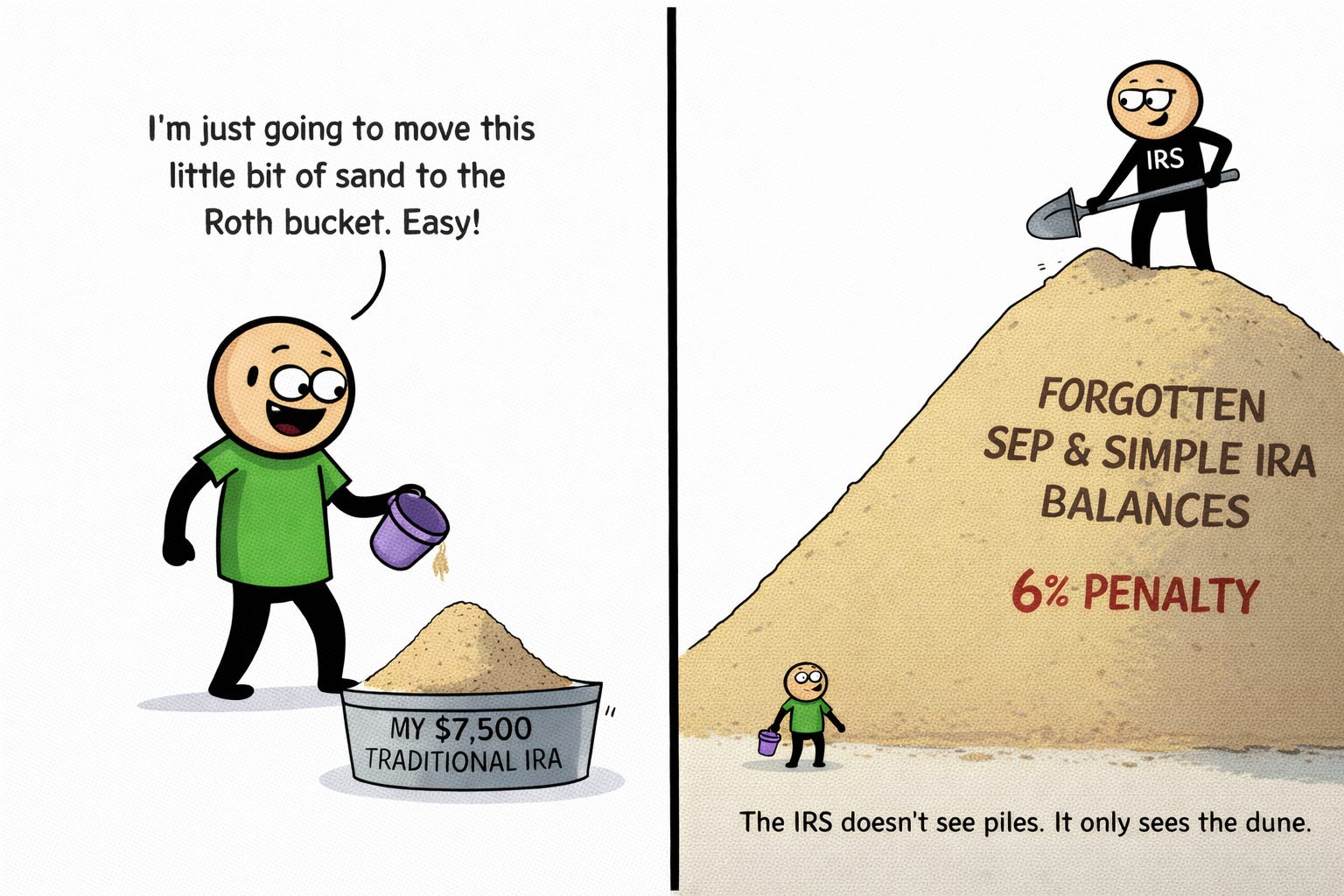
People learn the pro-rata formula and think they understand it. Nondeductible contributions divided by total IRA balance. Simple fraction. Simple math.
Then they find out their SEP IRA is in the denominator. Or their SIMPLE IRA. Or the rollover they did in October. Or the RMD they took in November. The numerator is straightforward. The denominator is where people get it wrong.
The IRS defines “total Traditional IRA balance” for pro-rata purposes on Form 8606, Line 6. It includes every dollar in every Traditional IRA, SEP IRA, and SIMPLE IRA you own as of December 31 of that year. Plus adjustments. Here is the complete list of what counts and what does not.
Counts: Traditional IRA balances.
Every Traditional IRA in your name at every custodian. Does not matter when you opened it. Does not matter if it is actively receiving contributions or sitting dormant. Does not matter if you forgot it existed. If it is a Traditional IRA and your Social Security number is on it, the December 31 balance is in the denominator.
This includes IRAs funded by deductible contributions, nondeductible contributions, rollovers from employer plans, or any combination. The IRS does not distinguish between funding sources when calculating the total balance. It all goes in.
Counts: SEP IRA balances.
A SEP IRA is legally a Traditional IRA with employer contributions. The IRS treats it identically for aggregation and pro-rata purposes. If you are self-employed and have a SEP with $200,000 from years of employer contributions, that $200,000 is in your denominator even if you never touch it and never convert a dime from it.
This is the balance that ruins most backdoor Roth conversions for self-employed people. They set up a separate Traditional IRA for the nondeductible contribution and think the SEP is walled off. It is not.
Counts: SIMPLE IRA balances (with a condition).
SIMPLE IRA balances are included in the aggregation, but only after the two-year holding period from the date of your first contribution to the SIMPLE plan. During the first two years, a SIMPLE IRA exists in its own silo. After two years, it joins the Traditional IRA pool for pro-rata purposes.
If your first SIMPLE IRA contribution was January 2024, the two-year clock ends January 2026. Starting in 2026, that SIMPLE balance is in your denominator. This means on your 2026 tax return (filed in 2027), the SIMPLE IRA balance as of December 31, 2026 must be included in the Form 8606 calculation. Before the two-year mark, it is excluded.
Once the two-year period passes, the SIMPLE IRA is treated exactly like a Traditional IRA. You can even roll it into a Traditional IRA or convert it to a Roth. But its balance counts in the pro-rata calculation from that point forward.
Counts: Distributions and conversions taken during the year.
This one confuses people. Form 8606, Line 6 adds back any distributions, conversions, or rollovers to employer plans that occurred during the year. The reason is mechanical: the December 31 balance already reflects the money leaving the account, so the form adds it back to calculate the ratio as if the money were still there.
If you started the year with $100,000 in your Traditional IRA and converted $30,000 to a Roth in June, your December 31 balance might be $72,000 (the remaining $70,000 plus some growth). But Line 6 adds the $30,000 conversion back, so the total for pro-rata purposes is $102,000.
This prevents you from gaming the ratio by converting most of the pretax money first and then claiming a higher tax-free percentage on the remaining after-tax money.
Counts: Outstanding rollovers.
If you took a distribution from a Traditional IRA and are in the middle of a 60-day rollover that has not yet been completed by December 31, that amount is included in Line 6. The money is technically out of the account on December 31, but the IRS still counts it because you intend to put it back.
This is a narrow scenario but it matters for anyone who does an indirect rollover near year-end. The balance is temporarily out of the account but not out of the calculation.
If you took a qualified disaster distribution in a prior year and are repaying it, any repayment amount that is in process but not yet completed by December 31 is included in the Line 6 total. This is a narrow scenario that applies to a small number of taxpayers, but if you are one of them and you are also planning a conversion, the repayment affects your denominator and shifts your ratio.
Does NOT count: Roth IRA balances.
Roth IRAs are tracked separately. Your Roth IRA balance, regardless of size, is never included in the pro-rata denominator. A person with $50,000 in Traditional IRAs and $500,000 in Roth IRAs has a denominator of $50,000. The Roth money is invisible to this calculation.
Does NOT count: Employer plan balances (while in the plan).
Your 401(k), 403(b), 457(b), and any other employer-sponsored plan balances are excluded from the pro-rata calculation as long as the money remains in the plan. A $2,000,000 401(k) does not affect your pro-rata ratio at all.
The moment you roll that money into a Traditional IRA, it enters the pool. This is why the decision of whether to roll an old 401(k) into an IRA or leave it in the plan has pro-rata consequences. Rolling it in increases your denominator. Leaving it in the plan keeps it out.
And the reverse is also true. If you roll your Traditional IRA pretax balance into a 401(k), you remove it from the denominator. The IRS allows you to separate pretax and after-tax money on a rollover to an employer plan. The pretax goes into the 401(k). The after-tax stays in the IRA. That shrinks the denominator and increases your tax-free percentage for any future conversion.
Does NOT count: Inherited IRAs.
An IRA you inherited from someone else is not aggregated with your own IRAs. It has its own distribution rules, its own beneficiary timeline, and its own tax treatment. Even if it is a Traditional IRA, the inherited balance does not enter your personal pro-rata calculation.
The exception: a surviving spouse who elects to treat an inherited IRA as their own. Once they make that election, the balance joins their personal IRA pool and counts in the denominator.
Does NOT count: HSAs, 529s, or any non-IRA account.
Health savings accounts, education savings accounts, brokerage accounts, and savings accounts have no connection to the pro-rata calculation. Only accounts that carry the legal designation of Traditional IRA, SEP IRA, or SIMPLE IRA (past two years) are included.
Here is a quick reference:
In the denominator: Traditional IRA, SEP IRA, SIMPLE IRA (after two years), current-year distributions and conversions added back, outstanding 60-day rollovers.
Not in the denominator: Roth IRA, 401(k), 403(b), 457(b), inherited IRA (unless spousal and elected as own), HSA, 529, brokerage.
The pro-rata rule is one fraction. But the denominator pulls from more places than most people check. If you are planning a conversion and your denominator is bigger than you thought, your tax-free percentage is smaller than you expected. Run the numbers with every account included before you convert.
I write one of these every day, one retirement rule, explained in plain language and verified against the source. The daily email is free: subscribe here.
Full archive, worksheets, and search live at RetirementNewsRundown.com
Disclaimer This article is for educational and informational purposes only. It is not tax, legal, or financial advice and does not create an advisor-client relationship. Always consult appropriate professionals regarding your specific situation.