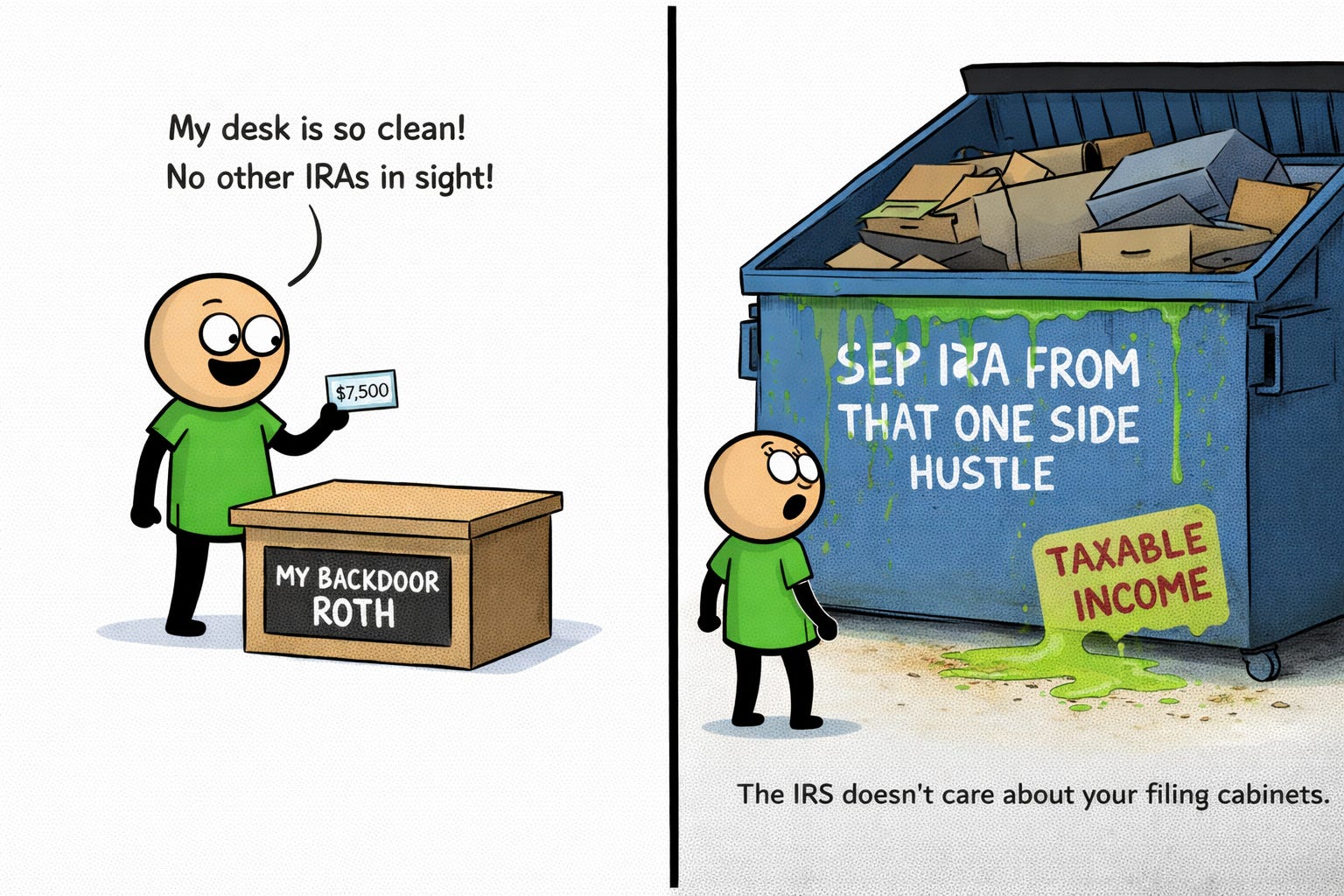
The backdoor Roth conversation almost always focuses on Traditional IRA balances. Clear out the pretax money, make a nondeductible contribution, convert, done. Most guides stop there.
They should not. Because the account that ruins more backdoor Roth conversions than any other is not the Traditional IRA. It is the SEP IRA sitting at a custodian you have not logged into in three years.
A SEP IRA is legally a Traditional IRA. The IRS does not treat it as a separate category. When you open a SEP IRA and your employer (or you, as a self-employed person) makes contributions to it, those contributions go into an account that carries the same tax designation as every other Traditional IRA you own. It has the same aggregation rules. It has the same pro-rata treatment. And its balance is included in the same denominator on Form 8606.
The same is true for SIMPLE IRAs, once the two-year holding period from your first contribution has passed. Before two years, the SIMPLE IRA sits in its own silo. After two years, it joins the pool.
Here is how it plays out.
David is a software engineer earning $210,000. His income exceeds the Roth IRA limit for single filers, so he does a backdoor Roth every year. He contributes $7,500 to a nondeductible Traditional IRA and converts it to a Roth within a week. No other Traditional IRA balances. Clean conversion. Zero tax.
In 2024, David starts freelancing on the side. His accountant recommends a SEP IRA for the tax deduction. David contributes $15,000 to a SEP for 2024 and another $20,000 for 2025. He does not think about the SEP again. It is at a different custodian from his Traditional IRA. It serves a different purpose in his mind.
In January 2026, David makes his usual $7,500 nondeductible Traditional IRA contribution and converts it.
December 31, 2026: David’s Traditional IRA balance is $0 (he converted everything). His SEP IRA balance is $38,000 (the $35,000 in contributions plus growth).
Form 8606 math:
Total basis: $7,500 Total IRA value (Line 6): $38,000 + $7,500 (conversion added back) = $45,500 Tax-free percentage: $7,500 / $45,500 = 16.5% Tax-free portion of conversion: $7,500 x 16.5% = $1,238 Taxable portion: $7,500 - $1,238 = $6,262
David expected zero tax. He owes income tax on $6,262. The SEP IRA he never touched, never converted from, and barely thinks about added $38,000 to his denominator and made 83.5% of his “tax-free” conversion taxable.
SIMPLE IRAs create the same problem with an added timing trap.
Rachel works for a small company that offers a SIMPLE IRA. She has been contributing for four years. Her SIMPLE IRA balance is $52,000. She also does a backdoor Roth every year using a separate Traditional IRA at a different custodian.
Rachel’s SIMPLE IRA passed the two-year holding period years ago. That $52,000 is in her pro-rata denominator. Her backdoor Roth has never been clean. Every year, the conversion has been partially taxable, and she has never filed Form 8606 to account for it.
If Rachel’s SIMPLE IRA were still within its first two years, the balance would be excluded. But the two-year clock started with her first contribution, not her most recent one. Once it passes, every dollar in the SIMPLE IRA counts permanently.
The wrinkle that catches business owners who wear multiple hats is having both a SEP IRA from self-employment and a SIMPLE IRA from a separate employer. Both balances count. Both are in the denominator. And neither one has anything to do with the Traditional IRA the person is converting from. The IRS does not care about the source of the money or the purpose of the account. It cares about the total pretax balance across every qualifying account in your name.
A business owner with a $7,500 nondeductible contribution, a $60,000 SEP, and a $40,000 SIMPLE IRA (past two years) has a denominator of $107,500. The tax-free percentage on the conversion is 7%. The backdoor Roth is not backdoor anymore. It is mostly a taxable conversion with extra steps.
The fix is the same one that works for Traditional IRA pretax balances: move the money out of the IRA system before December 31.
If you have a Solo 401(k) that accepts incoming rollovers, you can roll the SEP IRA balance into it. The pretax money leaves the IRA pool and enters the employer plan pool, which is not included in the pro-rata calculation. With the SEP balance gone, your nondeductible contribution is the only money in the Traditional IRA system, and the conversion is clean.
SIMPLE IRAs can also be rolled into a 401(k), but only after the two-year holding period. During the first two years, the SIMPLE IRA cannot be moved to a non-SIMPLE plan without triggering a 25% early distribution penalty (instead of the usual 10%). After two years, a rollover to a 401(k) follows the same rules as any other Traditional IRA rollover.
There is one exception. Under SECURE 2.0, if an employer terminates a SIMPLE IRA plan mid-year to replace it with a Safe Harbor 401(k), the two-year rule is waived for rollovers into that specific new plan. This means employees can roll their SIMPLE IRA balances into the replacement 401(k) immediately without the 25% penalty, even if they have not hit the two-year mark. This is a narrow scenario, but for a small business owner considering switching plan types, it eliminates the usual waiting period and lets employees clear their SIMPLE balances from the pro-rata denominator sooner.
There is an important detail here. The IRS allows you to separate pretax and after-tax money on a rollover to an employer plan. Roll the pretax into the 401(k), leave the after-tax in the IRA. That is the mechanism that makes the clearing the deck strategy work. But if you never had after-tax money in the SEP or SIMPLE, the entire balance goes to the 401(k) and your IRA system is empty.
Not everyone has a 401(k) that accepts rollovers. If you are self-employed, you can establish a Solo 401(k) specifically for this purpose. The plan must be established by December 31 of the year you want to use it (you cannot retroactively open a Solo 401(k) and roll money into it for a prior year). The rollover can happen after establishment as long as the plan documents allow incoming rollovers.
If you work for an employer and their 401(k) does not accept rollovers, you are stuck. The SEP or SIMPLE balance stays in the IRA system and the pro-rata rule applies. Your options at that point are to accept the partial taxation on backdoor Roth conversions, stop doing backdoor Roths until the pretax balance is gone (through distributions or conversions spread over multiple years), or lobby your employer to amend the plan to accept rollovers.
The lesson for anyone with self-employment income, past or present, is simple. Before you execute a backdoor Roth, check every IRA in your name. Not just the one you are converting from. Every Traditional IRA, every SEP IRA, and every SIMPLE IRA past its two-year mark. If the combined pretax balance is anything above zero, the conversion is not tax-free.
The account you forgot about is the one that changes the math.
I write one of these every day, one retirement rule, explained in plain language and verified against the source. The daily email is free: subscribe here.
Full archive, worksheets, and search live at RetirementNewsRundown.com
Disclaimer This article is for educational and informational purposes only. It is not tax, legal, or financial advice and does not create an advisor-client relationship. Always consult appropriate professionals regarding your specific situation.