Roth conversions are sold as a tax strategy. Move money from a Traditional IRA to a Roth, pay the tax now, never pay tax on it again. The pitch makes it sound like a choice. Convert or do not convert. Pay tax or do not pay tax.
The reality is more specific. You are always paying tax on a Roth conversion. The only variable is how much. And one rule determines that amount for every conversion, every year, for every taxpayer.
The rule is the pro-rata rule. It calculates the taxable portion of any Roth conversion by applying a single ratio: your total nondeductible (after-tax) IRA contributions divided by your total Traditional IRA balance as of December 31. The result is the percentage of the conversion that is tax-free. Everything else is taxable income.
If you have never made a nondeductible contribution, the ratio is zero. The entire conversion is taxable. There is no after-tax money to recover. This is the situation for most people who convert: they have Traditional IRAs funded entirely by deductible contributions, rollovers from employer plans, and investment earnings. All pretax. All taxable on conversion.
If you have made nondeductible contributions, some portion of the conversion is tax-free. But only the proportional share determined by the ratio. Not the full nondeductible amount. Not the specific dollars you want to convert. The proportional share across all accounts.
The tax treatment of a Roth conversion is reported in two places on your tax return.
First, Form 1099-R. Your custodian issues this form showing the gross distribution amount in Box 1 and the taxable amount in Box 2a. For conversions, Box 2a often shows the full amount as taxable because the custodian does not know your nondeductible basis. They report what left the account. You determine what is taxable.
Second, Form 8606. This is where you calculate the actual taxable amount using the pro-rata formula. The number on Form 8606 overrides whatever appears in Box 2a of the 1099-R. If your custodian reports $50,000 as fully taxable but Form 8606 shows $5,000 is nontaxable, you pay tax on $45,000. The form is the authority. The 1099-R is just the starting point.
People who skip Form 8606 and accept the 1099-R as final overpay their taxes. People who skip Form 8606 and assume the conversion is tax-free because they “only converted the after-tax money” underpay their taxes. Both mistakes trace back to not filing the form.
The conversion amount is added to your ordinary income for the year. It stacks on top of your wages, business income, interest, dividends, and everything else. There is no special tax rate for Roth conversions. No capital gains treatment. No preferential bracket. Ordinary income rates, applied at whatever marginal bracket the conversion pushes you into.
This is why conversion sizing matters. A $20,000 conversion for someone in the 22% bracket costs $4,400 in federal tax (assuming the full amount is taxable). But if they convert $80,000 instead, the last $30,000 might land in the 32% bracket. The blended rate on the full conversion is higher than the rate on a smaller one.
The people who convert strategically pick an amount that fills the current bracket without spilling into the next one. The people who convert without planning pick a round number and deal with the bracket surprise in April.
Here is a concrete example.
Karen is 55, single, and earns $85,000 in W-2 income. She has a Traditional IRA with $250,000, all from deductible contributions and rollovers. No nondeductible contributions. She converts $40,000 to a Roth.
Tax-free percentage: $0 / $250,000 = 0%. The entire $40,000 is taxable.
Karen’s total taxable income for the year: $85,000 + $40,000 = $125,000 (before the standard deduction). After the 2026 standard deduction of $16,100, her taxable income is $108,900.
The 2026 tax brackets for single filers: 10% up to $12,400, 12% from $12,401 to $50,400, 22% from $50,401 to $105,700, 24% from $105,701 to $201,775.
Without the conversion, Karen’s taxable income after standard deduction is $68,900. She is in the 22% bracket with room to spare.
With the $40,000 conversion, she pushes through the top of the 22% bracket and $3,200 spills into the 24% bracket. The first $36,800 of the conversion is taxed at 22% ($8,096). The remaining $3,200 is taxed at 24% ($768). Total federal tax on the conversion: $8,864.
If Karen had converted $36,800 instead of $40,000, the entire conversion would have stayed in the 22% bracket. Total tax: $8,096. She would save $768 by converting $3,200 less.
That $3,200 can be converted next year when she has another full 22% bracket to fill. The tax rate is the same. The timing is just more efficient.
Conversions also affect other parts of the tax return beyond the bracket calculation.
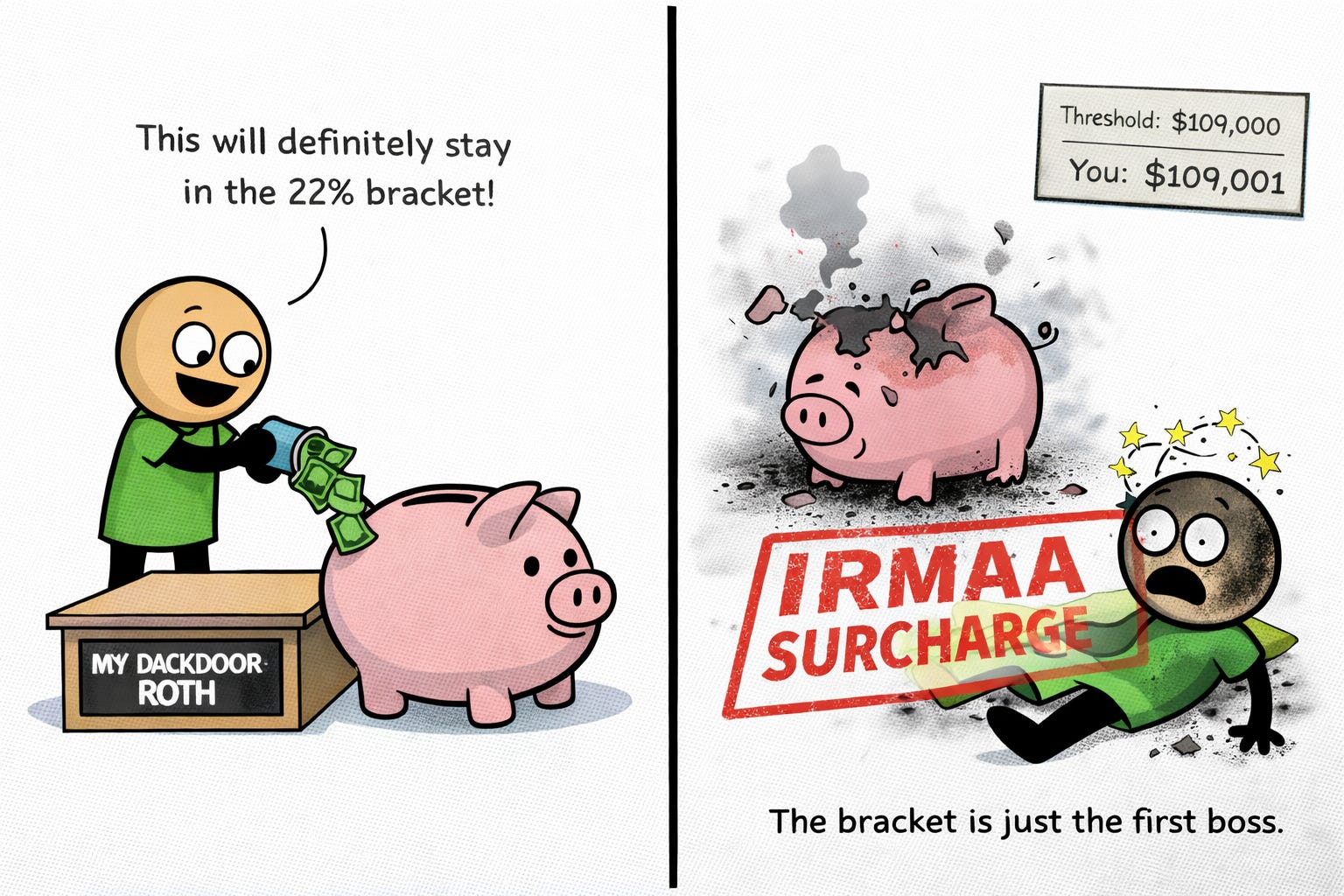
Medicare premiums. Modified adjusted gross income above certain thresholds triggers IRMAA surcharges on Part B and Part D premiums. For 2026, the surcharges begin at MAGI above $109,000 for single filers. A large conversion can push you over that threshold, adding thousands in annual Medicare costs starting two years later. Karen's $40,000 conversion pushes her MAGI to $125,000, which triggers the first-tier surcharge in 2028.
Social Security taxation. If you are collecting Social Security, up to 85% of your benefits can be taxable depending on your "combined income," which the IRS calculates as your adjusted gross income plus nontaxable interest plus half of your Social Security benefits. A Roth conversion increases AGI directly, which does two things at once: the conversion itself is taxable, and it can push more of your Social Security benefits into the taxable range. It acts as a double tax. You pay tax on the conversion and you pay more tax on benefits that were previously untaxed. For single filers, combined income above $25,000 triggers taxation on up to 50% of benefits. Above $34,000, up to 85% becomes taxable.
Net Investment Income Tax. The 3.8% NIIT applies to the lesser of net investment income or MAGI above $200,000 for single filers. A conversion does not count as investment income, but it increases your MAGI, which can push your existing investment income above the threshold.
Capital gains bracket. A conversion increases your taxable income, which can push long-term capital gains from the 0% or 15% rate into the next tier.
The conversion itself might be taxed at 22%. But the downstream effects on Medicare premiums, Social Security taxation, and investment income can add hidden costs that do not show up on the conversion calculation alone.
The rule that determines how Roth conversions are taxed is not one rule. It is one rule that activates a chain of consequences. The pro-rata ratio determines the taxable amount. The taxable amount determines the bracket impact. The bracket impact determines the downstream effects on Medicare, Social Security, and investment income.
This is why running the numbers before converting is not optional. The conversion amount, your total IRA balances, your other income, and your December 31 snapshot all feed into a calculation that touches multiple parts of your tax return. Getting the pro-rata formula right is step one. Understanding what the taxable amount does to the rest of your return is step two.
I write one of these every day, one retirement rule, explained in plain language and verified against the source. The daily email is free: subscribe here.
Full archive, worksheets, and search live at RetirementNewsRundown.com
Disclaimer This article is for educational and informational purposes only. It is not tax, legal, or financial advice and does not create an advisor-client relationship. Always consult appropriate professionals regarding your specific situation.