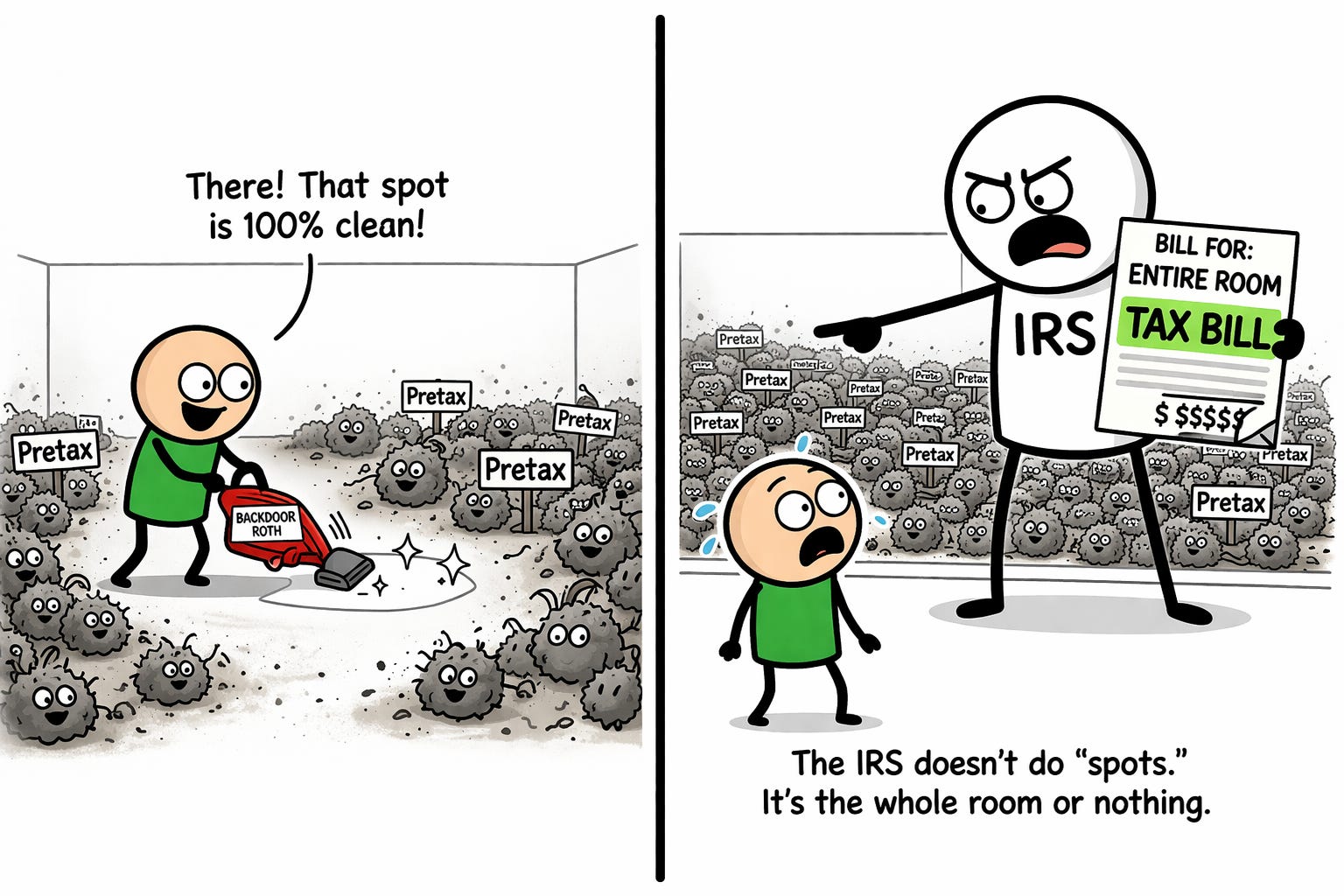
Every post this week has circled the same problem from a different angle. The pro-rata rule takes your total Traditional IRA balance and uses it to determine how much of any conversion is taxable. The bigger the pretax balance, the more tax you pay.
The logical conclusion is obvious. If you want the backdoor Roth conversion to be tax-free, the pretax balance needs to be zero.
Not low. Not small. Zero.
The math is unforgiving on this point. A $500 pretax balance in a forgotten Traditional IRA is enough to make a portion of your conversion taxable. A $50,000 SEP IRA you stopped contributing to years ago makes the majority of it taxable. The pro-rata rule does not have a threshold or a safe harbor. Any pretax dollar in any Traditional, SEP, or SIMPLE IRA (past two years) on December 31 enters the denominator and reduces your tax-free percentage.
The only way to get 100% of your backdoor Roth conversion tax-free is to have $0 in pretax Traditional IRA money on December 31 of the conversion year. That means the numerator (your nondeductible contributions) equals the denominator (your total IRA balance), and the tax-free percentage is 100%.
There are three ways to get to zero. Each has tradeoffs.
Method 1: Roll pretax IRA money into an employer plan.
This is the cleanest option if it is available to you. Take every dollar of pretax money in your Traditional, SEP, and SIMPLE IRAs and roll it into a 401(k), 403(b), or other employer plan that accepts incoming rollovers. The pretax money leaves the IRA system. The after-tax money (your nondeductible contributions) stays behind in the Traditional IRA. Convert the remaining after-tax balance to a Roth. Tax-free.
The IRS allows you to separate pretax and after-tax on a rollover to an employer plan. This is the only time you can cherry-pick. The pretax goes to the 401(k). The after-tax stays in the IRA. The pro-rata denominator drops to just the after-tax amount, and the conversion is clean.
Requirements: your employer plan must accept incoming rollovers. Not all do. Check the plan document or ask HR. If you are self-employed, you can establish a Solo 401(k) that accepts rollovers, but the plan must be established by December 31 of the year you want to use it.
For SIMPLE IRAs, you can only roll into an employer plan after the two-year holding period. Before two years, the money is stuck in the SIMPLE system.
Timeline: the rollover must be complete and the pretax money must be out of the IRA system before December 31. Do not wait until December 28. Custodians have processing times. Some take five to seven business days. Some require paperwork by mail. Start the rollover in October or November to give yourself a buffer.
Method 2: Convert the entire pretax balance to Roth.
If you cannot roll money into an employer plan, you can convert everything in your Traditional IRAs to a Roth. That empties the pretax balance by turning it into Roth money. The pro-rata denominator goes to zero because there is nothing left in the Traditional IRA system.
The tradeoff is obvious. You pay tax on the entire pretax amount in the year of conversion. If you have $200,000 in pretax IRA money, converting it all in one year adds $200,000 to your taxable income. That likely pushes you into the 32% or 35% bracket, triggers IRMAA surcharges two years later, and may affect Social Security taxation and the net investment income tax.
This method works best when the pretax balance is small. If you have $10,000 or $15,000 in pretax money, converting it all in a year with lower income is manageable. If you have $300,000, spreading the conversion over multiple years makes more sense to control the bracket impact.
The multi-year approach means you are not doing a clean backdoor Roth during those years. You are doing partial conversions to draw down the pretax balance while accepting a partially taxable backdoor Roth each year. Once the pretax balance reaches zero, future backdoor Roths are clean.
Method 3: Distribute the pretax balance.
You can simply withdraw the pretax money from the Traditional IRA. The distribution is taxable income, same as a conversion, and if you are under 59 1/2 it also triggers the 10% early distribution penalty. This is the worst of the three options for most people. You pay the tax, you may pay the penalty, and the money leaves the retirement system entirely.
The only scenario where this makes sense is if the pretax balance is very small (a few hundred dollars) and you want to clean up the account quickly without the paperwork of a rollover or conversion. On $500, the tax is negligible and the simplicity may be worth it.
What “zero” actually means on December 31.
The balance the IRS uses is the fair market value as of December 31 of the conversion year. This means the account does not need to be closed. It just needs to have zero pretax money in it. If you rolled all the pretax money into a 401(k) in November and the only thing left in the Traditional IRA is $7,500 in nondeductible contributions you just made, the December 31 pretax balance is zero. The $7,500 is after-tax. The conversion is 100% tax-free.
Be careful with timing. If you have investments in the Traditional IRA, they may generate dividends or capital gains distributions between the rollover and December 31. A $12 dividend deposited in December is pretax money. It is small. But it is not zero. And it will make a tiny portion of your conversion taxable.
The safest approach is to move the nondeductible contribution into a money market or settlement fund before converting. No dividends, no surprise gains, no stray pretax dollars appearing after you thought the account was clean.
The annual maintenance cycle.
For people who do backdoor Roths every year, this is not a one-time cleanup. It is an annual process.
Step 1: Confirm that no pretax money exists in any Traditional, SEP, or SIMPLE IRA in your name. Check every custodian. Check accounts you opened years ago. Check the SEP your former accountant set up.
Step 2: Make the nondeductible contribution to your Traditional IRA. For 2026, the limit is $7,500 ($8,600 if 50 or older).
Step 3: Convert to Roth. Do this promptly after contributing. The longer the money sits in the Traditional IRA, the more earnings accumulate, and those earnings are pretax and taxable on conversion.
Step 4: File Form 8606 with your tax return. Part I for the nondeductible contribution. Part II for the conversion. Every year. No exceptions.
Step 5: Do not roll any employer plan money into a Traditional IRA during the calendar year. If you change jobs, leave the old 401(k) in the plan or roll it into the new employer’s plan. Do not bring it into the IRA system.
Step 6: Verify your December 31 balances in January. Pull statements from every custodian. Confirm the pretax balance is zero before you file.
Miss any step and the backdoor Roth leaks. The conversion still happens. It is just partially taxable instead of tax-free.
The backdoor Roth is not a one-time maneuver. It is an annual discipline. The pro-rata rule applies every year, based on every account, using the December 31 snapshot. Zeroing out the pretax balance is not the final step. It is the prerequisite. And it needs to be true every single year you want a clean conversion.
The accounts you ignored all week are the ones that determine whether this works. Check them now. The calculator is waiting.
I write one of these every day, one retirement rule, explained in plain language and verified against the source. The daily email is free: subscribe here.
Full archive, worksheets, and search live at RetirementNewsRundown.com
Run your own numbers with the IRA Pro-Rata Calculator
Disclaimer This article is for educational and informational purposes only. It is not tax, legal, or financial advice and does not create an advisor-client relationship. Always consult appropriate professionals regarding your specific situation.