You get a 1099-R showing a $60,000 distribution. You open it expecting to see how much tax you owe. Box 1 shows $60,000. Box 2a is blank. Box 7 has a code you don’t recognize. You stare at the form trying to figure out if you owe taxes on $60,000 or zero or something in between. The form doesn’t answer the question. It just reports that money moved.
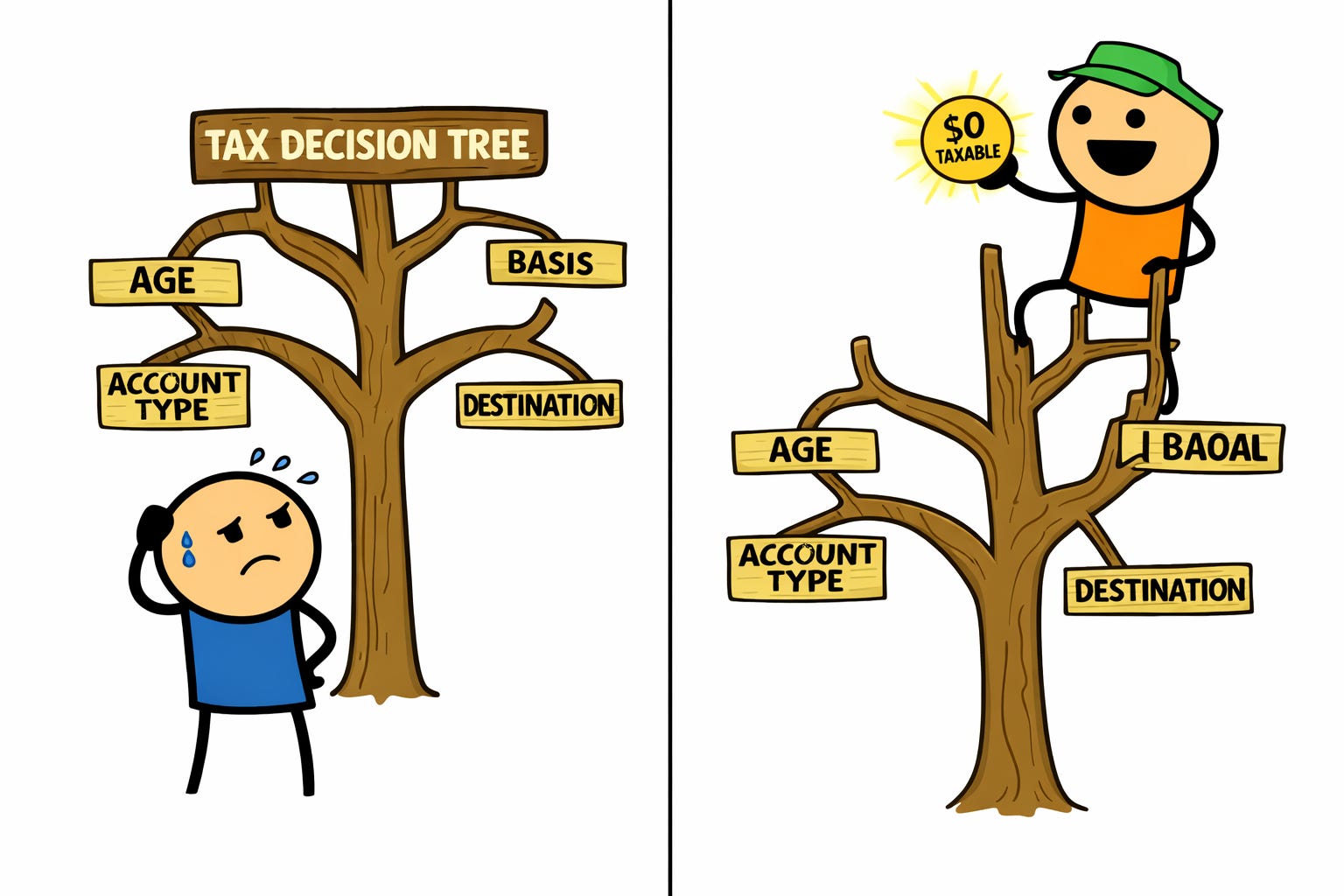
Whether a retirement distribution is taxable isn’t determined by a single rule. It’s determined by a combination of factors that interact with each other. The type of account the money came from. Your age when you took the distribution. Whether you have basis in the account. What you did with the money after it left the account. The distribution code on the 1099-R. All of these factors combine to produce the answer. Change one variable and the tax treatment changes completely.
People assume the 1099-R tells them what’s taxable. It doesn’t. The 1099-R reports what happened. The taxpayer determines the tax consequences by applying the rules to their specific situation.
The first factor is the account type. A distribution from a traditional IRA is taxable unless you have basis. A distribution from a Roth IRA is tax-free if it’s qualified and potentially taxable if it’s not. The account type sets the baseline tax treatment before any other factors apply.
A traditional IRA is funded with pre-tax or after-tax dollars. If you deducted the contributions, the entire distribution is taxable. If you made nondeductible contributions and tracked your basis on Form 8606, part of the distribution is taxable and part is a return of basis. The custodian doesn’t know your basis. They report the gross distribution and leave it to you to calculate the taxable portion using the pro-rata rule.
A Roth IRA is funded with after-tax dollars. Distributions come out in order. Contributions first, conversions second, earnings last. Contributions are always tax-free because you already paid taxes on that money. Conversions are tax-free if they’ve been in the Roth for at least five years or you’re over 59½. Earnings are tax-free if the distribution is qualified. The custodian doesn’t track which bucket your distribution came from. They report the gross distribution with code J and you determine whether any portion is taxable.
The second factor is your age. If you’re under 59½, an early distribution from a traditional IRA or 401k is subject to a 10% penalty in addition to ordinary income tax. If you’re over 59½, the penalty doesn’t apply. The age threshold matters for Roth conversions too. Each conversion has its own five-year clock before it can be withdrawn penalty-free. But if you’re 59½ or older, you can access conversions immediately without the penalty even if five years haven’t passed.
The penalty has exceptions. First-time home purchase up to $10,000 for IRAs only. Qualified higher education expenses for IRAs only. Medical expenses exceeding 7.5% of adjusted gross income. Disability. Death. These exceptions apply differently depending on the account type. The first-time home purchase and education exceptions work for IRAs but not for 401k plans. If you’re 55 and take money from your 401k to buy a house, you pay the 10% penalty. If you roll the 401k to an IRA first and then take the distribution, the exception applies.
A penalty exception just removes the additional 10%. The ordinary income tax still applies unless the distribution is from a Roth and qualifies as tax-free under Roth rules.
For Roth IRAs, age 59½ is one of the requirements for a qualified distribution. The other requirement is the five-year rule. The Roth must have been open for at least five years. If both conditions are met, the entire distribution including earnings is tax-free. If either condition isn’t met, the distribution is nonqualified. Contributions still come out tax-free. Conversions come out tax-free if they’ve been in the Roth for five years or you’re over 59½. Earnings are taxable and subject to the 10% penalty if you’re under 59½ and no exception applies.
The third factor is basis. If you made nondeductible contributions to a traditional IRA, you have basis. When you take a distribution, part of it is a return of your basis and part of it is taxable growth. The pro-rata rule determines the split. You divide your total basis by your total IRA balance across all non-Roth IRAs as of December 31st of the distribution year. That percentage of each distribution is nontaxable. The rest is taxable.
The IRS views all your traditional, SEP, and SIMPLE IRAs as one combined account for pro-rata purposes. You can’t isolate basis in a specific IRA and claim that particular account is nontaxable. The calculation applies across everything.
If you have $20,000 of basis and $200,000 in total traditional IRA balances, 25% of every distribution is nontaxable. If you take a $10,000 distribution, $2,500 is a return of basis and $7,500 is taxable. The custodian doesn’t calculate this for you. They report $10,000 in box 1, leave box 2a blank, and check box 2b indicating the taxable amount is not determined. You file Form 8606 with your tax return showing the calculation.
For Roth IRAs, basis works differently. Your contributions are always basis. They come out first and they’re always tax-free. Conversions become basis after five years or when you reach 59½. Earnings are not basis. They come out last and they’re taxable if the distribution is nonqualified. The ordering rules handle this automatically. You don’t use the pro-rata rule for Roth distributions.
The fourth factor is what you did with the money. If you took a distribution and deposited it into another retirement account within 60 days, it’s a rollover. Rollovers are not taxable. The 1099-R shows the distribution with code G for a direct rollover or code 1 for an indirect rollover. You report the distribution on your tax return but exclude it from taxable income by showing the rollover on the appropriate line.
If you took a distribution and made a qualified charitable distribution, the 1099-R will show code 7 if you’re over 59½. There is no specific distribution code for QCDs. The custodian reports it as a normal distribution. You must report the gross distribution on your tax return and write “QCD” next to the line to show why the taxable amount is zero. QCDs are available starting at age 70½. They satisfy your required minimum distribution if you’re subject to RMDs, which begin at age 73 for people turning 73 in 2026.
If you took a distribution to correct an excess contribution, it’s reported with code P. The returned contribution is taxable in the year you remove it if you deducted it originally. If you didn’t deduct it, the removal is nontaxable. The earnings on the excess contribution are always taxable.
The distribution code in box 7 provides a clue about the transaction but it doesn’t determine the tax treatment by itself. Code 1 means early distribution with no known exception. Code 2 means early distribution with an exception. Code 7 means normal distribution after 59½. Code G means direct rollover. Code J means Roth distribution. Code P means excess contribution removal. Code Q means qualified Roth distribution, not qualified charitable distribution.
The code tells you what kind of transaction occurred. It doesn’t tell you whether it’s taxable. You still have to apply the account type rules, the age rules, the basis rules, and the rollover rules to determine the final tax consequences. A code 7 distribution from a traditional IRA is fully taxable. A code 7 distribution from a Roth IRA might be fully tax-free if it’s qualified. Same code, different account type, different result.
At Charles Schwab, I took calls from people trying to determine if their distribution was taxable. Here’s a specific example. A 55-year-old takes a $50,000 distribution from a traditional IRA. They have $10,000 of nondeductible contributions tracked on prior Form 8606s. Their total traditional IRA balance across all accounts as of December 31st is $200,000. They took the distribution and spent it. No rollover. No exception to the penalty.
The pro-rata calculation: $10,000 basis divided by $200,000 total balance equals 5%. Five percent of the $50,000 distribution is nontaxable. That’s $2,500. The remaining $47,500 is taxable income. Because they’re under 59½ and no exception applies, the $47,500 is also subject to the 10% early withdrawal penalty. Total tax consequences: $47,500 added to ordinary income and a $4,750 penalty.
The custodian’s 1099-R shows $50,000 in box 1, blank in box 2a, code 1 in box 7, and box 2b checked. The taxpayer files Form 8606 showing the basis calculation. They report $47,500 as taxable income on their return. They pay the 10% penalty on Form 5329.
Whether a distribution is taxable depends on the interaction of multiple factors. The account type sets the baseline. Your age determines whether penalties apply and whether certain tax-free treatments are available. Basis reduces the taxable portion if you made nondeductible contributions. What you did with the money determines whether it’s a rollover, a QCD, or a taxable distribution. The distribution code provides context but doesn’t override the underlying rules.
You can’t look at a single data point and know the answer. You need all the variables. Account type, age, basis, destination, and code. Put them together and the tax treatment becomes clear. The 1099-R gives you some of the information. You provide the rest.
I write one of these every day, one retirement rule, explained in plain language and verified against the source. The daily email is free: subscribe here.
Full archive, worksheets, and search live at RetirementNewsRundown.com.
Disclaimer
This article is for educational and informational purposes only. It is not tax, legal, or financial advice and does not create an advisor–client relationship. Always consult appropriate professionals regarding your specific situation.