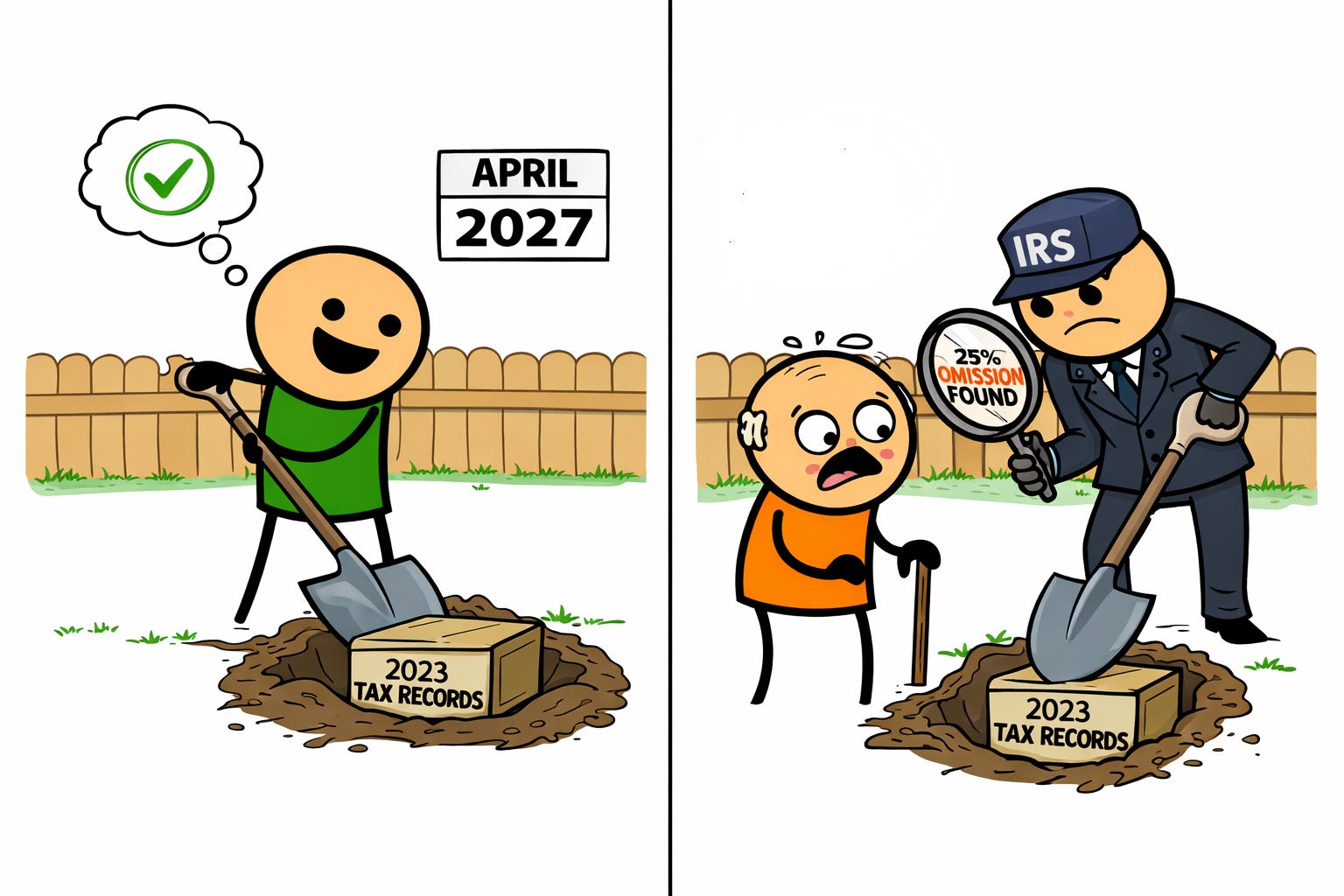
You take a Roth conversion in 2023. You report it correctly on your 2023 tax return filed in March 2024. You pay the taxes. The IRS processes your return and issues your refund in April 2024. You assume the matter is closed. Then in November 2026, nearly three years after the conversion, you get a letter from the IRS asking you to verify the transaction and provide documentation proving you reported it correctly.
You’re confused. The return was filed almost three years ago. The IRS accepted it. They issued the refund. Why are they questioning it now? What took them so long? And do they still have the authority to change your tax liability this far after the fact?
The IRS has a statute of limitations for assessing additional tax. For most returns, it’s three years from the later of the filing deadline or the date you actually filed. That gives them a long window to review transactions, request documentation, and propose adjustments. The clock doesn’t start the moment you file. It starts based on when the return was due or when you filed it, whichever comes later.
The three-year statute runs from April 15th for returns filed on time. If you file your 2023 return in February 2024, the statute starts on April 15th, 2024. The IRS has until April 15th, 2027, to assess additional tax. Filing early doesn’t shorten the statute. The clock waits until the due date to start.
If you file on extension and submit your return on October 15th, 2024, the statute starts on October 15th, 2024. The IRS has until October 15th, 2027, to assess additional tax. Filing on extension actually pushes the IRS deadline back by six months. The statute starts on the later of the original due date or the actual filing date.
If you file late without an extension, the statute still starts on the date you filed, not the original due date. If you file your 2023 return in December 2024 without having filed an extension, the statute runs until December 2027. Filing late gives the IRS more time, not less.
If you never file a return at all, the statute never starts. The IRS can come after you decades later for an unfiled return. The three-year clock only begins when you actually file. No return means no statute protection.
If you omit more than 25% of your gross income from your tax return, the statute extends to six years. This applies to underreported income and overstated basis. If you report your IRA distribution basis as $100,000 when it was actually $10,000, you’ve hidden $90,000 of taxable income. That counts as an omission under the 25% rule even though you didn’t leave the distribution off the return entirely. You just inflated the nontaxable portion.
The 25% threshold is calculated against your total gross income, not just retirement income. If your total gross income for the year was $200,000 and you omitted $60,000, you crossed the 25% threshold. The six-year statute applies automatically. The IRS doesn’t have to prove you intended to cheat. The math alone triggers the extended statute. If the omission hits 25.01%, the IRS gets six years regardless of whether the mistake was intentional.
If fraud is involved, there is no statute of limitations at all. If the IRS can prove willful intent to evade tax, they can assess additional tax from any year in history. Fraud keeps the statute open indefinitely. This is rare and requires proof of intentional deception, but it eliminates the time limit entirely.
The three-year window gives the IRS time to run their matching programs, review flagged returns, and issue notices proposing adjustments. Most notices arrive twelve to eighteen months after filing because that’s when the automated matching programs run. But if a return gets selected for audit, if amended information returns get filed, or if the IRS identifies a complex issue requiring manual review, the notice can arrive much later.
At Charles Schwab, I took calls from people who got IRS notices two or three years after filing returns. They were surprised the IRS was still reviewing transactions from that far back. They assumed the statute was shorter. One year. Maybe eighteen months. Not three full years from the filing deadline.
Here’s a specific example. A taxpayer files their 2023 return on March 1st, 2024, reporting a $100,000 Roth conversion. The IRS processes the return in April 2024 and issues the refund. The custodian files the 1099-R showing the conversion on March 30th, 2024. The IRS loads that data into their system in May 2024. The automated matching program runs in August 2025. Everything matches. No issue.
But in October 2025, the custodian files an amended 1099-R correcting the distribution amount to $110,000. There was a calculation error on the original form. The IRS receives the correction, updates their database, and runs a secondary match. Now there’s a $10,000 discrepancy. The system generates a CP2000 notice in December 2025. The taxpayer receives it in January 2026. Nearly two years after they filed the return.
The taxpayer responds explaining they reported the distribution based on the original 1099-R. They attach the original form showing $100,000. The IRS reviews the response and requests documentation showing the taxpayer paid tax on the full $110,000 once they became aware of the correction. If the taxpayer amended their return to report the additional $10,000, the case closes. If they didn’t, the IRS assesses the additional tax on $10,000 plus interest dating back to April 15th, 2024.
The assessment happens in mid-2026. Two years after the return was filed. But it’s still within the three-year statute because the deadline is April 15th, 2027.
If you file an amended return showing additional tax owed within 60 days of the statute expiring, the IRS gets an extra 60 days to assess that specific amount. The amended return doesn’t reset the entire three-year clock. But it does give the IRS a narrow extension to process the amendment and assess the additional tax you reported.
The IRS doesn’t have to act quickly. They have three years from the later of the filing deadline or the filing date to assess additional tax. They can take the full three years if they need it. An audit notice can arrive two and a half years after you filed. Once they start the audit, they have time to complete the examination and issue a notice of deficiency before the statute expires.
If the IRS doesn’t assess additional tax before the statute expires, they lose the ability to collect. The assessment has to happen before the deadline. Once the statute closes, the tax year becomes final and the IRS can’t go back and assess tax later.
This is why keeping retirement account records for at least six to seven years after filing is the safer approach. The standard three-year statute covers most situations. But the six-year extended statute for 25% omissions means a return you filed in 2024 could still be questioned in 2030 if basis was overstated or income was significantly underreported. Having documentation that far back protects you if the IRS comes asking questions years later.
If you don’t have the records and you get a notice two or three years after filing, you’re trying to reconstruct a transaction from memory. Custodians keep records but requesting copies takes time. The IRS gives you a deadline to respond. If you miss it because you’re gathering old documentation, the IRS can proceed with the assessment based on their records alone.
The IRS operates on a three-year statute measured from the later of the filing deadline or the actual filing date. They can question transactions, request documentation, and propose adjustments at any point during that window. If you omitted more than 25% of gross income or overstated basis significantly, the statute extends to six years. If fraud is involved, the statute never closes.
A return filed in early 2024 isn’t final until mid-2027 at the earliest. During that entire period, the IRS can review the return, compare it against information returns, and issue notices if discrepancies surface. If you get a notice two or three years after filing, it’s not unusual. The IRS is operating within their statutory authority.
Respond to the notice with documentation. Explain the transaction. Provide proof. The IRS will either agree with your explanation and close the case or assess additional tax before the statute expires. The clock is always running until the statute closes and the tax year becomes final.
I write one of these every day, one retirement rule, explained in plain language and verified against the source. The daily email is free: subscribe here.
Full archive, worksheets, and search live at RetirementNewsRundown.com.
Disclaimer
This article is for educational and informational purposes only. It is not tax, legal, or financial advice and does not create an advisor–client relationship. Always consult appropriate professionals regarding your specific situation.