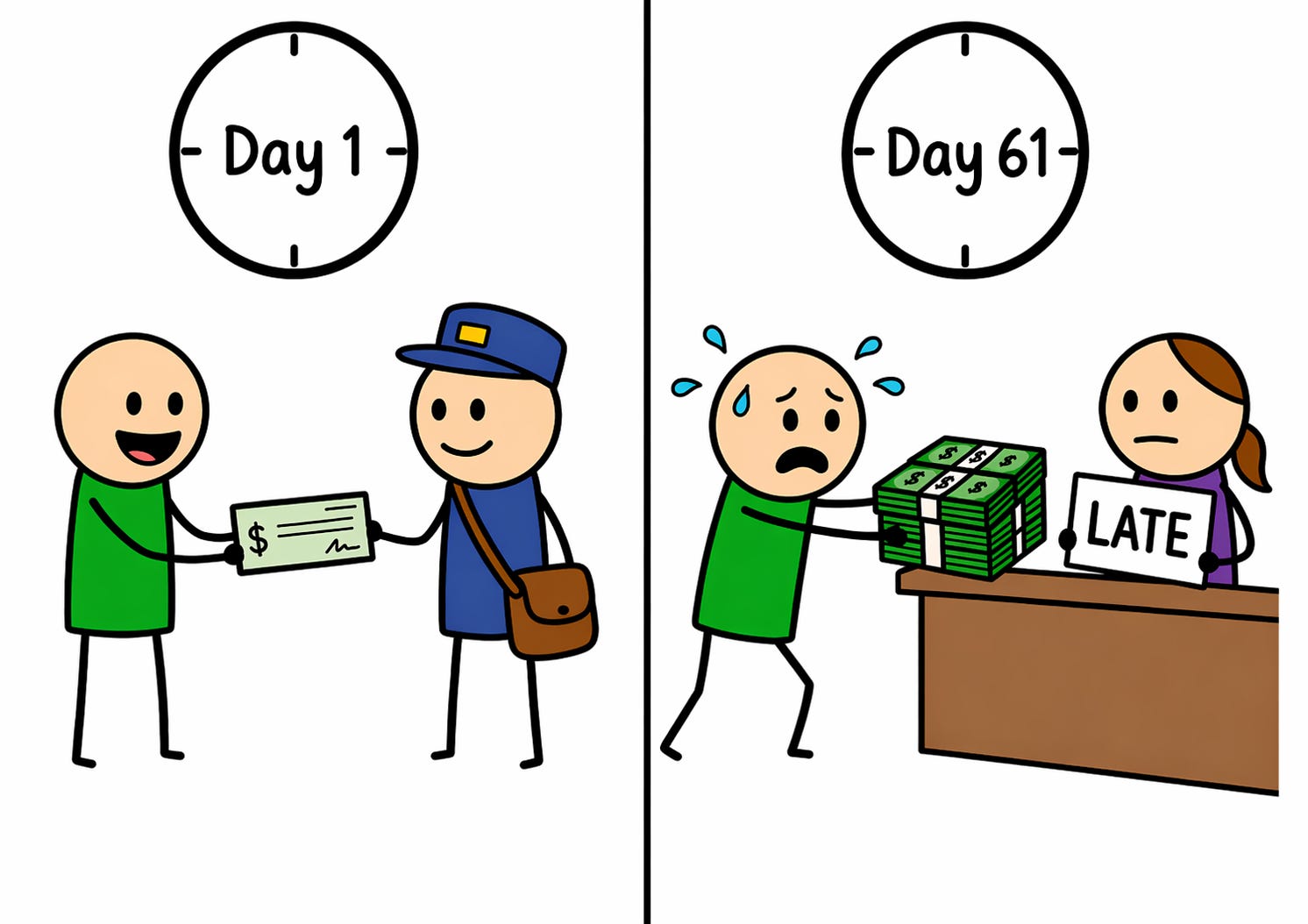
The 60-day rollover clock does not start when you call your custodian. It does not start when the paperwork is filed. It does not start when the check is dated. It starts the day the money lands in your hands. Everything before that moment is just the retirement system warming up
Most people think the clock starts when they initiate the rollover. Or when the check is dated. Or when the funds leave the old account. None of those are correct. The clock starts on the date you receive the distribution. For a check, that means the day it arrives in your mailbox or the day you pick it up. For a direct deposit, that means the day the funds hit your bank account. Not the day your custodian wired them. The day they cleared.
This distinction matters because the space between “they sent it” and “I got it” can eat a week of your 60 days before you even know the clock is running.
When you take a distribution from a retirement account (IRA, 401(k), 403(b), or similar), you have exactly 60 calendar days from the date of receipt to deposit those funds into another eligible retirement account. If you complete the deposit within that window, the IRS treats the transaction as a tax-free rollover. The money moved from one retirement account to another. No income recognized. No tax owed.
If you miss the window by even one day, the entire distribution becomes taxable income in the year you received it. If you are under age 59½, you also owe the 10% early withdrawal penalty on top of the income tax. There is no partial credit for being close. Day 59 is a rollover. Day 61 is a taxable distribution.
The 60 days are calendar days. Not business days. Weekends count. Holidays count. If day 60 falls on a Saturday, your deadline is Saturday. The IRS does not extend the rollover window the way it extends tax filing deadlines when April 15 falls on a weekend. This is a hard 60-day line with no built-in cushion for timing.
There is also a limit on how often you can use this window. For IRA-to-IRA rollovers, you get one indirect rollover per 12-month period across all your IRAs. Not one per account. One total. If you did an indirect rollover from any IRA in the last 12 months, a second one is not a rollover. It is a taxable distribution. This limit does not apply to 401(k)-to-IRA rollovers or to direct trustee-to-trustee transfers. It only applies when you personally receive a check from one IRA and deposit it into another.
One critical detail people miss: if your former employer’s plan withholds 20% for federal taxes (which they are required to do on eligible rollover distributions paid directly to you), you still need to deposit the full original amount into the new account to avoid taxes on the shortfall. If your 401(k) distributed $50,000 and withheld $10,000, you received $40,000. But to complete a full rollover, you need to deposit $50,000 into your IRA within 60 days. The missing $10,000 comes out of your own pocket. You get it back when you file your tax return and claim the withholding credit, but you have to front the money. If you only deposit the $40,000 you actually received, the IRS treats the other $10,000 as a taxable distribution.
This is one of the most common and most expensive misunderstandings in the entire rollover process.
Say you leave your job on March 1, 2026. You request a distribution from your 401(k) on March 5. Your former employer’s plan administrator processes the request on March 12. The check is dated March 14. It arrives in your mailbox on March 19.
Your 60-day clock starts March 19. Not March 1. Not March 5. Not March 12. Not March 14. March 19, the day you received the check.
Sixty calendar days from March 19 is May 18, 2026. That is your deadline. If you deposit the funds into an IRA or another employer plan by May 18, the rollover is complete and tax-free. If you deposit on May 19, the entire amount is taxable income for 2026.
Now say the check was for $80,000 but your plan withheld 20%. You received a check for $64,000 and the plan sent $16,000 to the IRS on your behalf. To complete a full rollover, you need to deposit $80,000 into your IRA by May 18. You put in the $64,000 from the check plus $16,000 from your savings. When you file your 2026 tax return, you report the rollover on your return, and the $16,000 withholding shows up as a tax payment. If your total tax liability is less than $16,000, you get a refund. But you had to come up with $16,000 in cash to bridge the gap.
If you only deposit the $64,000, the IRS treats the $16,000 that was withheld as a taxable distribution. You owe income tax on $16,000 plus the 10% early withdrawal penalty if you are under 59½. That is $1,600 in penalty alone on money you never actually spent.
The 60-day rollover is not the only way to move retirement money. A direct rollover (also called a trustee-to-trustee transfer) avoids the 60-day window entirely. The money moves from one custodian to another without you ever touching it. No withholding. No deadline pressure. No risk of missing the window.
The 60-day clock only applies when the money passes through your hands first. And that only happens when you request a distribution paid to you personally rather than transferred directly to the new custodian.
If you are moving retirement money, always ask whether a direct rollover is available before accepting a distribution check. Most custodians and employer plans support it. It eliminates the 60-day risk, eliminates the 20% withholding problem, and eliminates the chance that a slow mail delivery or a forgotten deposit turns your tax-free rollover into a five-figure tax bill.
There is one narrow escape hatch. If you miss the 60-day window for a reason outside your control, such as a bank error, a check lost in the mail, a hospitalization, or a natural disaster, you may be able to self-certify the late rollover under Revenue Procedure 2020-46. You send a signed letter to the receiving custodian stating the reason for the delay and certifying that it qualifies under one of the IRS-approved exceptions. The custodian accepts the deposit as a rollover. This is not a loophole. The IRS can audit the certification and reject it. But it exists for legitimate situations where the system failed, not the person.
The 60-day window exists as a safety net for people who receive distributions and need a short period to redirect them. It was never designed to be a float period, a temporary loan, or a planning strategy. Treating it as anything other than a hard deadline with real consequences is where people get hurt.
I write one of these every day, one retirement rule, explained in plain language and verified against the source. The daily email is free: subscribe here.
Full archive, worksheets, and search live at RetirementNewsRundown.com.
Disclaimer This article is for educational and informational purposes only. It is not tax, legal, or financial advice and does not create an advisor-client relationship. Always consult appropriate professionals regarding your specific situation.