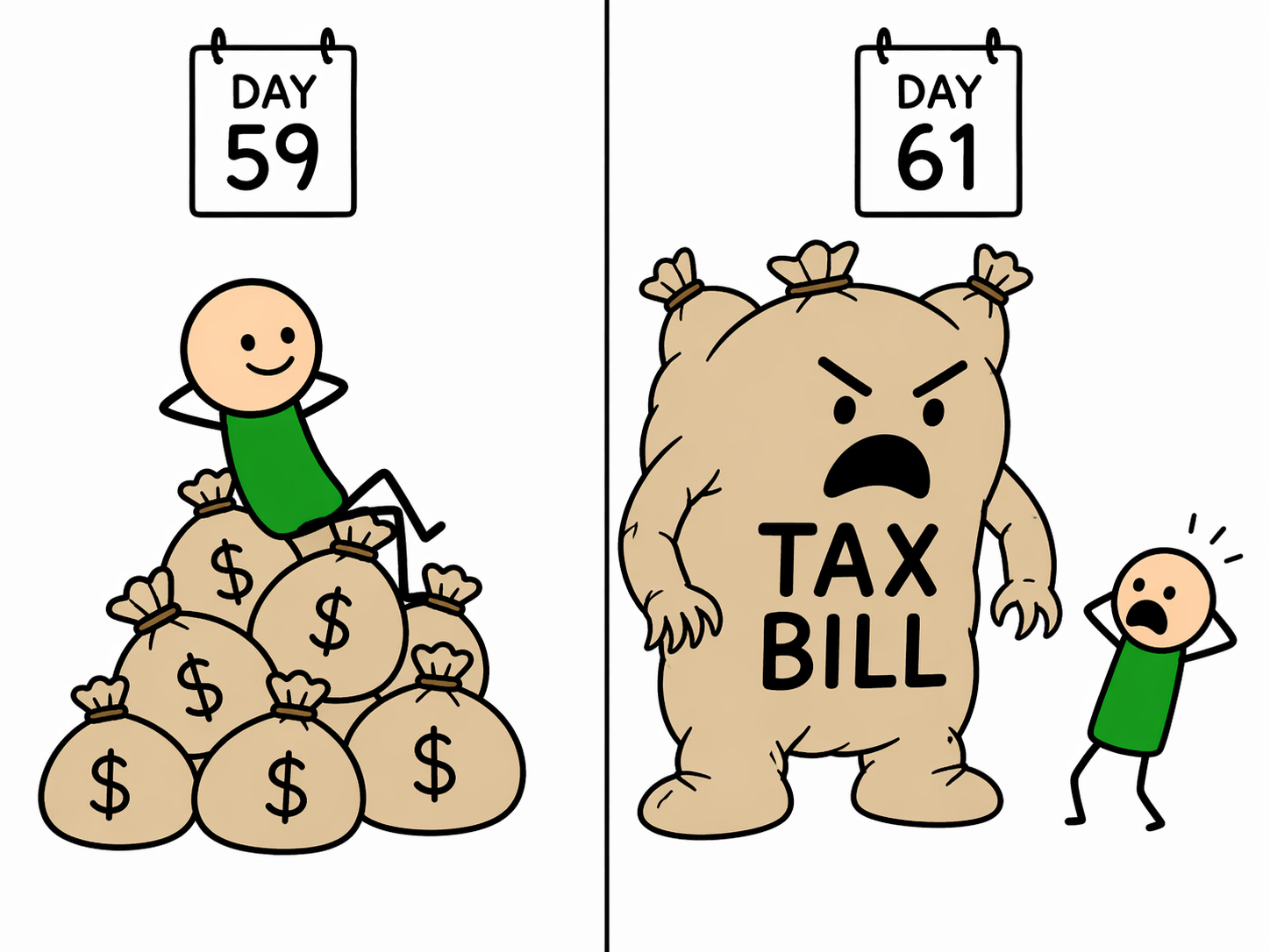
A rollover does not become taxable when you make a mistake. It becomes taxable when a deadline passes without action. The IRS does not retroactively punish you for starting the process. It punishes you for not finishing it.
Most people assume a rollover is either taxable or it isn’t, like a light switch. In reality, every indirect rollover exists in a temporary gray zone. The money left one retirement account. It has not yet arrived in another. During that window, the IRS is watching the calendar, not your intentions. The moment the window closes with the money still in your possession, the transaction changes identity. What was a rollover in progress becomes a taxable distribution. Permanently.
When you receive a distribution from a retirement account and intend to roll it over, the IRS gives you 60 calendar days from the date of receipt to complete the deposit into another eligible retirement account. During those 60 days, the money is in limbo. It is not yet taxable income. It is not yet a completed rollover. It is waiting for you to finish the job.
The moment the rollover becomes taxable is 12:01 AM on day 61.
That is not a metaphor. The IRS draws the line at exactly 60 calendar days. On day 60, you can walk into a bank, deposit the check, and the rollover is valid. On day 61, the same deposit is just a contribution, and the original distribution is now taxable income for the year you received it.
Once that line is crossed, the reclassification is not temporary. You cannot fix it by depositing the money on day 62 and asking the IRS to treat it as a rollover. The window closed. The money is now ordinary income on your tax return for that year. If you are under 59½, the 10% early withdrawal penalty applies on top of the income tax. The only potential relief is the self-certification process under Revenue Procedure 2020-46, and that only applies if the delay was caused by something outside your control, like a bank error, a hospitalization, a postal failure, or a federally declared disaster. “I forgot” does not qualify. “I was busy” does not qualify. “I didn’t know” does not qualify.
The taxable amount is not just what you spent or kept. It is the full amount of the original distribution. If your 401(k) sent you $100,000, your former employer withheld 20% ($20,000) for federal taxes, and you received $80,000, the IRS still treats the full $100,000 as the distribution. If you only deposit the $80,000 you received, the remaining $20,000 that was withheld is treated as a taxable distribution. You owe income tax on $20,000 plus the 10% early withdrawal penalty if applicable. The withholding credit shows up on your tax return, but the taxable event already happened.
This means you can miss a rollover on money you never actually touched. The 20% your employer withheld went straight to the IRS, but if you do not replace that 20% out of pocket within the 60-day window, it becomes taxable income to you. The IRS effectively taxes you on money it already has.
Say you leave your employer on February 1, 2026 and request your 401(k) balance of $120,000 as a distribution. The plan withholds 20%, so you receive a check for $96,000 on February 20. Your 60-day window runs from February 20 to April 21, 2026.
Scenario one: On April 15, you deposit $120,000 into your IRA. You use the $96,000 from the check plus $24,000 from your savings account. The rollover is complete. The full $120,000 is reported as a non-taxable rollover on your tax return. When you file, the $24,000 withholding is credited against your tax liability. If you overpaid, you get a refund. No taxes owed on the rollover.
Scenario two: On April 15, you deposit only the $96,000 you received. You did not have $24,000 in savings to make up the difference. The $96,000 deposited is a valid partial rollover. But the $24,000 that was withheld and not replaced is a taxable distribution. You owe income tax on $24,000 at your marginal rate. If you are 45 years old, you also owe a $2,400 early withdrawal penalty. The $24,000 in withholding still gets credited on your tax return, which may offset some or all of the tax owed, but the penalty is a separate charge.
Scenario three: You get busy. April turns into May. You deposit the $96,000 on April 25, four days past the deadline. The entire $120,000 is now a taxable distribution. Not just the $24,000 withholding. All of it. You owe income tax on $120,000. At the 24% bracket, that is $28,800 in federal income tax. Plus $12,000 in early withdrawal penalty if you are under 59½. The four-day delay cost you over $40,000.
The difference between scenario one and scenario three is six days on a calendar.
The rollover does not become taxable because you did something wrong with the money. It becomes taxable because a deadline passed. You could leave the check sitting in a drawer untouched for 61 days and the result is the same as if you spent it on a boat. The IRS does not distinguish between “I forgot to deposit it” and “I cashed it and went to Vegas.” Both are taxable distributions after day 60.
The system is mechanical. There is no intent requirement, no good faith exception built into the standard rule, and no automatic extension for reasonable cause. The 60-day window is the window. The moment it closes, the rollover option disappears and the tax consequence locks in.
The clearest way to avoid this entirely is to never let the money pass through your hands in the first place. A direct rollover, where the funds transfer from one custodian to another without you receiving a check, has no 60-day window because there is no distribution. No distribution means no taxable event. No calendar to watch. No withholding to replace. The money moves and the IRS never considers it income.
If you are sitting inside a 60-day window right now, the only question that matters is what day you received the money. Count forward 60 calendar days. That is your deadline. Everything else is a conversation for after the deposit clears.
I write one of these every day, one retirement rule, explained in plain language and verified against the source. The daily email is free: subscribe here.
Full archive, worksheets, and search live at RetirementNewsRundown.com.
Disclaimer This article is for educational and informational purposes only. It is not tax, legal, or financial advice and does not create an advisor-client relationship. Always consult appropriate professionals regarding your specific situation.